
Last updated November 17, 2026
 Wrought iron
 Wood & steel frame
 Farm & ranch
 Sliding driveway gates
 LiftMaster operators
Free on-site gate assessment - hinges, posts, and your LiftMaster or Nice gate operator checked before anything is quoted
The assessment is free and the quote is the invoice.
Get your free estimateGate Repair Warning Signs: A Boulder City Homeowner’s Reference Guide
A gate that reverses direction for no apparent reason is not glitching. It is reporting an obstruction or a force overload the way the system was designed to, and ignoring that signal usually ends with a bent arm, a blown control board, or a gate that quits on a Saturday night when you have guests coming up the drive. In our experience across Boulder City, the expensive failures almost always had weeks of warnings in front of them. This guide names those signals precisely: what each sound points to, what each behavior means, how to tell harmless rust from structural rust, and which signs mean the gate is a safety risk today rather than eventually.
Quick Answer
The core warning signs of a failing gate are grinding or squealing at the hinge, clicking at the motor, humming without movement, reversal on contact, slowing travel time, inconsistent remote response, and rust that has reached a weld seam. Any gate that reverses unpredictably, moves with a person or vehicle in its path, or shows rust at a structural joint is a safety concern and should be inspected before it is used again. Most of these problems are cheaper to fix early and far more costly once something bends or a control board fails.
Styles & brands we work with
- Wrought iron
- Wood & steel frame
- Farm & ranch
- Sliding driveway gates
- LiftMaster operators
Table of Contents
- Listen First: What Each Gate Sound Is Telling You
- Behavioral Warning Signs in Automated Gates
- The Visual Inspection: Surface Rust Versus Structural Rust
- After a Vehicle Strike: What to Check Before You Assume the Damage
- The Signs That Mean the Gate Is a Safety Risk Today
- How Boulder City Heat and Dust Accelerate Gate Wear
- A Ten-Minute Monthly Inspection You Can Do Yourself
Listen First: What Each Gate Sound Is Telling You
Sound is the cheapest diagnostic tool you own. A gate that has started making noise has usually been making it for a while, just quietly enough that the ear filters it out on the way to the car. The trick is knowing which component each sound belongs to, because a hinge problem and a gear problem look identical from the driver’s seat and cost very different amounts to repair.
To place the sound, stand beside the gate and listen with it moving in both directions. A slow, uneven grind that follows the gate as it swings is usually metal on metal at the hinge or pivot. A high, dry squeal that rises and falls with the gate’s arc is a dry bearing. A rhythmic click at the motor housing is a gear tooth or drive engagement. A hum with no movement is an electrical fault. A rattle that speeds up with the gate is a loose chain.
- Grinding at a hinge: worn pin, dried bushing, or a hinge that has shifted under load. Left alone, the hinge wears into the gate post.
- Squealing that rises and falls: a seized or dry bearing. This one is often the cheapest early fix and the most commonly ignored.
- Rhythmic clicking at the motor: a chipped gear tooth, or a drive that has begun slipping out of engagement. This rarely heals and usually gets faster and louder with use.
- Low humming with no movement: the motor is receiving power and cannot turn the load. Stop running it. A motor that hums under strain can burn out a winding or overheat a control board.
- Chain rattle or slapping: a loosened chain, a sagging chain, or a chain that has jumped the sprocket and is running against its guard.
Two of these sounds belong to the mechanical side of the gate and two belong to the automation. That matters, because a homeowner who hears a click and replaces the opener is spending money on the wrong half of the system. If the gate has a LiftMaster or Linear operator on it, the motor is generally the last thing to fail, not the first. If you have driven past a gate in Boulder City that clicks on every open and close, that gate has a gear problem nobody has looked at yet.
Behavioral Warning Signs in Automated Gates
The newer and better-behaved the operator, the more reliable its complaint. A gate that reverses on contact is doing exactly what its safety circuit was designed to do: it has detected either a physical obstruction or a force reading above its threshold, and it has backed off. A gate that reverses for no reason at all has detected the same thing. One of those is a nuisance. The other is a loose gate, a sagging hinge, a dragging wheel, or a failing safety edge, and any of them can bend the arm or burn out a board within a few cycles.
Slow travel time is the quietest warning on this list. When a gate takes noticeably longer to open than it did last year, the motor is working against resistance: a hinge that has stiffened, a track that has dropped, a wheel that has worn flat, or a control setting that has been fighting friction for months. Consistent response to the remote deserves the same attention from the other direction. If the gate opens from the top of the driveway but not from the kitchen window, the receiver, the antenna, or the battery in the remote is failing, and the problem will get worse rather than better.
- Reversal on contact or on nothing at all: check the path for debris, then assume a force or safety-edge fault. Do not keep cycling the gate to test it.
- Slowing travel: a mechanical resistance problem, not a motor problem, roughly nine times in ten.
- Remote failure at longer range but not close up: a receiver or antenna issue.
- Remote failure everywhere, plus a gate that still works on the keypad: the remote itself, not the gate.
- A gate that stops partway, pauses, and then continues: a force limit that is tripping during the heaviest part of the travel, usually a hinge or a levelling issue.
One more behavior worth naming: a gate that hesitates for a second before moving. That pause is the control board running its checks, and a pause that has grown longer than it used to be is often the earliest sign that a safety input is developing a fault. A gate repair call at that stage is a small one. The same call after the board has failed outright is not.
The Visual Inspection: Surface Rust Versus Structural Rust
Rust on a gate is either cosmetic or it is a scope-of-repair decision waiting to be made correctly. The difference between them comes down to where the rust is sitting, not how much of it you can see. Surface rust blooms on a painted face, sits on top of the coating, and lifts off with a scuff pad. Structural rust has eaten into a weld seam, a hinge barrel, a post base, or an anchor plate, and it weakens the joint whether it looks dramatic or not.
Look at the seams first, then the flats. Run a gloved hand along every weld you can reach and feel for pitting, blistering, or a line of rust that has developed along the edge of the weld bead. Rust along a weld seam means the moisture has reached the joint, and that is the failure point on a gate, not the decorative surface. Check the hinge barrels where they meet the gate frame, the bottom rail where it meets the ground, the anchor bolts at the post base, and the underside of the gate where it hangs closest to the ground. On a Boulder City gate, the underside is where we find it first.
- Surface-only rust: a light orange film that scuffs off; no pitting. Repairable with prep and repaint, usually no structural scope.
- Structural rust: rust bleeding out of a weld seam, blistering paint over a weld, a hinge barrel that has cratered, or an anchor plate that has started to lift. That is a welding and reinforcement repair, not a paint job.
- Rust inside the hinge or pivot: often visible as a rust-colored streak running down the gate frame from the hinge point. That streak is telling you the hinge is dry and has been wet.
We have seen gates in Boulder City where the visible rust was nothing and the seam rust was everything. Painting over structural rust guarantees a repeat visit, at a worse price. If you want a second opinion on what a rust line means before anyone touches a grinder, that call is free, and it is the right call to make before the gate goes back into service.
After a Vehicle Strike: What to Check Before You Assume the Damage
A gate that has been hit is a two-part problem: the damage you can see, and the damage hidden in the moving parts behind it. The visible dent or bend usually is not the expensive part. What moves after an impact is the alignment of the whole assembly, and a gate that closes and latches smoothly on the afternoon of the strike can start dragging within a week.
- Stop using the automation. Do not run the operator to test the gate. A bent arm under an operator’s force is how a small repair becomes an opener replacement.
- Photograph the gate before touching it. Show the bend, the latch gap, the post, and the ground where the gate sits. That record is worth more than a memory when the repair is scoped.
- Check the post, not just the gate leaf. An impact pushes the load down through the frame and into the post footing. A post that has moved a quarter inch at the base is the reason the gate no longer latches.
- Look at the hinges and the pivot. An impact loosens the hinge pin and stretches the hinge barrel. If either has opened up, the gate will sag under its own weight.
- Inspect the operator arm, the mount, and the wiring. A bent arm, a cracked mount, or a stretched wire at the operator is common after a strike even when the gate leaf looks fine.
- Check the safety edges and the photo-eye. A camera eye that has been knocked out of alignment is a safety fault, and the operator should not be used until it is reset.
One detail we look for after a driveway strike in Boulder City: a gate that has always sat square but now looks a little lazy at the latch. That lazy latch is the sign the frame took the energy, not just the sheet metal, and it is what turns a dent repair into a structural job.
The Signs That Mean the Gate Is a Safety Risk Today
Some warning signs can wait a week. A short list cannot. A gate is a moving piece of steel on an automated operator, and the wrong failure at the wrong moment is a serious injury, especially for anyone in the household who walks through the drive, drives a golf cart through it, or lets grandchildren play near the property line.
- The gate reverses on contact or fails to reverse at all. Reversal on nothing is a fault. Failure to reverse when it should is a safety failure, and the gate should be taken out of automatic service.
- The safety photo-eye is damaged, misaligned, or has been bypassed. A bypassed photo-eye is a gate that will close on a vehicle or a person. This is the most common serious safety fault we see.
- A gate that has sagged enough to drag, catch, or swing outside its arc. A dragging gate can drop off its track under load, and a gate that swings outside its arc can strike a person walking through.
- A hinge pin that has moved or a hinge barrel that has torn. A hinge failure drops the gate leaf. There is no slow version of this failure.
- Structural rust at a weld seam or anchor plate. Rust that has reached the anchors or a weld seam has reached the load path. Do not run the operator on a gate with a compromised load path.
If any of these are present, put the gate in manual and secure it so it cannot swing, then call for a professional inspection. Do not attempt to readjust a safety photo-eye or a force limit as a homeowner. Those systems are set against the operator’s rated force, and a wrong setting is how a gate ends up not detecting the very thing it is there to detect. A trained technician with the correct diagnostic tool for the operator will reset those values against the manufacturer’s spec, which is what a FAAC or BFT system expects.
How Boulder City Heat and Dust Accelerate Gate Wear
A gate in Boulder City works in conditions that most of the country does not share. Summer ground temperatures in the direct sun run high enough to cook lubricant out of a hinge, and the seasonal swing between hot days and cold desert nights works metal joints open and shut like a slow pump. Add the dust and grit that come off an unpaved shoulder or a wind-blown lot, and the gate’s moving parts are effectively being sanded every time they cycle.
The practical effect is that a hinge we would expect to last a certain time in a milder climate dries out sooner here, and a control box in direct afternoon sun runs hotter than its enclosure was designed for. That is why we recommend a seasonal tune-up on a Boulder City gate at the start of the hot season and again as the nights cool, rather than once a year as a checkbox. The $89 Seasonal Tune-Up is built around exactly that cycle: lubricate the hinges and bearings, check the travel and the force settings, inspect the seams, test the photo-eye and safety edges, and catch what the ear and eye alone will miss.
Gates facing west or sitting on an exposed ridge in Boulder City see the worst of it. So do gates on properties with a long unpaved approach, where the dust load is heaviest. If your gate lives in either of those conditions, treat the monthly inspection as a habit rather than a suggestion.
A Ten-Minute Monthly Inspection You Can Do Yourself
Ten minutes a month is enough to catch most of the warning signs on this list before they turn into emergency repairs. You do not need tools for most of it, and you do not need to touch anything that carries power or stores force.
- Walk the path. Stand at the gate and listen through one full open and close. Name every sound you hear, then match it to the list above.
- Watch the travel time. Count the seconds. If it is slower than it was last month, write it down.
- Test the remote from three distances: at the gate, halfway up the drive, and from inside the house. Note where it stops working.
- Run a gloved hand along every weld seam you can safely reach. Look for blistering and rust streaks, especially at the hinge points and the base.
- Look at the hinges and pivot. Any rust streak, any looseness, any hinge that has visibly shifted is a call.
- Check the photo-eye and the safety edge by eye only. Confirm the lens is clear and aligned. Do not test it with your body or with a vehicle.
- Look at the ground under the gate. Fresh metal shavings or rust flakes under the gate mean something is grinding.
- Look at the post base. A crack in the concrete around the anchor plate or a visible shift in the post means the load path has moved. That is a repair call, not a maintenance call.
Write down what you find each month. A gate that has been opening in nine seconds and is now opening in fourteen is a gate that has told you exactly where to look. When the guide in your hand runs out of answers, that is when our gate repair service takes over.
Common Mistakes to Avoid
- Painting over rust at a weld seam. It buys a season of appearance and hides a structural problem behind fresh paint, which costs more to fix once the seam has gone further.
- Spraying oil into a motor housing to quiet a click. A click at the motor is usually a gear or a drive engagement. Oil on the gear does nothing but attract desert dust.
- Adjusting the force limit upward to stop a reversal. A gate that reverses is reporting a real load. Raising the limit lets the operator force through resistance and turns a hinge repair into a bent arm or a burned board.
- Running the gate after a vehicle strike to “see if it still works.” A bent arm under operator force can damage the operator itself, and the strike that damaged the gate can also have moved the post.
- Bypassing a photo-eye because the gate keeps opening. A bypassed safety eye is the single most dangerous modification a homeowner can make on a gate, and it is expensive in the worst way.
- Skipping the seasonal tune-up because the gate “still works.” A gate that still works on a Boulder City drive in late summer is often a gate that has been quietly fighting dried hinges and dust for months.
- Calling a generalist for an operator fault. Gate automation is a specialty. The correct repair on a LiftMaster, FAAC, BFT, or Linear system is made on the first visit by a technician trained and equipped on that brand; a generalist with a multimeter and a guess usually costs two visits.
See the difference
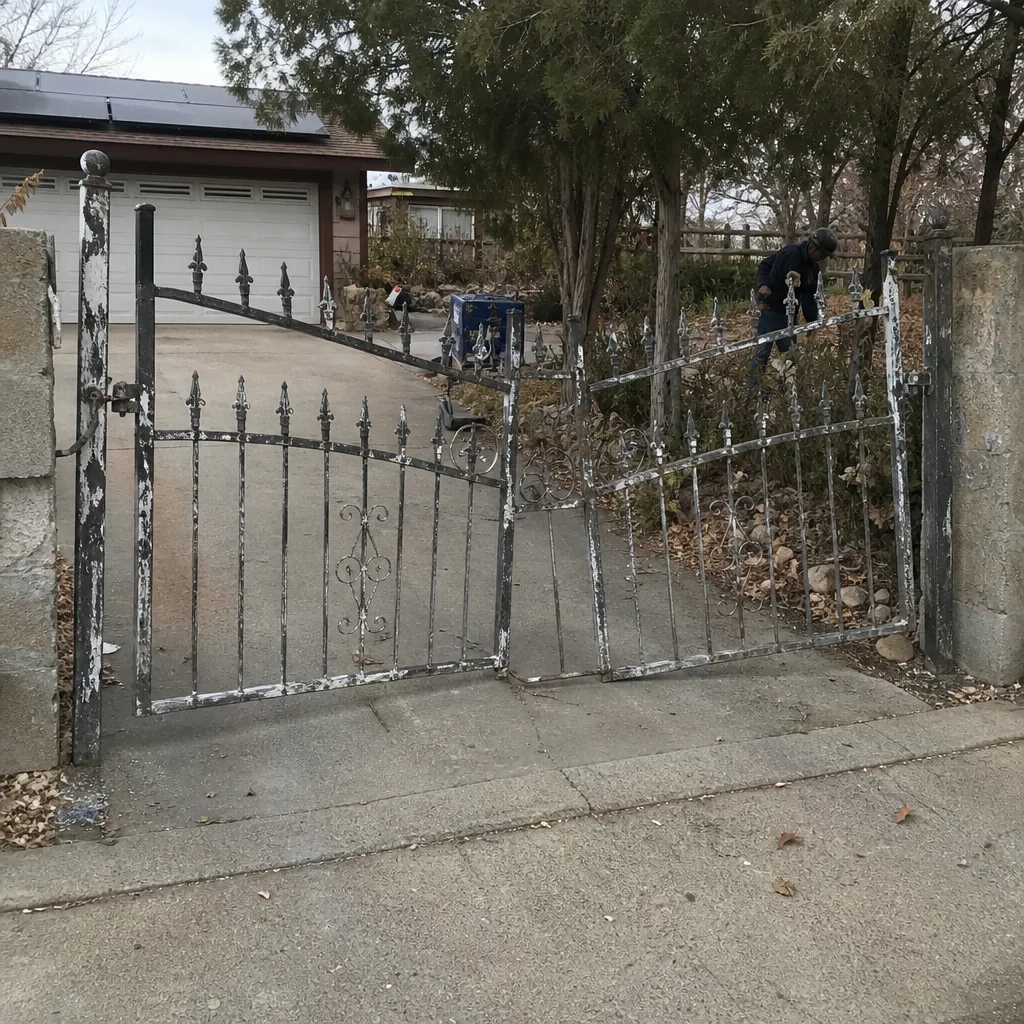 Before
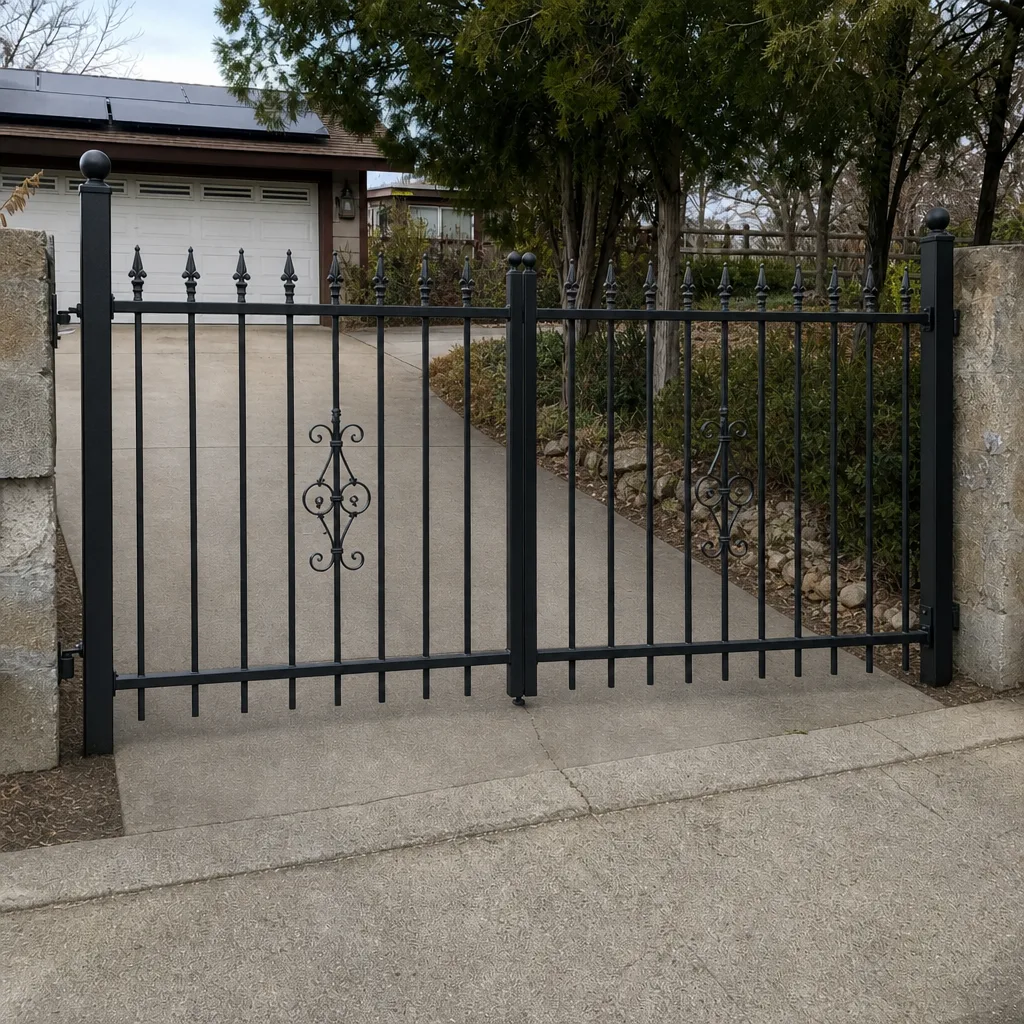 After
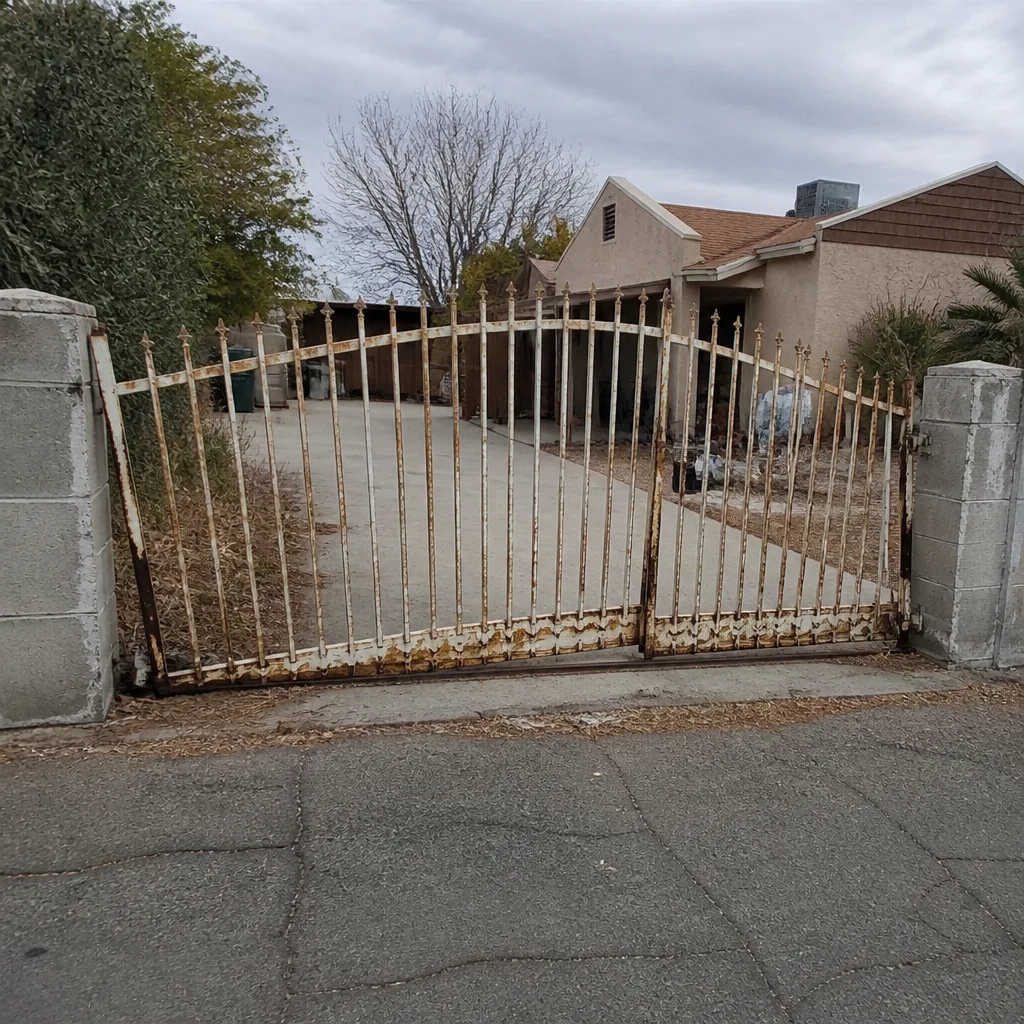 Before
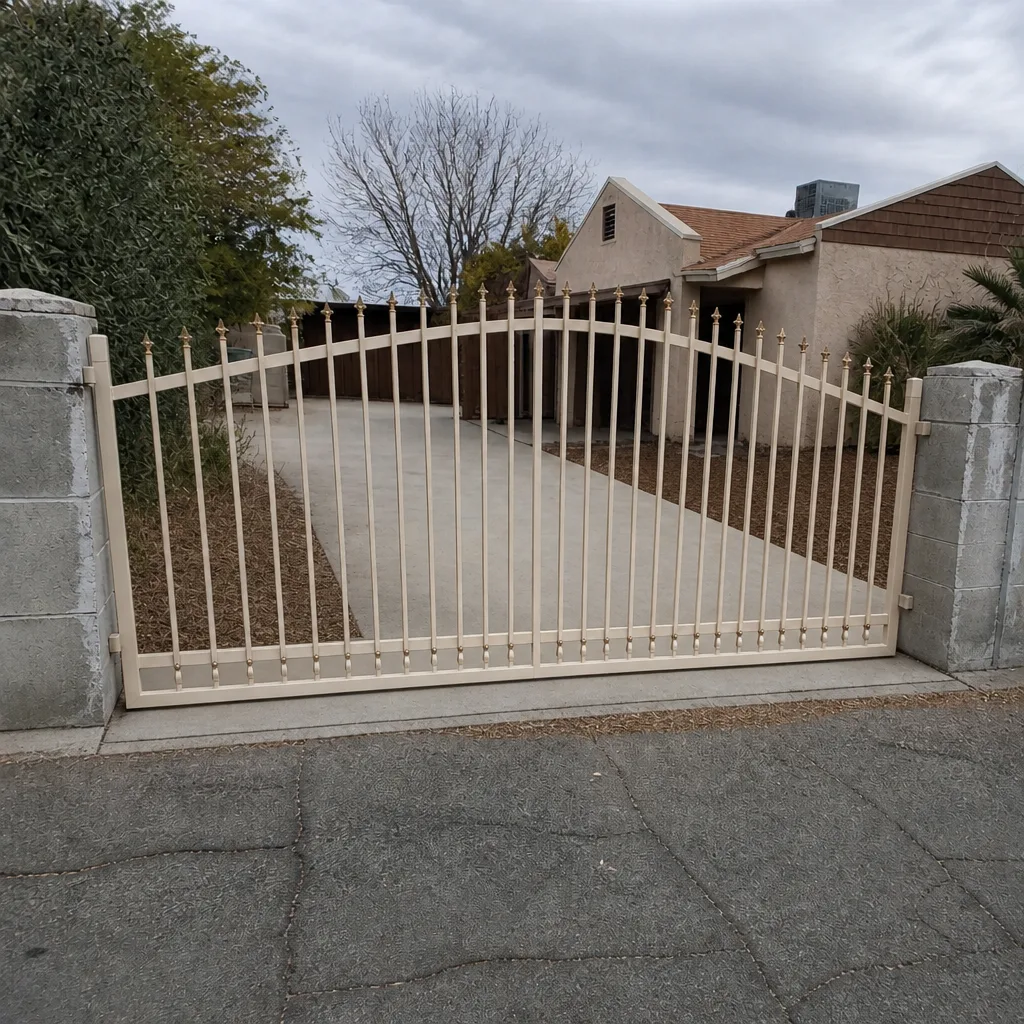 After
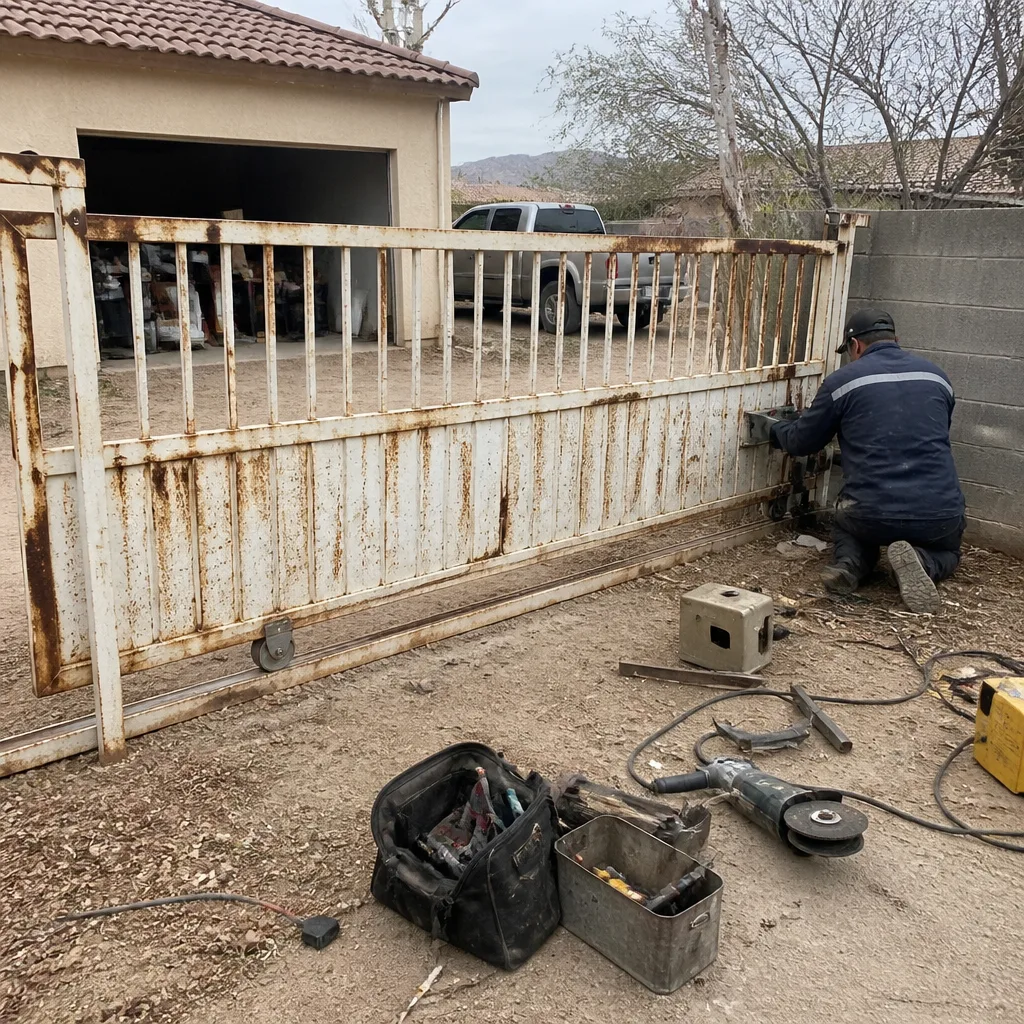 Before
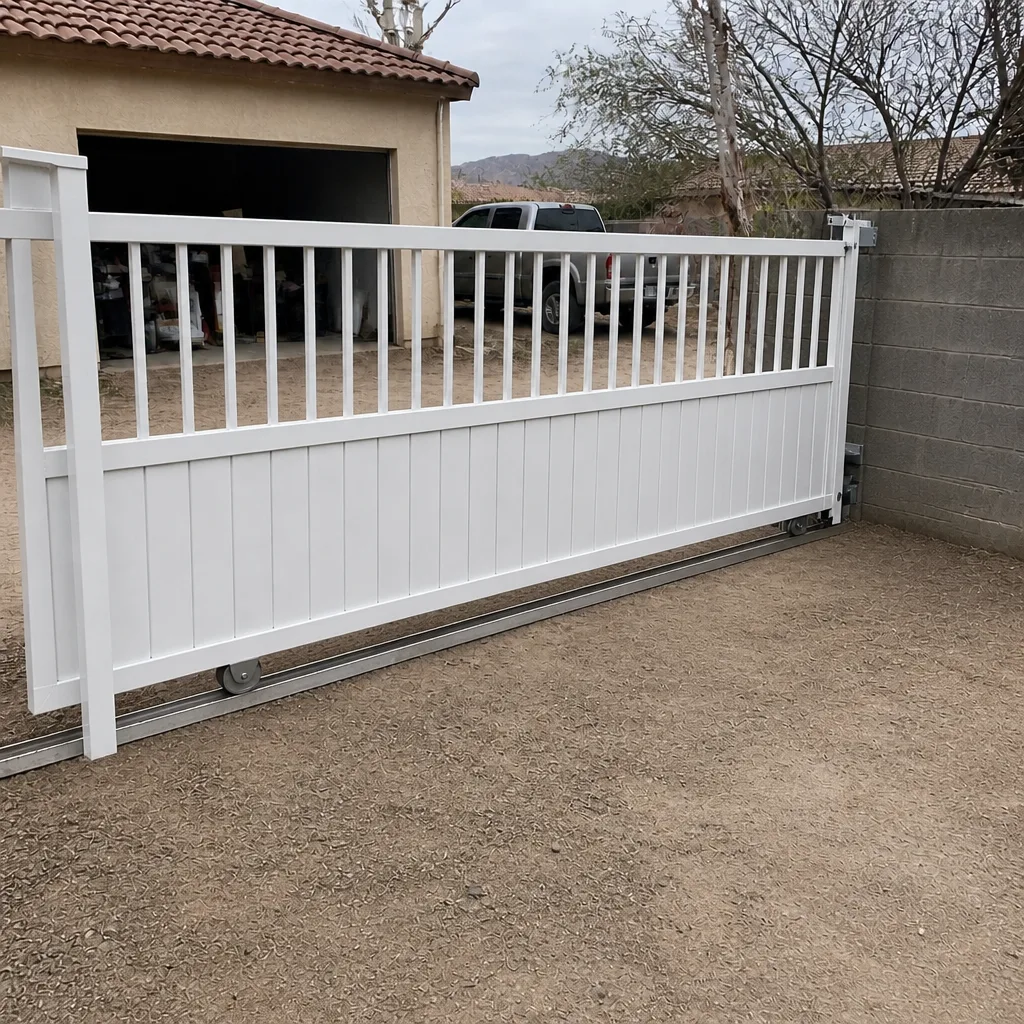 After
When to Call a Professional
Call for an inspection when the gate reverses unpredictably, when the photo-eye or safety edge is damaged or has been bypassed, when a hinge or pivot has visibly shifted, when rust has reached a weld seam or an anchor plate, or after any vehicle strike, even a light one. Call when a motor hums without moving, when a gate has slowed noticeably, or when a click at the operator has become a regular rhythm. And call when the gate has been sitting untouched since it was installed and nobody remembers the last time it was serviced. Ironworks Gate Co. Boulder City offers free estimates in Boulder City and the surrounding area. Our technicians have up to 13 years of experience, and we service nine major automation brands, so the diagnosis is made by someone trained on the specific operator on your drive. Call (888) 276-7609 and a live person will answer, day or night. If the gate needs work beyond repair, our Gate Installation in Winchester team handles new gates from measure to final weld.
Frequently Asked Questions
A change in the gate’s normal sound is the most common early warning sign, and a faint new grind at the hinge or a click at the motor is usually the first thing to appear. Most other signs, from reversal to slowing travel, show up weeks later. If you notice a sound that was not there last month, get it checked before it becomes a mechanical fault.
Yes. A gate that reverses without contact has detected an obstruction or a force overload, and the safety circuit is doing its job. The gate should be taken out of automatic service until a technician inspects the force settings, the safety edges, and the moving parts. Call (888) 276-7609 for a same-day diagnostic in Boulder City.
Cosmetic rust sits on top of the coating and scuffs off. Structural rust has reached a weld seam, a hinge barrel, a post base, or an anchor plate, and it shows as pitting, blistering, or a rust line along a weld edge. Structural rust is a welding repair, not a paint job, and a free second opinion on a written estimate is the right way to sort one from the other.
Stop using the automation first, photograph the gate, and then check the post base, the hinges, the operator arm, and the safety photo-eye alignment. Any shift at the post base or the hinges is a structural repair call, and a bent operator arm should not be cycled until it has been inspected. A strike that looks cosmetic can still have moved the frame.
A Boulder City gate benefits from a seasonal tune-up twice a year, once before the hot season and again as the nights cool, because heat and dust wear the hinges and the operator faster here than in a milder climate. Between tune-ups, a ten-minute monthly inspection catches most of the warning signs on this list. The $89 Seasonal Tune-Up is built around exactly that twice-a-year cycle.
We are trained and equipped on nine major gate automation brands, including LiftMaster, FAAC, BFT, Linear, Viking, Ghost Controls, DoorKing, Elite, and Mighty Mule. That means the correct fix on your operator is made on the first visit. Call (888) 276-7609 with the brand and model and we will tell you what to expect before anyone is dispatched.
The Bottom Line
A failing gate almost never fails without warning. The grind at the hinge, the click at the motor, the reversal on nothing, the rust streak under a weld, the extra three seconds in travel time, the photo-eye that nobody has checked in years: each of those is a message the gate is sending weeks before the expensive repair. Read them early and the cost stays small. Ignore them and the gate makes the decision for you. If this guide has left you with a specific question about your own gate, or you want a trained eye on what you have found, our Gate Repair in Winchester team and our Gate Motor & Opener in Winchester specialists are the people to call next.
Every job we do is backed in writing by the 90-Day Done Right Promise: if the gate is not right, we come back and make it right, with no paperwork and no arguing. Upfront pricing is settled before a single bolt is turned, so there are no surprises on the bill. Current offers include $50 Off Any Repair Over $250, a Free Second Opinion on Any Written Estimate, an $89 Seasonal Tune-Up, and a standing 5% Senior and Veteran discount. Visit the Ironworks Gate Co. Boulder City home page to see the full scope of what we handle, from hinges and welds to keypads and automation, and call (888) 276-7609 for a free estimate. A live person answers, 24 hours a day, 7 days a week.
Written by the team at Ironworks Gate Co. Boulder City.