
Last updated November 17, 2026
 Wrought iron
 Wood & steel frame
 Farm & ranch
 Sliding driveway gates
 LiftMaster operators
Free on-site gate assessment - hinges, posts, and your LiftMaster or Nice gate operator checked before anything is quoted
The assessment is free and the quote is the invoice.
Get your free estimateGate Repair Troubleshooting: Common Problems and How to Fix Them
A gate that reverses halfway open looks exactly the same whether the cause is a $12 safety sensor knocked out of alignment or a motor that is cooking itself cycle after cycle. The difference in repair cost between those two scenarios is roughly $380, and the only way to know which one you are looking at is to read the symptoms correctly before you pick up the phone. Most troubleshooting guides list problems without teaching you to separate them. This one gives you a decision tree: what each failure mode means, how to run five safe checks without tools, what those blinking error codes actually say, and which symptoms are stable nuisances versus ones that get worse every single time the gate moves. We work on gates across Boulder City, and we would rather you call us already knowing what you are dealing with.
Quick Answer
Most gate problems fall into six failure modes: reversal, non-response, grinding, slow movement, partial opening, and remote failure. A reversing gate is usually a safety sensor or obstruction issue and often runs under $150 to correct, while grinding or slow movement points to mechanical wear, hinge binding, or a motor under strain that gets more expensive the longer it runs. Run the five no-tool safety checks below, note any error code, and you will know whether you are facing a small adjustment or a repair that needs a technician.
Styles & brands we work with
- Wrought iron
- Wood & steel frame
- Farm & ranch
- Sliding driveway gates
- LiftMaster operators
Table of Contents
- The Six Failure Modes: A Symptom-to-Cause Matrix
- Five Diagnostic Checks You Can Do Without Tools
- What Your Opener’s Error Codes Actually Mean
- Stable Nuisance or Getting Worse? How to Tell
- The $40 Fix vs. the $400 Fix: Triaging Before You Call
- What to Collect Before the Technician Arrives
- Why Gates Fail Differently in Boulder City
- Common Mistakes to Avoid
The Six Failure Modes: A Symptom-to-Cause Matrix
Every gate problem you are likely to see traces back to one of six categories. Knowing which one you are in narrows the repair sharply before anyone touches the gate.
- Reversal (gate stops and backs up): Almost always a safety sensor out of alignment, a leaf hitting an obstruction, or a force-setting that has drifted. Rarely the motor itself. This is the low-cost end of the spectrum.
- Non-response (nothing happens): Check power at the source, the control board fuse, and the remote battery before assuming the motor is dead. A blown low-voltage fuse can mimic a failed operator exactly.
- Grinding noise: Worn hinge pins, dry or failing bearings, a chain or rack out of tension, or debris in the track. Left alone, grinding turns a $60 hinge job into a bent operator arm.
- Slow movement: A motor straining against mechanical resistance (binding hinges, a sagging leaf) or a failing capacitor. This is the symptom that quietly burns out motors.
- Partial open: Travel limits have drifted, a safety edge is triggering mid-cycle, or the operator is hitting a thermal cutout from overheating. On a hot Boulder City afternoon, thermal cutout is worth ruling out first.
- Remote failure: Dead remote battery, lost programming after a power surge, or a receiver fault. Test with the wall control first; if the wall button works, the operator is fine and the problem is in the remote or receiver.
Read that list against your gate’s behavior and you have already cut the diagnostic time roughly in half. That matters at the repair counter.
Five Diagnostic Checks You Can Do Without Tools
These five checks require no tools, no ladder climbing, and no contact with the gate’s moving metal. They are safe for any homeowner. Do them in order, note what you find, and stop if anything feels unsafe or the gate behaves unpredictably.
- Watch a full cycle from a distance. Stand clear and open the gate once. Watch the entire travel from closed to open. Note exactly where it reverses or hesitates. The point in the cycle tells the technician a great deal.
- Check the safety sensors. Most operators have a pair of photo-eyes near the gate path. Look for dirt, spider webs, or a knocked mount. Wipe the lenses with a soft cloth and confirm nothing is in the path. This alone clears a large share of “reverses halfway” calls.
- Test the wall control vs. the remote. If the wall-mounted button opens the gate but the remote does not, the operator is fine and your problem is the remote battery or its programming.
- Look at the control board indicator. Open the operator housing cover (unlock it, do not force it) and find the status LED or diagnostic display. Note how many times it blinks or what code it shows. Write it down.
- Listen and feel for the gate’s resistance by hand only when the power is off. With the operator disengaged (use the manual release), walk the gate open and closed by hand. If it binds, sags, or drags, that is a mechanical problem, not a motor problem. Never reach into moving parts while the gate is powered.
Write your findings on a notepad. A short, specific description (“reverses twelve inches into opening, status light blinks three times, gate drags when walked by hand”) saves the technician time and saves you money on diagnostic labor. For anything beyond these five checks, that is where a trained professional belongs. The springs, the operator’s internal gearing, and anything electrical on the gate should be left to someone qualified. We would rather be called than have you hurt.
What Your Opener’s Error Codes Actually Mean
Error codes are the single most useful piece of information you can bring to a repair call, but they are also the most misunderstood. Here is plain language for what the major brands display.
- Linear: A blinking status light that repeats a number of flashes usually points to a limit fault, an obstruction, or a safety-device trigger. Linear’s diagnostic system is one of the more reliable ones – the flash count translates directly to a category.
- DoorKing: DoorKing’s displays often show numeric codes tied to the control board state. A code that repeats after a reset and a manual cycle generally indicates a sensor or limit issue rather than the motor.
- Ghost Controls: Blink counts on the control board typically map to obstruction, sensor misalignment, or a low battery in the remote. A fresh remote battery resolves a surprising share of these.
- Viking: Fault indicators usually separate a safety-device trigger from a travel-limit problem. If the gate opens about a foot and stops, that is a classic limit-trigger signal.
- Others (LiftMaster, FAAC, BFT, Elite, Mighty Mule): Each has its own blink or numeric pattern. The rule of thumb: a single repeating blink or code means a consistent fault; a random pattern often means an intermittent sensor or wiring issue.
Write down the code exactly as it presents, including how many flashes and any pauses. Then read your operator’s manual. If you cannot find the manual, our team is trained and equipped on nine brands and can translate any code over the phone. A free second opinion on any written estimate is standing policy at our shop, so if another contractor has quoted a repair and blamed the motor, bring us the code and the quote.
Stable Nuisance or Getting Worse? How to Tell
Not every gate problem is an emergency. Some are stable nuisances you can live with for a few weeks. Others quietly get worse every cycle. Tell them apart before you decide to wait.
Stable nuisances include a slightly noisy hinge, a remote that needs a firmer press, or a cosmetic chip in the paint. These will not damage the gate if you wait a week for a scheduled repair.
Worsening problems are the ones that cost real money. If your gate grinds louder each cycle, if it reverses at a different point every time, if the motor is hot to the touch after a normal cycle, or if the gate sags further each week, stop using it and call for service. The worst of these is a motor straining against a mechanical problem. The resistance heats the operator, the capacitor and control board cook slowly, and a $60 hinge adjustment turns into a $450 motor replacement. In our experience, a gate that grinds on Monday is a gate that is bent by Friday.
Use this simple rule: if the symptom changes any time the gate moves, treat it as worsening. If it is identical on every single cycle, it is likely stable and can wait for a scheduled visit.
The $40 Fix vs. the $400 Fix: Triaging Before You Call
Here is roughly what the categories look like in a Boulder City market. Prices are ranges, and your exact quote depends on the gate, the operator, and what the diagnosis finds. The point is not to guess at a final bill; it is to know what ballpark you are standing in before you call anyone.
| Problem Category | Typical Range | What Drives the Price |
|---|---|---|
| Safety sensor realignment or a remote battery | $40 – $120 | Simple adjustment or part swap; often same-day |
| Hinge pin, bearing, or minor mechanical | $100 – $220 | Parts and welding time |
| Travel-limit adjustment or diagnostic reset | $120 – $220 | Access and programming |
| Capacitor, control board, or fuse replacement | $180 – $380 | Which component failed and brand |
| Motor or operator replacement | $450 – $1,200+ | Gate size, brand, and operator type |
The single biggest cost saver is doing the five checks before anyone comes out. A homeowner who says “the gate reverses and the status light blinks three times” has already cut roughly thirty to sixty minutes of diagnostic labor off the bill. That is real money. If you suspect your issue is mechanical and want expert eyes on it, our crew handles gate repair in Winchester and the surrounding communities, and we always settle the price before a single bolt is turned. No surprises on the bill.
What to Collect Before the Technician Arrives
Preparation is the difference between a focused repair and an expensive exploratory visit. Gather this information before you call.
- Your operator’s brand and model number (look for a plate or label on the housing).
- The exact error code or blink pattern you observed.
- A short description of the symptom: when it happens, how often, and which part of the cycle.
- The gate’s material (steel, aluminum, wood, ornamental iron) and roughly how wide it is.
- Whether the gate has a safety edge, ground loops, or photo-eye sensors.
- A photo of the operator and of the gate overall.
- Any prior repair paperwork you can find.
This information lets a technician arrive already knowing what tools and parts to bring, which is why most of our jobs are completed in a single visit. It also lets us quote more accurately. When you have your documentation ready, call us and describe what you observed. We quote the upfront price, you approve it, and then the work begins.
Why Gates Fail Differently in Boulder City
Boulder City’s climate puts real demands on gate hardware that you will not see in a coastal market. The dry desert heat, the strong afternoon winds coming down off the mountains, and the sun exposure on a south-facing gate all wear parts faster than coast standards assume. We see hinge pins dry out and seize far sooner here, and photo-eye sensors knocked out of alignment by dust and wind are a weekly call. Our advice in Boulder City: lubricate hinges and moving parts on a schedule between repairs, and check the safety sensors after any windstorm.
If you are weighing a repair against a replacement, our expertise on the brand installed on your gate matters. We are trained on nine brands and have seen the differences in how each one ages in our local climate. For an upgrade, our gate installation in Winchester and the surrounding areas covers new installs sized to the gate and its duty cycle. And if the operator itself has reached the end of its service life, our gate motor & opener in Winchester service pairs a new operator to the gate and its access setup. If your automation has grown into keypad and entry-control territory, our Ironworks Gate Co. Boulder City home base page explains the full scope of what we service.
Common Mistakes to Avoid
- Pushing through a reversing gate by holding the remote. Holding the button wears the motor and the control board. Find the sensor problem, do not override it.
- Ignoring grinding long enough to bend the operator arm. That $60 hinge job becomes a $450 repair if left alone.
- Replacing the motor when the real problem is a binding gate. A new operator installed on a gate that drags will burn itself out too. Fix the gate first.
- Disabling the safety sensors to make the gate close. That is the one shortcut we will never recommend. The sensors exist to keep people safe. A misaligned sensor is a five-minute adjustment, not a reason to bypass the safety system.
- Skipping the seasonal maintenance and then paying for it twice. Our $89 seasonal tune-up catches binding hinges and sensor drift before they turn into a repair bill.
- Calling the wrong specialist. A general handyman can tighten a hinge but will often misdiagnose the operator. If your gate has an automaker you do not recognize, call a company trained on the brands.
- Ignoring the “stable nuisance” that is actually worsening. If the behavior changes cycle to cycle, it’s not stable.
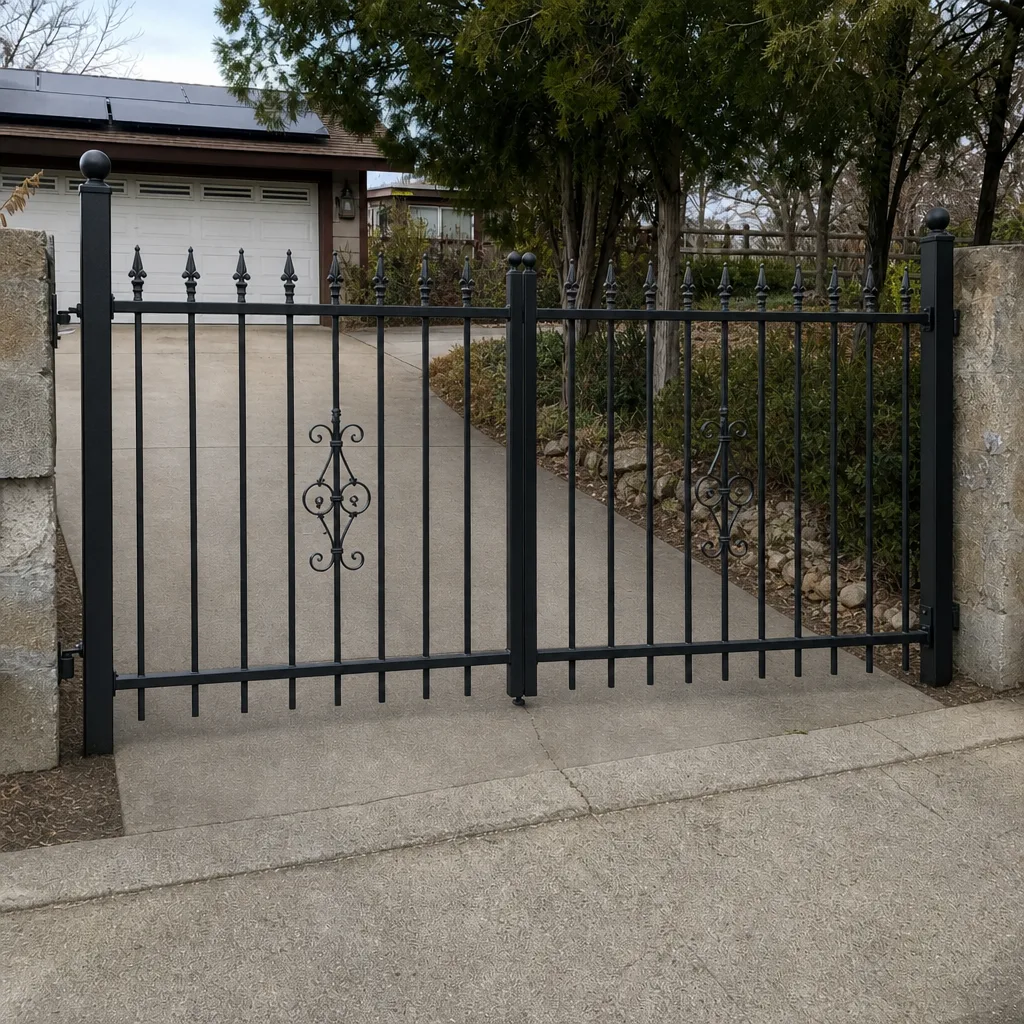
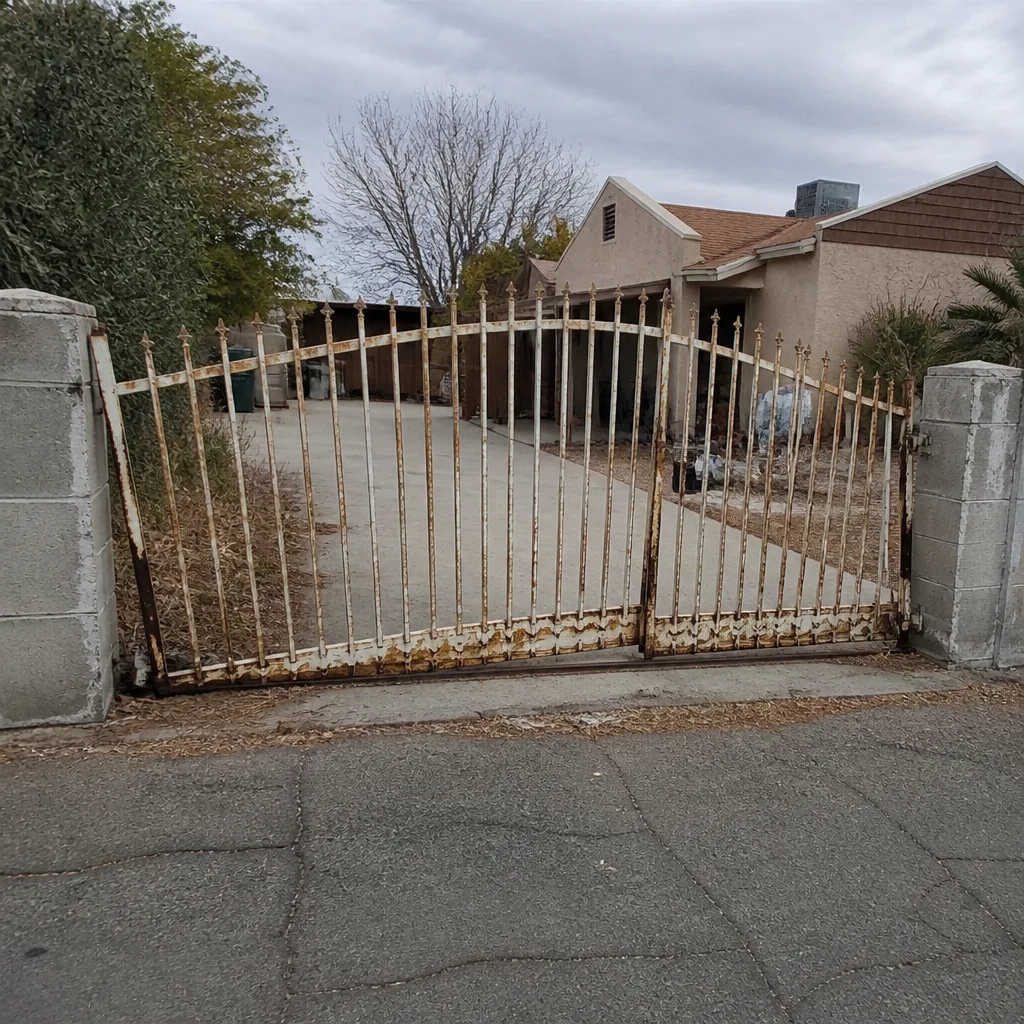
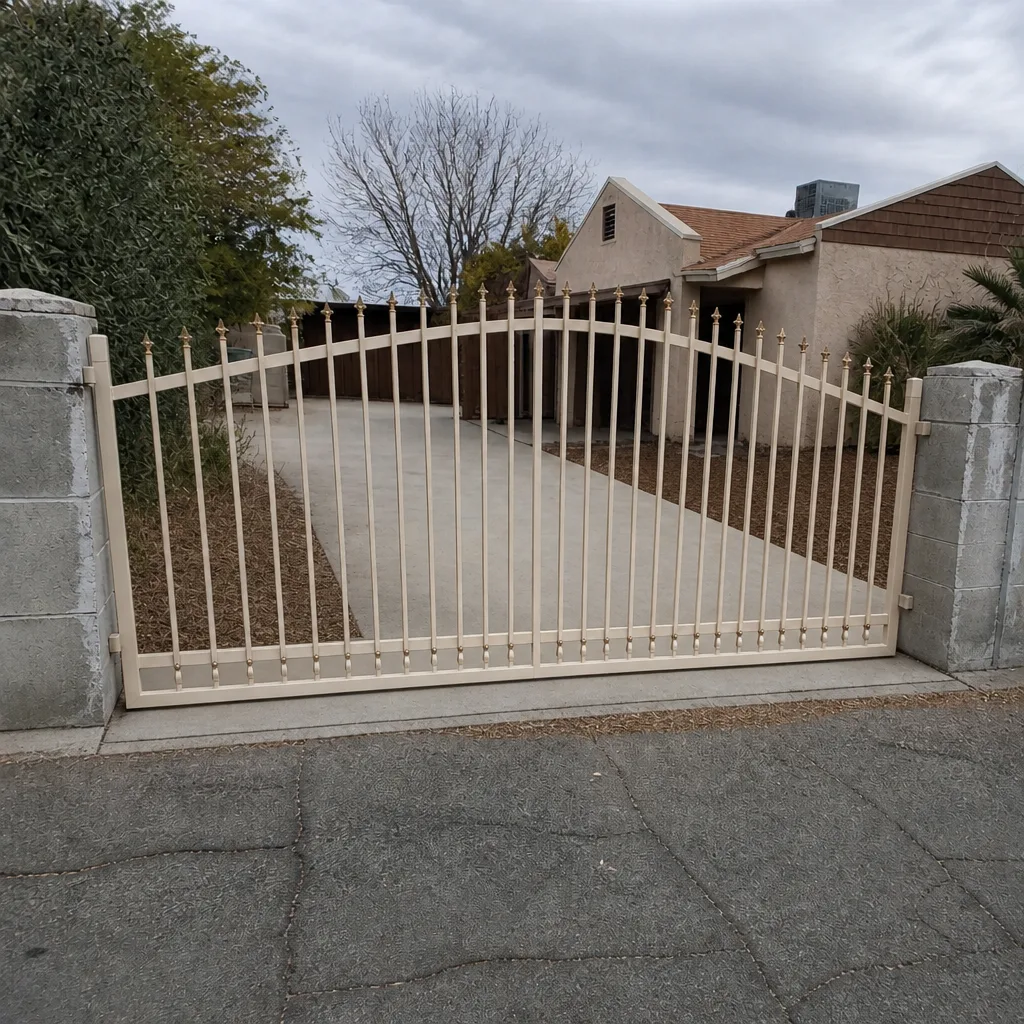
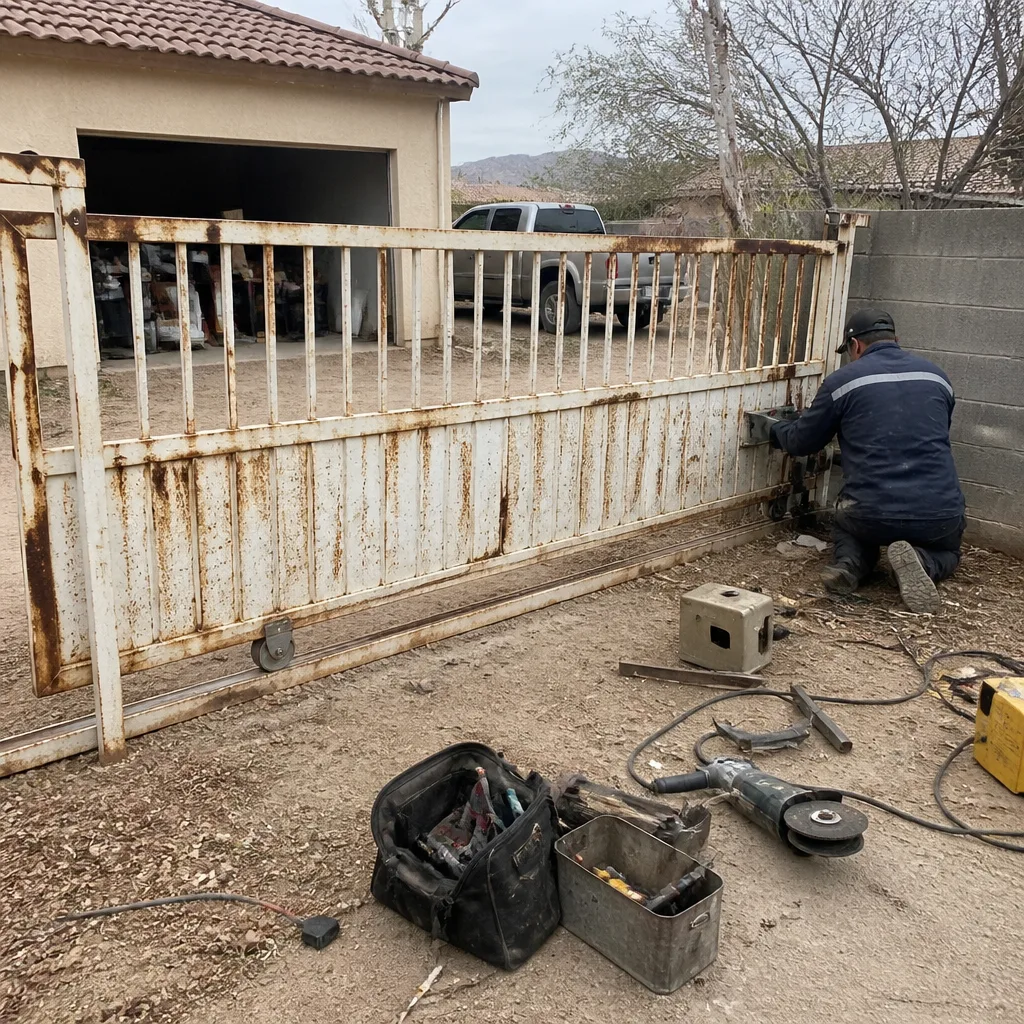
See the difference
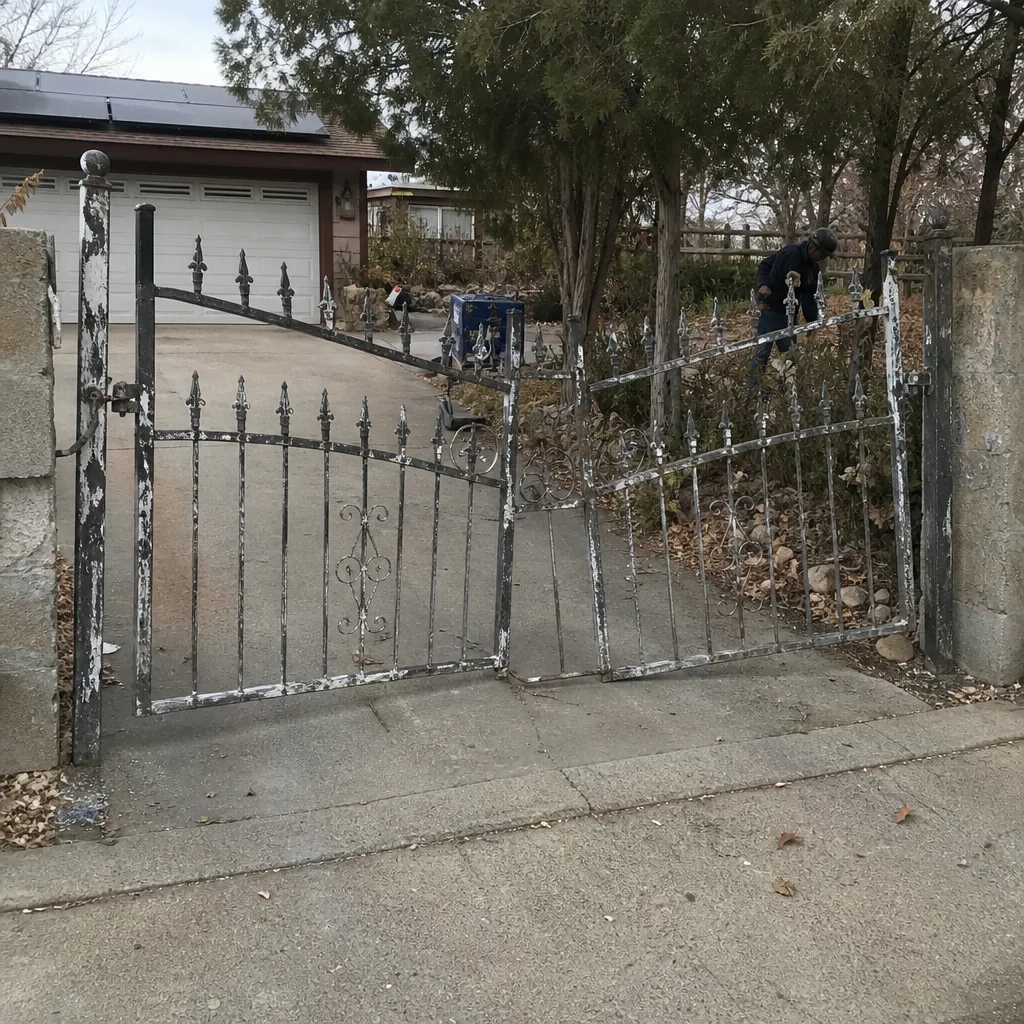 Before
 After
 Before
 After
 Before
 After
When to Call a Professional
Call a professional whenever the gate’s safety, the operator’s internals, or the electrical work is in question. These are the specific scenarios where we want to hear from you: a gate that reverses unpredictably, a motor that runs hot or smells, grinding that is getting worse, a gate that will not open fully, a damaged hinge or weld, any error code you cannot identify, a remote failure you cannot clear, or an installation or operator replacement that is due. We would rather you call than risk a burn, a pinch, or a gate that drops. Ironworks Gate Co. offers free estimates in Boulder City. Call (888) 276-7609. A live person answers the phone day or night. The quote is agreed upfront before any work starts, and every job is backed by our written 90-Day Done Right Promise.
Frequently Asked Questions
Most gate repairs land between $40 and $400 depending on the cause, with sensor and battery fixes on the low end and motor or operator replacement running from $450 up into the thousands. We quote the exact price before any work begins, so there are no surprises on the bill. Call (888) 276-7609 for an exact quote. Estimates are free.
We often can. We complete most jobs in a single visit, and a live person answers our phone 24 hours a day so you can reach someone today. Describe the symptom and any error code when you call, and we will tell you what to expect and get you on the schedule. Call (888) 276-7609 for a free estimate.
A full installation includes the gate itself, hinges and posts sized to the weight and duty cycle, the operator and its wiring, the safety sensors and edges, and the access control setup. The scope is measured and quoted in writing first. For a new install, call (888) 276-7609 for a free measure and a written price.
Yes. The power run to the operator and the safety edges and sensors along the gate path are part of the full scope. They are measured and scheduled, not dispatched, since a correct install depends on your layout. Call (888) 276-7609 for a free estimate and a written scope.
A gate that reverses halfway open is almost always a safety sensor out of alignment, an obstruction the operator is detecting, or a force setting that has drifted. It is rarely a failed motor, and it’s one of the cheapest problems to correct. Call (888) 276-7609 for a free estimate and we will confirm the cause.
We’re trained and equipped on nine leading gate-automation brands, including Linear, DoorKing, Ghost Controls, and Viking, so the correct fix is made on the first visit whatever is on your driveway. A free second opinion on any written estimate is always available. Call (888) 276-7609 to confirm your brand.
The Bottom Line
Troubleshooting a gate comes down to reading the symptom correctly. A reversal is almost always a sensor, not a motor. Grinding and slow movement are the expensive symptoms because they worsen with every cycle. Error codes, blink patterns, and a photo of the operator are the most valuable things you can bring to a repair call, and running five no-tool checks before you dial saves real money on diagnostic labor. Know which fix you are facing before you call anyone, and you stop overpaying for simple adjustments and stop turning small problems into structural ones. That is the whole point of this guide. Boulder City homeowners should never be left guessing. Every job we take on is backed by our 90-Day Done Right Promise, and the price is always settled before the first bolt turns.
Ready to get your gate working right? Call Ironworks Gate Co. at (888) 276-7609 for a free estimate. Upfront pricing, same-day availability on most repairs, and a live person on the other end.
Written by the team at Ironworks Gate Co. Boulder City.