
Last updated November 17, 2026
 Wrought iron
 Wood & steel frame
 Farm & ranch
 Sliding driveway gates
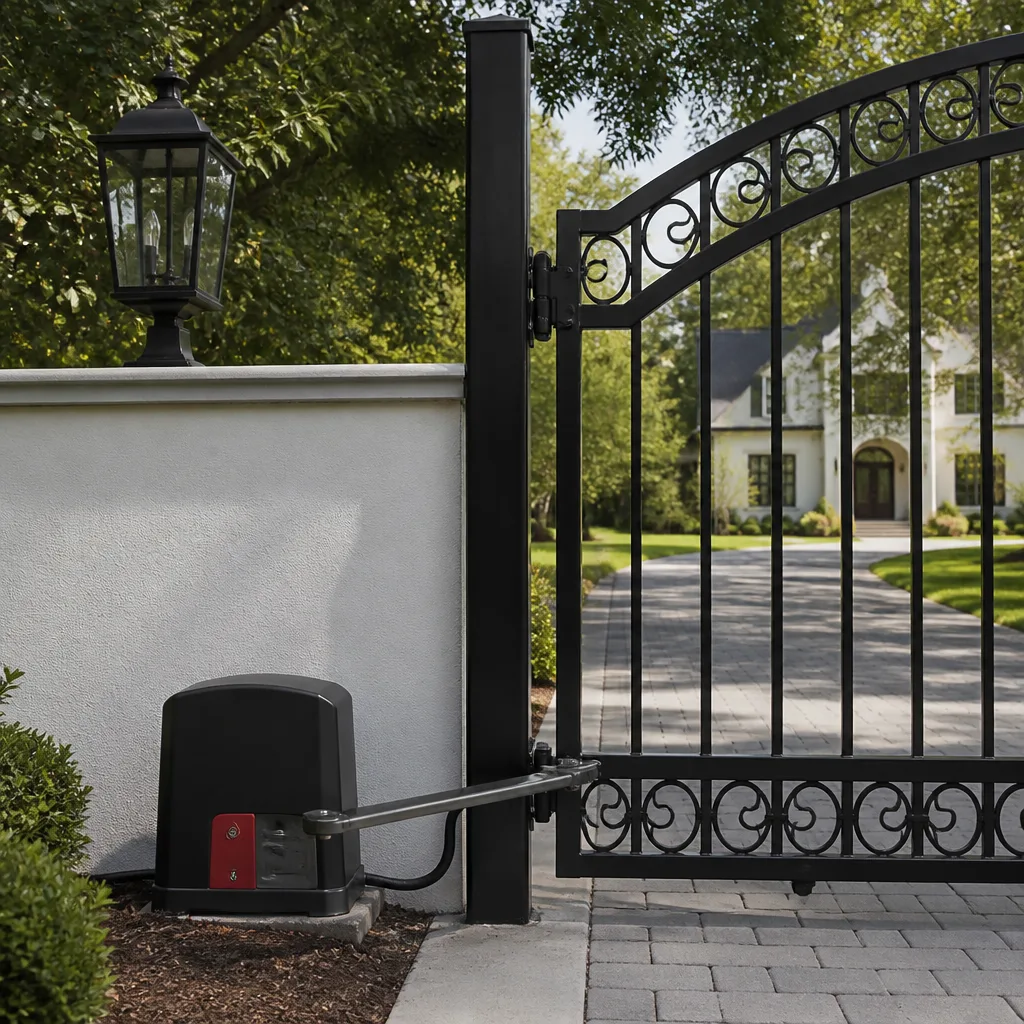 LiftMaster operators
Free on-site gate assessment - hinges, posts, and your LiftMaster or Nice gate operator checked before anything is quoted
The assessment is free and the quote is the invoice.
Get your free estimateHow Long Does Gate Parts & Welding Take? Timelines and What to Expect
When a technician quotes “a couple of hours” for a gate weld job without first inspecting the post footings, the existing weld condition, and the steel alloy, that’s not an estimate – it’s a guess. And it’s how same-day repairs quietly become multi-day projects. We’ve watched this play out across Boulder City more times than we can count: a homeowner takes the first number they hear, the welder arrives, finds the footing is soft or the steel is thin, and the two-hour job stretches into three visits. Here you’ll learn the honest timelines for the four most common welding jobs, the assessment steps that should come before any time quote, and what cure time and paint restoration really add.
Quick Answer
Most driveway and estate gate welding repairs are completed in a single visit of 1 to 4 hours, depending on the job type. A hinge re-weld typically runs 1 to 2 hours, a picket repair 30 minutes to 1 hour, a frame crack 2 to 3 hours, and a post collar 2 to 4 hours. Add 24 hours of cure time before full service load returns, and plan paint and finish restoration as a separate step that usually happens on a following visit or after the metal has cooled. The real timeline depends on three things a responsible welder checks before quoting: post footings, existing weld condition, and steel alloy.
Styles & brands we work with
- Wrought iron
- Wood & steel frame
- Farm & ranch
- Sliding driveway gates
- LiftMaster operators
Table of Contents
- Why Most Gate Welding Timelines Are Wrong
- The Three Assessment Steps Before Any Time Quote
- Realistic Timelines for the Four Most Common Welding Jobs
- Cure and Cool-Down Time: Why a Finished Weld Isn’t Ready
- Paint and Finish Restoration: The Step Almost Nobody Quotes
- When a Second Visit Is Normal – and When It Means the First Was Wrong
- What Changes the Timeline in Boulder City
Why Most Gate Welding Timelines Are Wrong
The tradesman who quotes a time before inspecting the metal is guessing, plain and simple. A gate is not a fence panel sitting on a level lawn. It hangs from hinges that carry hundreds of pounds, swings on a motor, and lives outdoors in desert sun and wind. When a weld fails, it usually fails for a reason – poor footing, metal fatigue, corrosion under the paint, or a hinge that was undersized for the gate from the start. Welding over a problem without diagnosing it produces a repair that looks finished and fails again in a season.
We’ve seen this on gates throughout Boulder City, from the older homes near the historic district to the newer properties out toward the edges of town. A homeowner calls about a sagging gate, hears “we’ll be out Thursday, it’s a quick weld,” and then the technician arrives, discovers the post footing has shifted, and the job either gets pushed to another day or gets patched in a way that won’t hold.
An honest timeline has to account for what the welder finds once the gate is inspected in person. That’s why a professional will refuse to give a firm time estimate sight-unseen. It’s not evasiveness – it’s the only way to give a number that means anything.
If you’re weighing repair against replacement for a gate that’s failed repeatedly, our guide to Gate Repair in Winchester walks through the decision points a failing weld can signal.
The Three Assessment Steps Before Any Time Quote
Before a responsible welder puts a time on the job, they walk the gate. Three inspections happen first, and each one can add or subtract an hour from the workday. Skipping them costs homeowners more than time – it costs a repeat visit and, often, a second bill.
- Post footing inspection. The welder checks whether the gate post is solid in the ground or has shifted. A hinge weld on a post with a soft or leaning footing will fail again within months. If the footing needs attention, that gets added to the timeline before the weld starts, not after it breaks.
- Existing weld condition. The welder looks at the failed weld and the welds around it. Corrosion under paint, hairline cracks, and old repairs stacked on top of each other all change the approach. Grinding out old weld and prepping the joint takes time that a fresh weld on clean metal doesn’t.
- Steel alloy identification. Not all gate steel welds the same way. Wrought iron, mild steel, and cast components require different techniques and different filler. A technician equipped to handle the metal correctly on the first pass saves the entire second visit. This is where training on specific gate hardware matters – the same discipline we apply when servicing brands like Elite, DoorKing, or Viking applies to the metal itself.
In our experience, a welder who skips these three steps and quotes a time over the phone is quoting the best case, not the real one. The honest number comes from the driveway, not the dispatch desk.
Realistic Timelines for the Four Most Common Welding Jobs
These ranges reflect what we see in the field for standard residential driveway and estate gates. Every gate is its own animal, but these are the numbers to hold a contractor to.
- Hinge re-weld: 1 to 2 hours. The joint is ground out, the hinge is aligned, and the weld is laid. Most of the time goes into getting the gate to hang true again, not into the weld itself.
- Picket repair: 30 minutes to 1 hour. A bent or broken picket is usually the fastest job on this list. If the picket is ornamental and needs matching profile work, add time.
- Frame crack repair: 2 to 3 hours. A crack in the gate frame requires grinding out the crack, prepping the joint, welding, and often reinforcing the area so it doesn’t reappear. A crack that runs into the hinge mount can push this toward the top of the range.
- Post collar installation: 2 to 4 hours. A post collar reinforces a gate post where it meets the ground. It’s the most involved of the four because it involves fitting the collar to the post, welding it fully around, and often addressing whatever caused the original failure. The 4-hour end is for collars on heavy estate gates or posts that need footing work first.
For a gate that’s already been through several repairs, or an estate gate where the automation is part of the picture, the full picture is covered in our Gate Installation in Winchester page – sometimes replacing the gate section is faster and cheaper than chasing a failing one.
Cure and Cool-Down Time: Why a Finished Weld Isn’t Ready
This is the part almost everyone leaves out of the estimate. A weld that looks done is not ready for full service load. Steel needs to cool at a controlled rate so the weld doesn’t develop cracks or lose its strength. On a gate that’s going to swing under motor power and be walked into by kids and dogs, that cooling window matters.
In practice, “cool-down” means the gate stays parked and out of service for a stretch of hours after the weld is laid – and for a full structural weld on a load-bearing point like a hinge or a post collar, we plan on the gate staying out of service until the next day. That’s not padding the bill. It’s the difference between a weld that lasts and a weld that cracks at the toe because the gate got slammed shut an hour after the torch came off.
If you have a gate operator, the automation adds another step. The gate should not be run until the weld has fully cooled and the alignment has been re-checked, because running a motor against a warped or still-hot hinge mount can stress the weld and the motor in the same motion. To understand the automation side, our Gate Motor & Opener in Winchester page explains what happens when the gate and the operator get out of sync.
In Boulder City, summer heat is its own factor. The desert sun on bare metal reaches temperatures that affect cooling rates and make a welder’s job hotter and slower than it would be in a shaded or mild climate. A welder factoring Boulder City in will plan a cooler part of the day and give the metal more settling time. That’s an honest timeline, not an inflated one.
Paint and Finish Restoration: The Step Almost Nobody Quotes
Welding burns off paint, and it leaves the surrounding finish discolored by heat. Every weld job is, in reality, a weld job plus a paint job. The paint step is almost never included in a phone quote, which is why the finished gate often looks worse than the homeowner expected for a few weeks until it’s addressed.
Here’s what finish restoration actually involves:
- Grinding and dressing the weld. The welded area gets ground smooth so the repair reads as part of the gate, not a lump on top of it.
- Surface prep. Bare steel and heat-affected paint need cleaning and priming before paint will adhere – skip this and the new paint flakes within a season.
- Matching the finish. On a painted gate, the repair needs to match the existing color. On an ornamental or wrought-style gate, the repair needs to match the finish profile and texture.
- Dry time. Paint is not dry when it’s dry to the touch. Full cure takes longer, and no one should be slamming the gate against fresh paint.
Our recommendation, and what we do on our own jobs, is to treat paint restoration as a planned second step: weld, let the metal cool, prep and prime, then paint. That’s a separate day on most gates. Anyone quoting a single two-hour slot for weld and paint is either going to do the paint badly or come back on a separate bill. For a company in Boulder City, that step is non-negotiable given how fast sun and dry air attack bare steel.
When a Second Visit Is Normal – and When It Means the First Was Wrong
A second visit is normal in a few specific situations. It’s the walk of shame in a few others. Here’s how to tell them apart.
Normal second visit:
- Paint and finish restoration after the weld has cooled, as above.
- Follow-up alignment check after cure time on a hinge or post collar repair that has to hang true under its own weight.
- Operator re-calibration after structural work if the gate has automation.
- Additional footing work that couldn’t be assessed until the gate was off its hinge.
Second visit that means the first was done wrong:
- The same weld fails within weeks. That means the joint wasn’t prepped or the steel wasn’t matched.
- The gate sags again in the same spot after a hinge repair. The alignment wasn’t set correctly, or the post footing wasn’t addressed.
- The technician is back to re-weld the same crack. Cracks recur when the cause is rigidity stress, and re-welding over the crack without reinforcing just postpones the problem.
- Paint flakes off the repaired area within a month or two. That’s poor surface prep, not age.
When a company stands behind the work in writing, a second visit is a phone call, not a negotiation. That’s the whole point of a written guarantee – the homeowner shouldn’t have to argue for a fix that was already promised.
What Changes the Timeline in Boulder City
Boulder City has a few quirks that affect how long a gate welding job actually takes. The desert heat means welders plan around the cooler mornings, and the bare metal gets too hot to handle safely in the afternoon during summer – which can push a job to the next day if it’s scheduled wrong. The dry air is forgiving to steel in some ways and unforgiving in others: rust moves slowly, but UV damage to paint and finish happens fast, which makes the paint step more important here than it would be in a wetter climate.
Older Boulder City properties often have gates that were installed decades ago, with steel that’s been repaired before. Those gates need more assessment time because the existing welds and previous repairs have to be evaluated carefully. Newer gates out toward the edge of town are often aluminum rather than steel, and aluminum welding is a different skill and a different timeline entirely – worth flagging before anyone quotes a time.
What doesn’t change: the value of a live person answering when you call, an upfront price agreed before a single bolt is turned, and a written guarantee. Those are the standards we hold on every Boulder City job. If you’re also looking at the automation on your gate, the entry point for the whole picture is our Ironworks Gate Co. Boulder City home page.
Common Mistakes to Avoid
- Accepting a phone-quoted time without an in-person inspection. A time quoted without seeing the footings, the old welds, and the metal is a guess, and it usually turns into a second visit at your expense.
- Letting the gate go back into service the same hour. Cure time is not optional. Running a gate under motor load while the weld is still cooling can crack it at the toe, and nobody wants to discover that a week later.
- Assuming paint is included. It usually isn’t, and it shouldn’t be skipped in Boulder City where bare steel takes a UV pounding.
- Welding over a footing problem. If the post is shifting, a new weld will fail again. The footing has to be addressed first or the repair is cosmetic.
- Not asking about steel alloy. A welder who doesn’t ask what the gate is made of before quoting a time is either going to guess or grind and find out later.
- Hiring a generalist for a structural weld. Gate welding is a specific trade. A handyman with a welder in the truck is not the same as a gate specialist trained on the metal and on the automation that has to keep working afterward.
- Ignoring the automation while welding. On a motorized gate, welding near the operator or its wiring can damage the control board if the technician doesn’t take the right precautions. A specialist knows to isolate the automation before the torch comes on.
See the difference
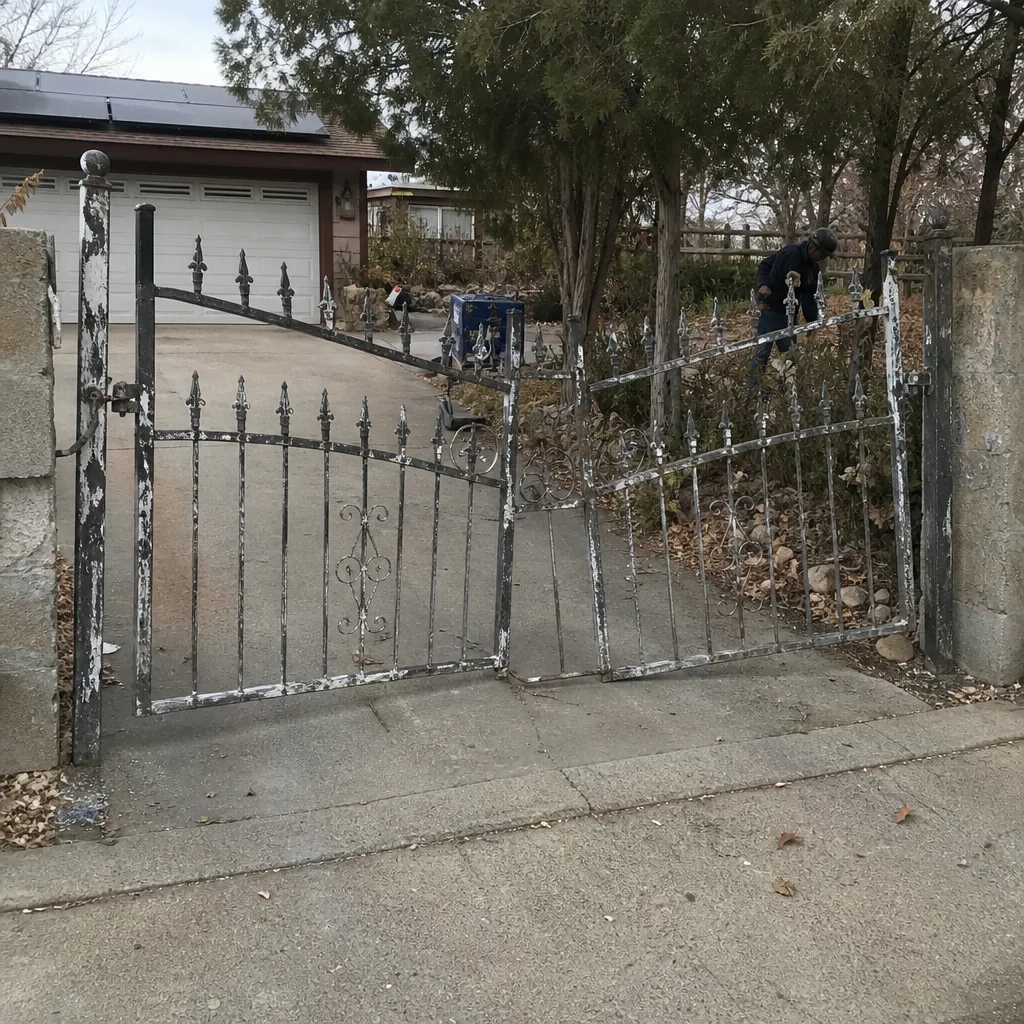 Before
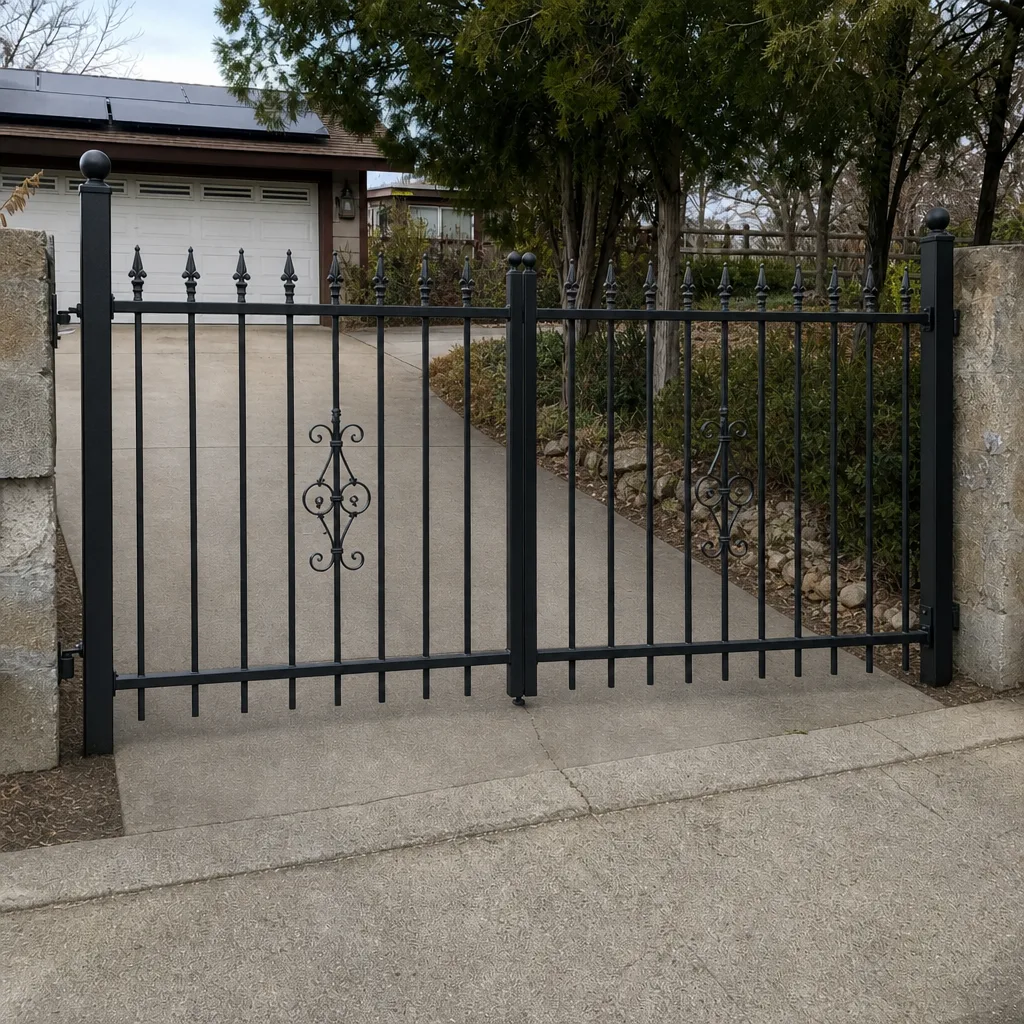 After
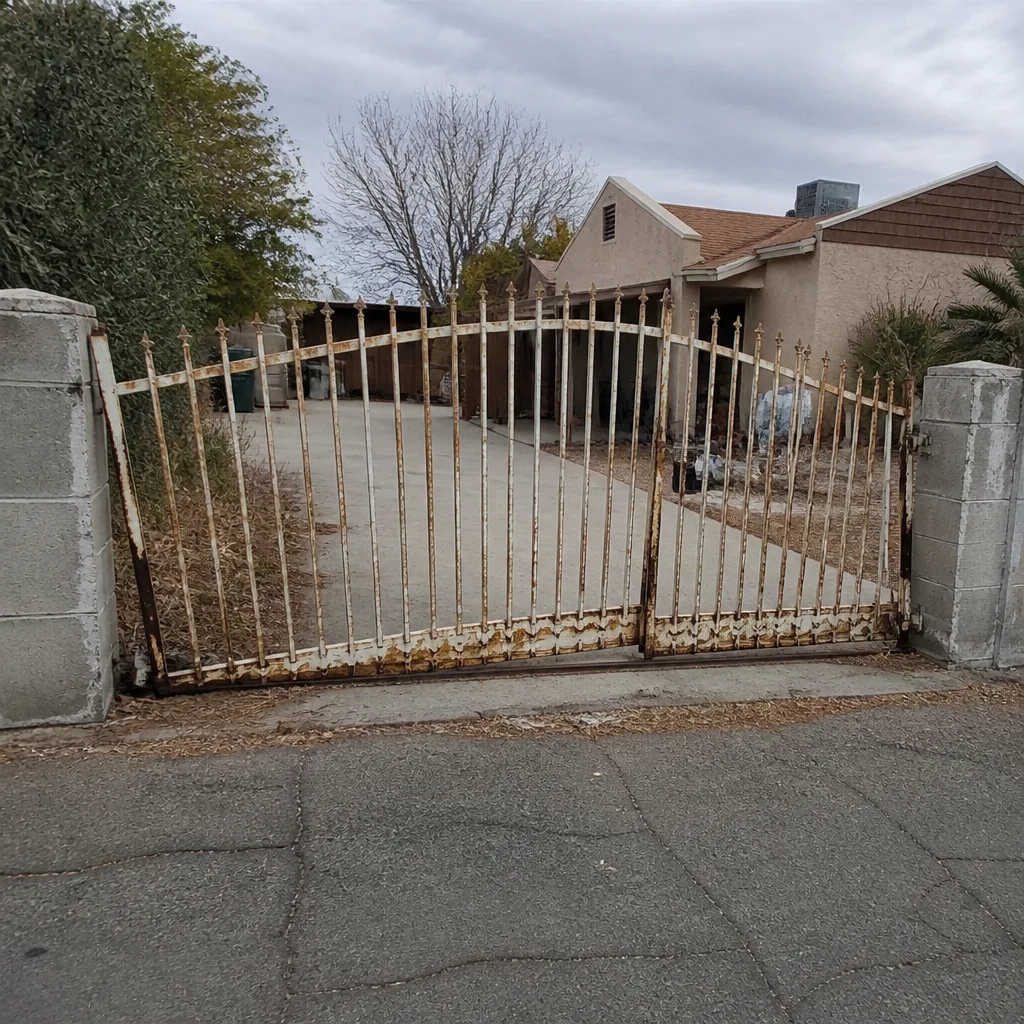 Before
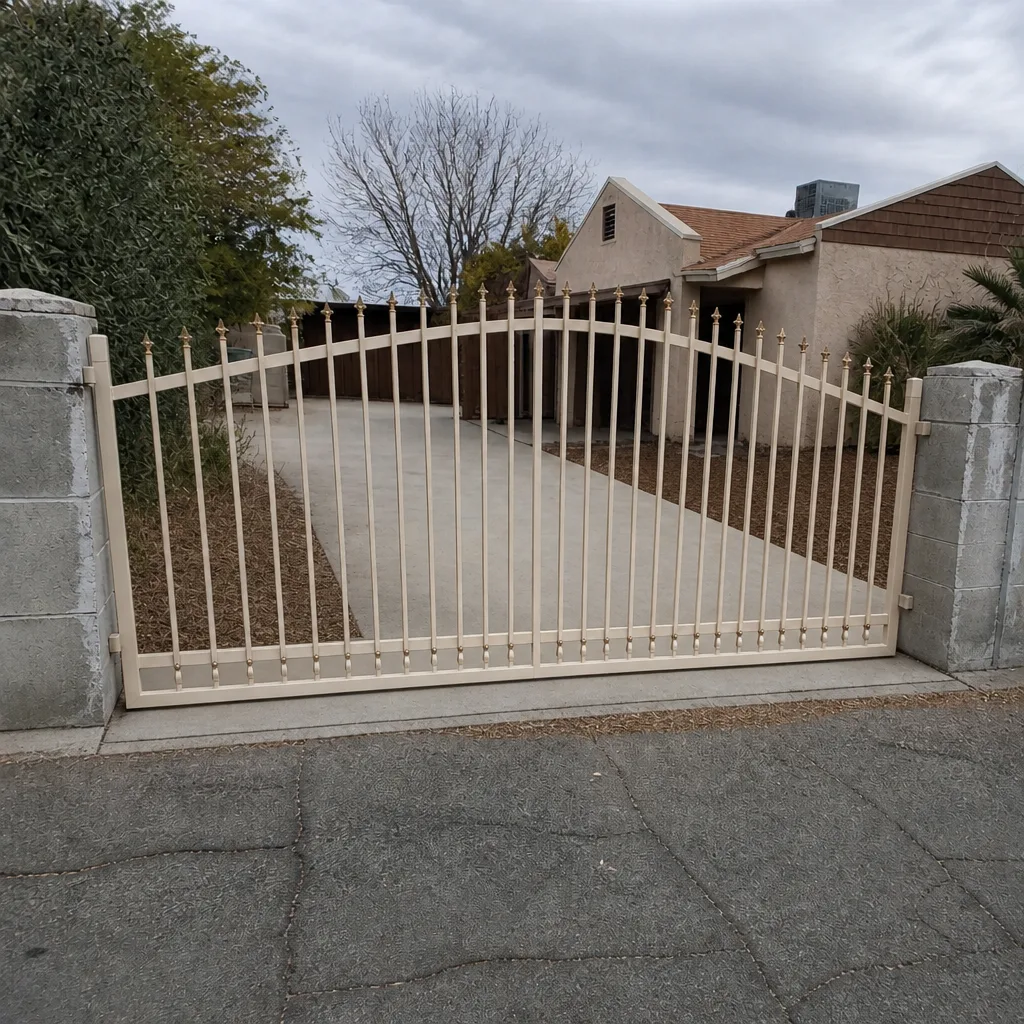 After
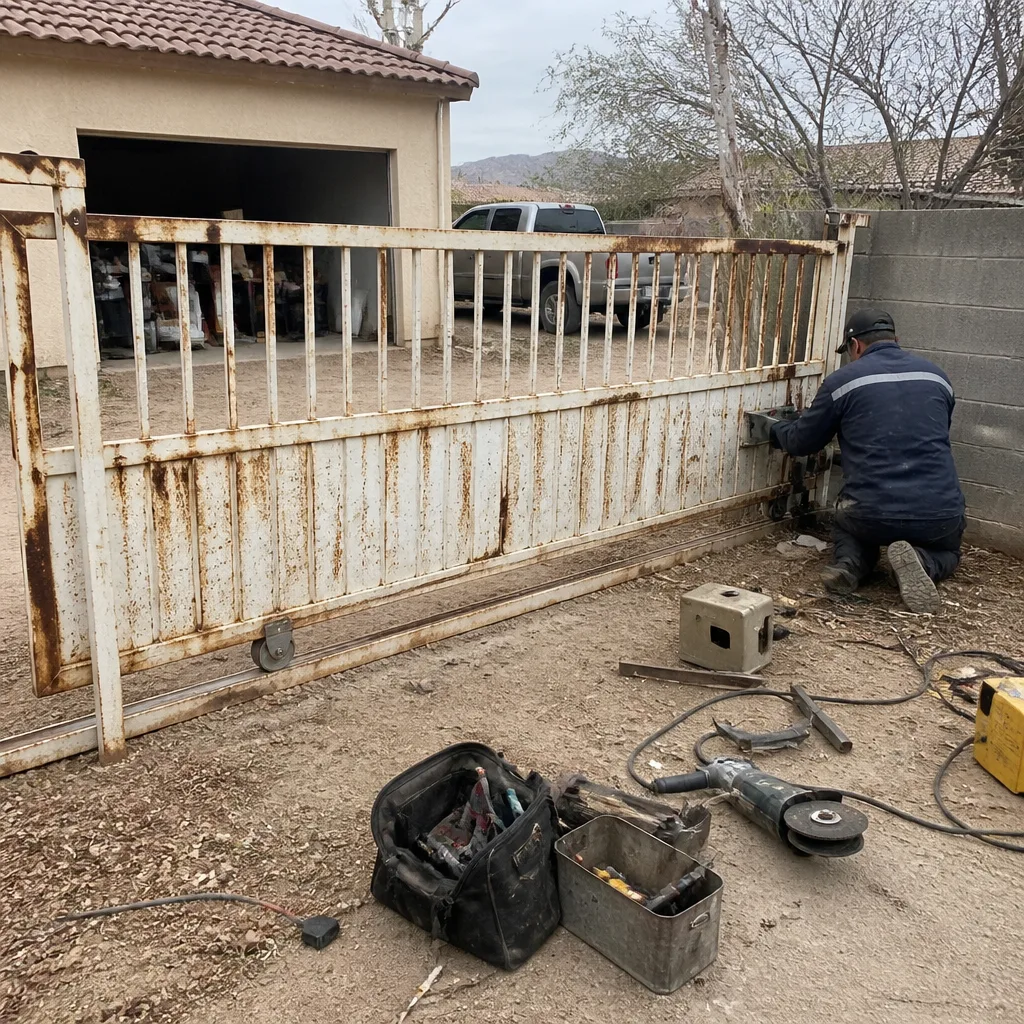 Before
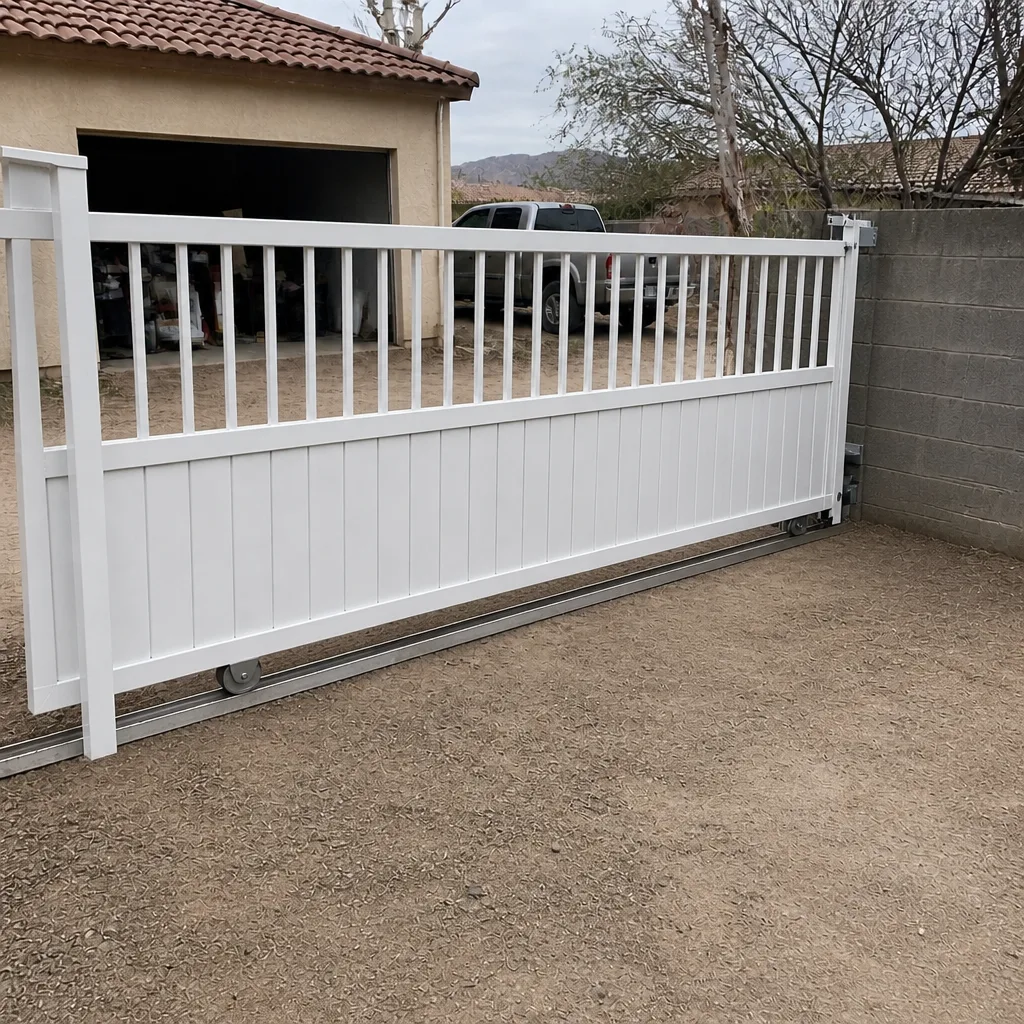 After
When to Call a Professional
Call a professional when a hinge has failed on a gate that carries real weight, when a frame crack has spread into a weld point, when a post collar is needed and the post footing is suspect, or when the gate has been repaired repeatedly and keeps failing in the same spot. These are structural welding jobs, and they’re genuinely dangerous to handle without the right training. Gate springs, gate weight under load, and hot work near an automated system all carry real risk to a homeowner attempting it alone. A trained professional checks the footings and the alloy first, plans the cooling window, and handles the paint so the repair holds and looks right. Ironworks Gate Co. Boulder City offers free estimates in Boulder City – call (888) 276-7609.
For related scope, our pages on gate repair, gate installation, and gate motor and opener service cover the adjacent decisions. Our technicians have up to 13 years of experience, and we’re trained and equipped on nine gate-automation brands including Elite, DoorKing, Viking, and Ghost Controls.
Frequently Asked Questions
Most gate welding repairs are completed in 1 to 4 hours depending on the job: hinge re-weld 1 to 2 hours, picket repair 30 minutes to 1 hour, frame crack 2 to 3 hours, and post collar 2 to 4 hours. Add 24 hours of cure time before the gate returns to full service load, and plan a separate paint step. Call (888) 276-7609 for an exact quote – estimates are free.
Often, yes – a hinge re-weld is one of the faster jobs and can usually be handled in a single visit when the footing and the surrounding welds check out. If the post footing is compromised, the repair needs more time, and we’ll tell you that after inspecting in person rather than guessing over the phone. Call (888) 276-7609 to schedule.
Steel needs to cool at a controlled rate so the weld doesn’t crack. Slamming a gate under motor load or body weight while the weld is still cooling can cause it to fail at the toe. The gate stays parked until we re-check the alignment, which is why we plan the job to leave room for cure. Call (888) 276-7609 with questions about your specific gate.
It’s usually quoted separately because paint restoration happens after the weld has cooled, ground, and prepped. In Boulder City, paint is worth budgeting for – the UV exposure here breaks down finish quickly, and bare steel needs protection. We’ll walk you through what the finish step involves. Call (888) 276-7609 for a free estimate.
Most single-visit gate welding repairs fall into a modest range, with hinge re-welds on the lower end and post collars on the higher end. The exact price depends on the job – footing condition, metal type, and whether paint is involved. We quote upfront and agree the price before any work begins, so there are no surprises on the bill. Call (888) 276-7609 for a free estimate.
Yes – gate welding and automation work together, and we’re trained on nine major brands including LiftMaster, FAAC, BFT, Linear, Viking, Ghost Controls, DoorKing, Elite, and Mighty Mule. That means the correct fix gets made on the first visit whether the gate has a Viking operator or a DoorKing control box. Call (888) 276-7609 for a free estimate.
The Bottom Line
The honest answer to how long gate parts and welding take depends on three things a responsible welder assesses before quoting: post footings, existing weld condition, and steel alloy. For the four most common jobs, expect 1 to 4 hours of work, plus 24 hours of cure time, plus a separate paint step after the metal cools. A second visit is normal for paint and post-cure alignment checks; a second visit for the same failed weld means the first one was done wrong. If you’re in Boulder City and want a real timeline from someone who inspects first and quotes upfront, call (888) 276-7609 for a free estimate. Every job we complete is backed by our written 90-Day Done Right Promise.
If you want a second opinion on a written estimate from another contractor, we offer that free – and the $89 seasonal tune-up is a good place to start for a gate that just needs a proper checkup. We’re a live-answered phone, 24 hours a day, 7 days a week. No voicemail, no callback queue.
Call (888) 276-7609 for a free estimate in Boulder City. We’ll be there when we say, quote the price before any work begins, and stand behind it in writing.
Written by the team at Ironworks Gate Co. Boulder City.