
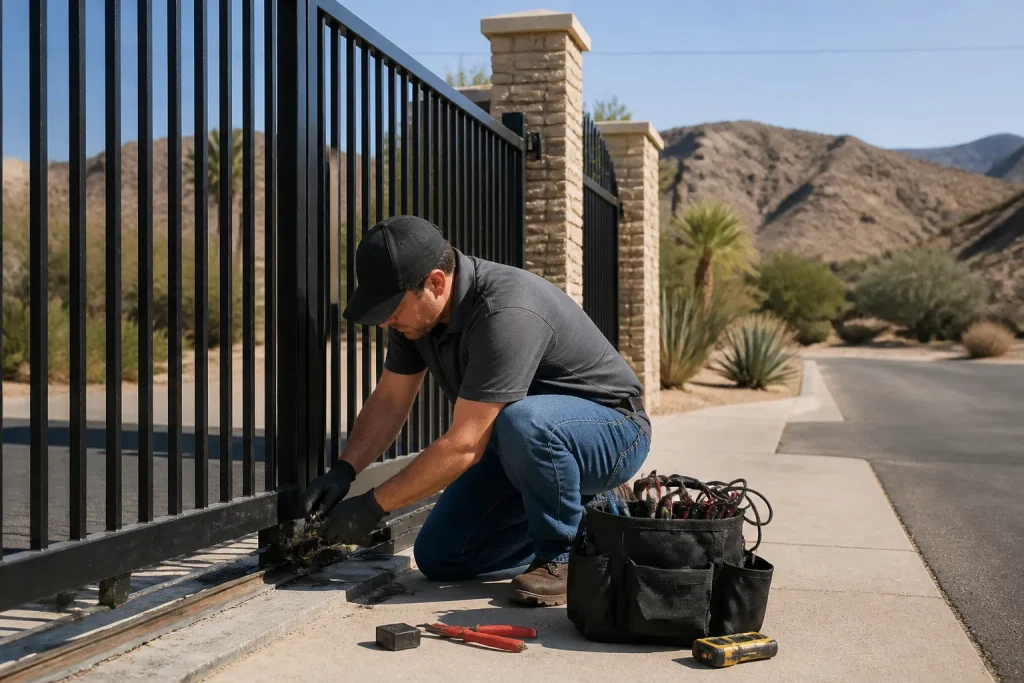
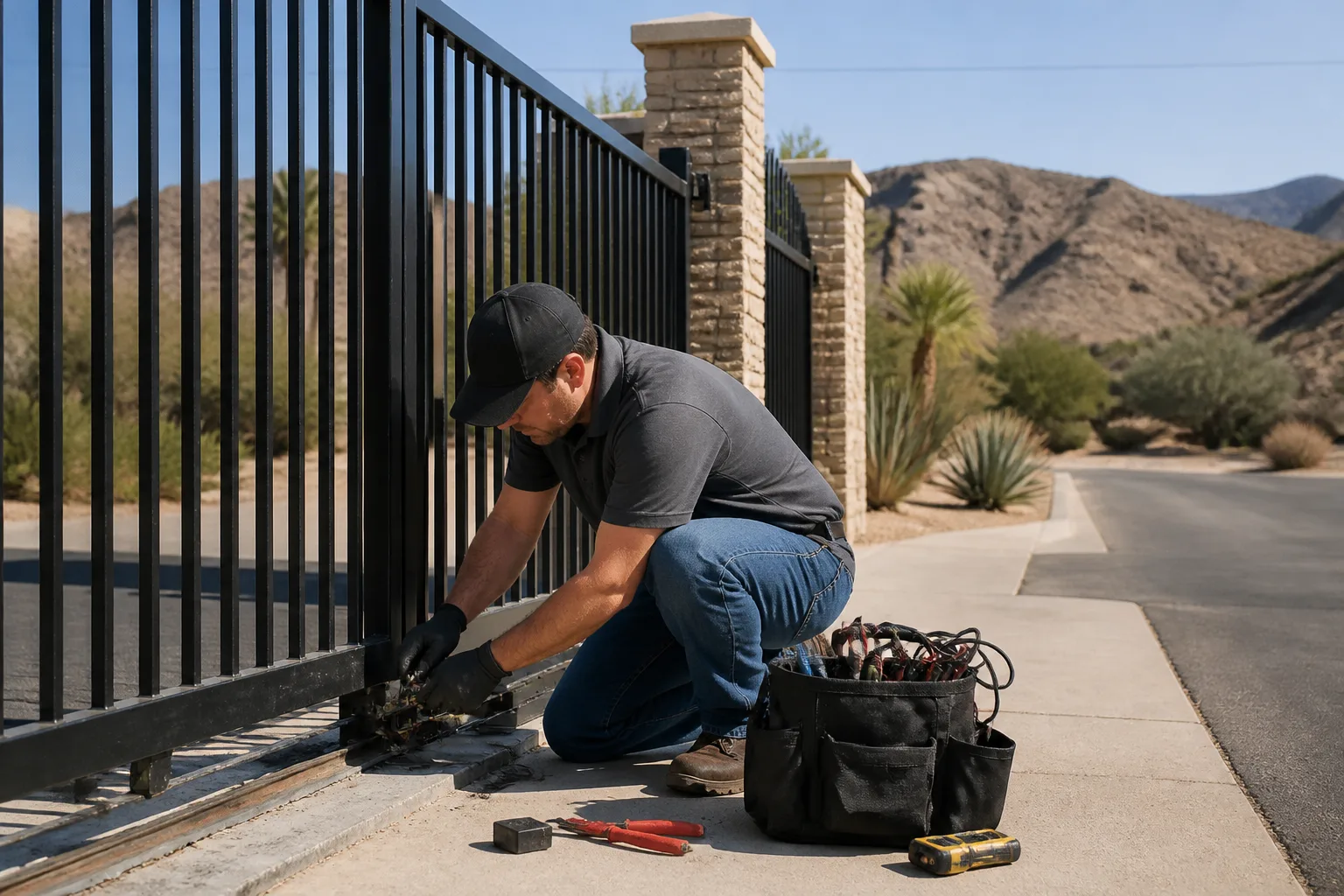
Linear Gate Repair in Boulder City: A Homeowner’s Guide
Two gates in Boulder City can both wear a Linear badge and have almost nothing in common underneath. Linear has passed through at least three corporate parents in the past two decades, and the product lines changed with each one. A “Linear gate” installed in 2008 and one installed in 2019 may share no compatible boards, no compatible limits, and no compatible arms. That single fact catches homeowners and generalist repairmen off guard when parts orders come back wrong. This guide is about telling those generations apart before anyone touches a wrench. If you’d rather not sort it out yourself, call (888) 276-7609 and we’ll take a look.
How do I identify which Linear gate operator I actually have?
Find the data plate before you do anything else. On most Linear residential operators it sits inside the housing, on the control box cover, or on the arm or chassis itself. The model prefix tells you the family, and the family tells you what parts will and won’t fit. This is the step most homeowners skip, and it’s the reason a $40 capacitor turns into three wrong orders and a week without a working gate.
Here’s the plain-language version of what those numbers mean:
- Older AC slide and swing units (the classic Linear residential lines from the 1990s and 2000s) use a straightforward AC motor, a start capacitor, and mechanical limits. Parts tend to be widely available and unit-repairable.
- Mid-generation operators added receiver boards and moved to solid-state limit sensing. The receiver board is where Boulder City’s interference problems show up.
- Newer DC brushless models use a different control board, different motor design, and often an integrated receiver. These are excellent units, but when the board or motor fails out of warranty, the math changes.
Write down the full model and serial number. In our experience across Boulder City, the serial number also tells you roughly when the unit was built, which matters when a supplier has two versions of the same board and only one is current production. If you’re not sure what you’re looking at, a photo of the plate and the control box is usually enough for us to tell you which generation you’ve got.
What are the most common Linear failures in Boulder City’s heat?
Boulder City summers are hard on gate hardware. The same dry heat that keeps the paint looking decent cooks the electronics inside the housing. We see the same handful of failures over and over, and three of them account for most of the repair calls we run here.
- Capacitor degradation. The start capacitor is a wear item. In hot-arid climates it dries out and loses capacitance years earlier than the manual suggests. The symptom is a gate that hums, stalls, or needs a nudge to get moving, especially on the first cycle of the day.
- Limit switch contamination. Fine desert dust works into the limit switch housing and either shorts the contacts or blocks the travel. The gate stops short, reverses early, or refuses to latch at the open position. It’s not a board failure, but it gets misdiagnosed as one constantly.
- Thermal cutout behavior. Linear’s control boards have thermal protection that shuts the operator down when the motor gets too hot. In Boulder City, a gate in full afternoon sun can trip that cutout on a normal summer afternoon, then work perfectly the next morning. That intermittent pattern is the trap: it looks like an electrical fault, gets called a ghost, and sometimes gets a whole board replaced that was never the problem.
There’s a fourth failure that shows up in the older residential pockets here: the gear box. On the older AC units, the gears wear before the motor does, and a worn gearset makes a grinding sound that owners describe as “the gate is tired.” It’s usually repairable, and worth checking before you price a whole new operator.
Why does my Linear gate open by itself, and what is Boulder City’s RF problem?
Phantom activations almost always come down to the receiver, not the operator. Linear’s receiver boards are sensitive to RF interference, and Boulder City’s layout makes that sensitivity noticeable in a way it isn’t in a quiet subdivision. The commercial corridors along the highway, the industrial lots, and the density of garage door openers, keypads, and security systems all crowd the same frequencies.
What we see most often:
- Phantom opens when a neighboring device transmits on the same channel. The gate opens at random, usually when nobody is home.
- Lock-outs where the remote stops working entirely for hours or days, then comes back. The receiver has picked up enough interference to jam itself.
- Keypad dropouts where a wired or wireless keypad stops responding but the remote still works. That’s usually a wiring or antenna placement issue, not the keypad.
The fix is usually straightforward: re-antenna the receiver, move the antenna lead clear of metal, switch to a rolling-code remote if the board supports it, and check the channel against nearby devices. If the board itself is failing, a replacement receiver is a small job on the older AC units and a bigger one on the newer integrated boards. What you should not accept is “it’s just interference, live with it.” A gate that opens on its own is a real problem, and a Linear-trained technician should be able to trace it in one visit.
Is it worth repairing an older Linear AC motor, or should I replace it?
This is the question that decides the whole job, and the answer depends entirely on which generation you’ve got. The break-even math is not complicated once you know the model.
On the older AC motor units, the motor itself is a simple, robust part. Failure is usually in the capacitor, the limits, or the gear box, all of which are serviceable for a fraction of replacement cost. A capacitor and limit service on a well-built AC unit is often one of the best values in gate repair, and if the chassis and gears are sound, there’s no reason to replace. We’ve pulled AC units out of driveways in Boulder City where the operator was old enough to have seen a few dozen homeowners move in, and it cycled cleanly after a gearset and capacitor service.
On the newer DC brushless models, the math shifts toward replacement. The control board is the expensive part, the motor is integrated with the board on some models, and when either fails outside warranty, the repair bill climbs toward the price of a new operator. Add the integrated receiver and the fact that replacement boards can be back-ordered, and replacement often makes more financial sense. The honest answer, though, is that it depends on the board version, and the only way to know is to read the data plate and the control box before you price anything.
Here’s the rough rule of thumb we use in Boulder City: if the repair quote lands above about half the installed cost of a comparable new operator, and the existing unit is DC, replacement usually wins. If it’s AC and the chassis is solid, repair usually wins. Neither number is a guess. We quote both options before a single bolt is turned.
How do I verify a Linear technician actually knows the product line?
This is the question most homeowners don’t ask, and it’s the one that saves the most money. A technician who knows the product line will answer the brand specifics without hesitation. One who doesn’t will speak in generalities and then order the wrong part. Here are the two or three questions that reveal the answer immediately:
- “Which generation of Linear operator is on my gate?” If the answer is a family name or a model prefix that matches your data plate, you’re talking to someone who knows the line. If the answer is “a Linear,” ask again.
- “Do you stock or source the receiver board for my revision, or will you swap the whole unit?” A Linear-trained tech knows the revisions and knows which boards are interchangeable. A generalist will replace the operator rather than chase a board.
- “What’s your diagnostic approach for a phantom activation?” A trained tech will talk about antenna placement, channel conflicts, and rolling-code options before they mention replacing a remote.
Ironworks Gate Co. services Linear alongside LiftMaster, FAAC, BFT, Viking, Ghost Controls, DoorKing, Elite, and Mighty Mule, so we’re used to the differences between lines as well as within one. Our technicians have up to 13 years of experience and we’re trained and equipped on each of those brands, which means the correct fix on the first visit, whatever is mounted on your driveway. If you’d like to compare that against the rest of our work, Ironworks Gate Co. Boulder City home lays it out.
When should you call a pro?
Any gate operator is a real electrical machine with stored energy and moving metal. A gate that opens on its own, a motor that hums and won’t start, exposed wiring, or a control box that smells hot are all reasons to stop and call a trained technician rather than troubleshoot further. Don’t open the control box on a live circuit, and don’t try to force a gate that’s jammed. The safety risk isn’t worth the savings.
If you’d rather have it diagnosed right the first time, our team can look at a photo of your data plate and tell you what generation you’ve got and what a sensible next step looks like. Unless you’re outside Boulder City, our related service pages cover the nearest work areas: Gate Repair in Winchester, Gate Installation in Winchester, and Gate Motor & Opener in Winchester.
The Bottom Line
Linear gate repair in Boulder City comes down to one thing: identifying which generation of Linear operator is actually on your gate before anyone prices parts or recommends a replacement. Get the model and serial number off the data plate, expect the hot-arid failures (capacitor, limits, thermal cutout) to be the usual suspects, and treat phantom activations as the RF problem they are rather than something to live with. Older AC units are often economically repairable; newer DC units often are not. And ask the brand questions before the truck rolls, because the answer tells you everything.
If you’re in Boulder City and need help, Ironworks Gate Co. Boulder City offers free estimates. Call (888) 276-7609. A live person answers 24 hours a day, 7 days a week, every job is protected by our written 90-Day Done Right Promise, and we’ll quote both repair and replacement before a single bolt is turned.
Frequently Asked Questions
Most Linear repairs in Boulder City fall in a few common ranges: a capacitor and limit service is typically the low end, a receiver board replacement is mid-range, and a control board or motor replacement on a newer DC unit is the high end and sometimes rivals the cost of a new operator. We quote the exact price and settle it before any work starts, so there are no surprises on the bill. Call (888) 276-7609 for an exact quote, estimates are free.
Usually yes, if the photo shows the data plate clearly and the inside of the control box. The model prefix and serial number are what we need. Send both and we can tell you the generation, which parts are compatible, and whether repair or replacement is the sensible call. Call (888) 276-7609 if you’d rather talk it through.
It’s a real concern and worth fixing, not living with. Phantom activations on Linear receivers are usually an RF interference or antenna issue, and they can be traced and corrected. A gate that opens on its own is also a security problem, so don’t wait. Call (888) 276-7609 and we’ll get it sorted.
Yes. We’re trained and equipped on Linear, LiftMaster, FAAC, BFT, Viking, Ghost Controls, DoorKing, Elite, and Mighty Mule, so the correct fix is made on the first visit whatever is on your driveway. Call (888) 276-7609 for a free estimate and we’ll take it from there.
Written by the team at Ironworks Gate Co. Boulder City.
Need Gate Repair Help?
Call Ironworks Gate Co. Boulder City - licensed & insured, here with fast after-hours help in Boulder City.
(888) 276-7609