
LiftMaster Gate Repair in Boulder City: A Homeowner’s Guide
LiftMaster’s diagnostic system will tell a trained technician exactly what’s wrong within four minutes. Without the right equipment and certification, that same system looks like a black box, and homeowners pay for the guesswork. Most LiftMaster gate failures in Boulder City come down to three things: photo-eye misalignment, RPM sensor faults, and logic board resets after summer power surges. If you’d rather not sort through error codes on a Saturday morning, call (888) 276-7609 and we’ll take a look.
We work on LiftMaster equipment constantly, alongside FAAC and BFT systems, and we’ve learned that the most expensive part of a LiftMaster repair is usually not the part. It’s the wrong diagnosis that sends a homeowner down a path of replacement before anyone has checked the simplest cause. This guide is meant to help you tell the difference between a gate that needs a five-minute adjustment and one that genuinely needs a technician.
Why LiftMaster Systems Get Misdiagnosed in Boulder City
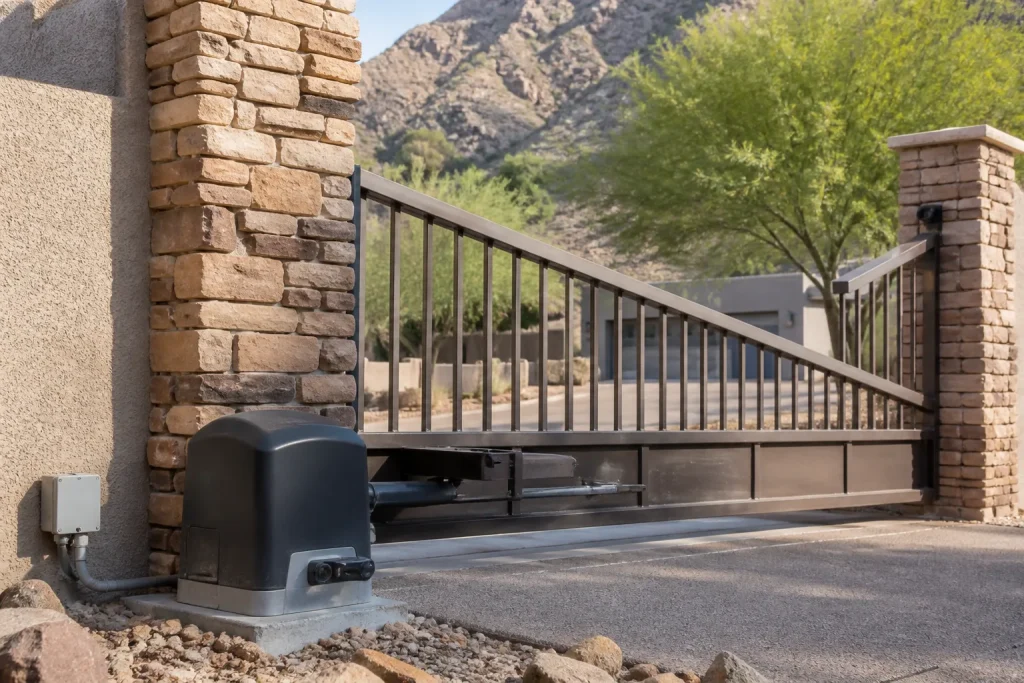
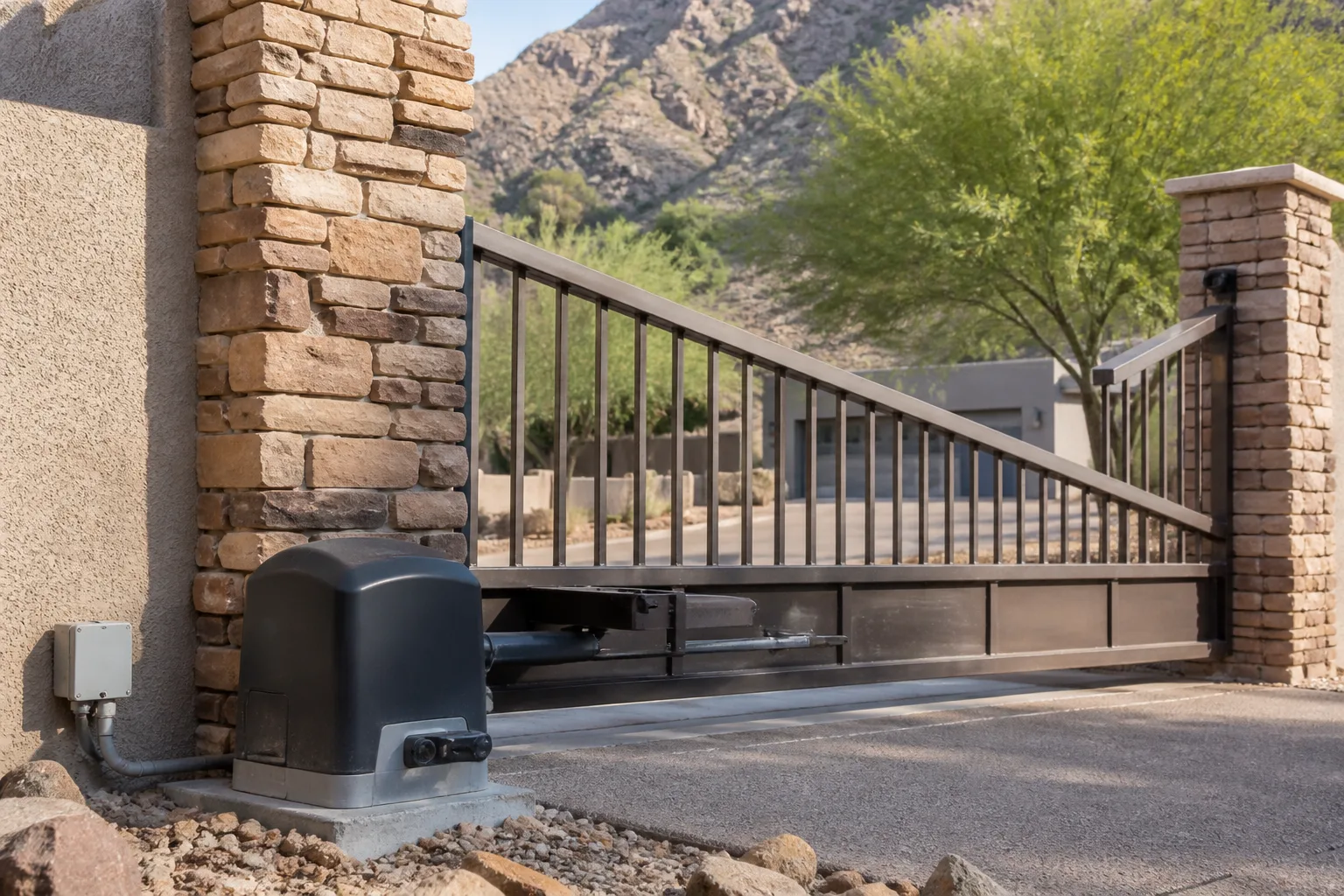
LiftMaster is the most sophisticated gate automation brand installed in Boulder City homes. That sophistication is the problem. The control board logs faults, the motor reports RPM data, the photo eyes run a continuous beam check, and the myQ module talks to your home network. When something goes wrong, the system knows more about it than most technicians are trained to read.
We’ve seen this play out repeatedly. A homeowner calls because the gate won’t close. One technician quotes a full operator replacement. A second technician resets the logic board and the gate runs fine for another year. The difference between those two outcomes is brand-specific training, and it matters more with LiftMaster than with almost any other equipment on a driveway.
Boulder City makes this worse in a few specific ways:
- Thermal expansion. Our summer swing between cool mornings and 105-degree afternoons moves metal and mounting brackets more than most gate hardware is designed for. Photo eyes drift out of alignment as a result.
- Dust infiltration. Desert wind carries fine particulate that works its way into the RPM sensor housing and the motor’s internal components. Over a season, that grit causes false faults and intermittent stops.
- Power fluctuations. Boulder City’s summer storm season sends voltage spikes through the grid. A spike that’s harmless to your refrigerator can corrupt the logic board’s memory, triggering a reset the homeowner can’t perform without the right access.
None of this is exotic. It’s just what happens to automation equipment in a desert climate. The fix is usually straightforward once you know which system is reporting the fault.
How Do You Tell a myQ Problem From a Gate Problem?
A myQ connectivity issue is not a gate failure. That sounds obvious, and it catches people every week. If your gate opens and closes fine at the keypad but won’t respond to the app, the gate itself is healthy. The problem lives in the network layer, and no amount of gate repair will fix it.
Here’s how to isolate the fault before you call anyone. This is the same sequence our technicians run, simplified for a homeowner to check safely:
- Test the gate manually. Use the wall-mounted control or keypad. If the gate opens and closes normally from a physical control, the operator, motor, and safety sensors are working. Move to step 4.
- If the gate won’t respond to any control, check the breaker. LiftMaster operators need steady power, and a tripped breaker mimics a dead board.
- Watch the indicator lights on the operator housing. A solid light typically means the unit has power and is ready. A blinking pattern is the system telling you something specific. Note the pattern. Do not open the housing to investigate further; the capacitors inside hold a charge long after power is cut, and that charge can injure you.
- If the gate works but the app doesn’t, check your home router first. myQ runs on your Wi-Fi, and a router reboot fixes more “gate failures” than any repair we perform. If that doesn’t help, the myQ gateway or its connection to the operator is the likely culprit.
- If the gate works from the keypad but not the remote, the issue is the receiver or the remote’s battery, not the gate.
That last distinction saves Boulder City homeowners real money. We’ve been called out to “failed gates” that turned out to be a $4 battery in a handheld remote. A quick check up front keeps you from paying for a service call you didn’t need.
The LiftMaster Safety Reversal Test You Should Run Every Month
Every LiftMaster gate operator has a safety reversal feature, and every Boulder City homeowner should test it once a month. This is not optional maintenance. It’s the single most important check you can perform on a gate that moves under its own power.
Here’s the test. With the gate open, place a solid object, a piece of lumber or a box, in the gate’s path. Command the gate to close. The gate should stop and reverse when it contacts the object. If it doesn’t reverse, stop using the automatic gate and call for service. A gate that doesn’t reverse is a gate that can injure a person, a pet, or a vehicle.
A failed reversal test tells you something specific about sensor condition:
- Gate closes on the object without stopping. The photo eyes are misaligned, blocked by dirt, or failed. This is the most common result and usually the cheapest to fix.
- Gate stops but doesn’t reverse. The force setting on the operator has drifted, often after temperature swings. It needs recalibration by someone with access to the operator’s programming.
- Gate reverses randomly with nothing in its path. A failing photo eye or a loose wire is sending false signals. This is a safety issue, not just an annoyance.
We pulled a LiftMaster unit out of a driveway over near the Historic District last spring where the homeowner had been forcing the gate closed by hand for three weeks because it kept reversing on its own. The photo eye bracket had loosened in the heat and was reading the gate’s own post as an obstruction. Fifteen minutes with a wrench and a realignment fixed it. She’d been ready to replace the whole operator.
The LiftMaster Models Most Common in Boulder City, and How Each One Fails
Most residential LiftMaster gate systems in Boulder City fall into three model families. Each has known service intervals and known failure points, which means a trained technician can often predict the problem before opening the housing.
- CSW200 (swing gate operator). Common on driveway gates in established neighborhoods. The gearbox and the limit switches are the wear items. Expect the limit switches to need attention first, usually presenting as a gate that stops short of full travel or grinds at the end of its arc.
- LA400 (slide gate operator). Found on properties where a swing gate won’t clear the driveway. The chain and the drive sprocket carry the load, and the RPM sensor is the component most affected by dust. When the LA400 reports an RPM fault, it’s often grit, not a failed motor.
- LACSD (heavy-duty slide operator). Used on larger estate gates. The board is robust, but the power supply is sensitive to voltage spikes. A logic board reset after a summer storm is the most common call we get on this model.
Service intervals follow the same pattern across all three. Plan on an annual inspection and a tune-up before the summer heat peaks. Spring, before the first 100-degree week, is the right window in Boulder City. A gate that’s adjusted and lubricated in April is far less likely to strand you in July. You can see the full scope of what we handle at our Ironworks Gate Co. Boulder City home page, or read more about Gate Motor & Opener in Winchester if your equipment is on the Nevada side of the line.
What LiftMaster Dealer Authorization Actually Means for Your Repair
When a technician is authorized on LiftMaster equipment, three practical things change for the homeowner. None of them are marketing language. All three affect whether your repair holds.
Firmware updates. LiftMaster releases firmware revisions that fix known bugs and improve myQ stability. An authorized technician can install them. An unauthorized technician can’t access them, which means your repaired gate stays on old firmware and may develop the same connectivity problems again.
Genuine OEM parts. Aftermarket photo eyes, logic boards, and sensors are cheaper for a reason. They often work, for a while. The failure curve is steeper, and on a safety component like a photo eye, a premature failure is a hazard. OEM parts are what the operator was designed around.
Warranty-valid repairs. If your LiftMaster operator is still under manufacturer warranty, unauthorized work can void it. That’s a costly mistake on a system this expensive. Dealer authorization keeps the warranty intact and holds the manufacturer to its coverage.
The practical test for a homeowner is simple: ask whether the technician is authorized on LiftMaster specifically. The right fix on a LiftMaster system is not interchangeable with the right fix on a Mighty Mule or a BFT. Brand-specific training is why the correct repair usually happens on the first visit.
When to Call a Pro
Some of this you can handle. A remote battery, a router reboot, a cleared obstruction in front of a photo eye. That’s homeowner-level work, and we’re glad to see you do it.
The rest should go to a trained technician. A gate that fails the reversal test, an operator housing that needs to be opened, a logic board that needs to be reprogrammed, or any symptom that involves the motor or the high-voltage wiring. Gate operators store energy in their capacitors and carry line voltage inside the housing. That’s not a job for a homeowner with a multimeter and a YouTube tab open. It’s a job for someone who does it safely, every day.
Related services in Boulder City: if what you actually need is a new operator rather than a repair, we handle Gate Installation in Winchester, and for repairs of any brand, our Gate Repair in Winchester team covers the full range.
The Bottom Line
LiftMaster systems in Boulder City fail in predictable ways, and most of them are diagnosable in minutes by a trained technician. The three failures we see most are photo eyes knocked out of alignment by thermal expansion, RPM sensor faults from desert dust, and logic boards corrupted by summer power spikes. A myQ problem is a network problem, not a gate problem, and it’s worth running the isolation steps before you call anyone. And the monthly safety reversal test is the one habit that protects your family and catches small problems before they become expensive ones.
The difference between a guess and a fix on a LiftMaster system is brand-specific training and genuine parts. Our technicians have up to 13 years of experience, we’re trained on nine leading gate automation brands, and every job is backed by our written 90-Day Done Right Promise. If you’re in Boulder City and need help, Ironworks Gate Co. Boulder City offers free estimates. Call (888) 276-7609.
Frequently Asked Questions
Most LiftMaster gate repairs in Boulder City fall in the $180 to $450 range. Photo-eye realignment and recalibration is typically on the low end. A logic board replacement or an RPM sensor fault requiring a motor service runs higher. The exact price depends on the model, the part, and the labor involved. We quote and agree on the price before any work starts, so there are no surprises on the bill. Call (888) 276-7609 for an exact quote; estimates are free.
In most cases, yes. Gate repair is the kind of work that can strand you, and we treat it that way. A live person answers our phone 24 hours a day, 7 days a week, so you’re never leaving a message and waiting until Monday. Call (888) 276-7609 and we’ll tell you honestly what’s possible for your gate today.
No. If the gate opens and closes normally from a physical control, the operator, motor, and safety sensors are healthy. The problem is in the network layer, almost always your home router or the myQ gateway’s connection to it. Reboot your router first. If that doesn’t fix it, the myQ gateway needs service, not the gate. Call (888) 276-7609 if you’d like us to take a look; estimates are free.
Once a year, with spring being the right window. A tune-up before the summer heat peak adjusts the limit switches, lubricates the moving parts, and checks the photo-eye alignment, which prevents most of the failures we see in July. Our $89 Seasonal Tune-Up covers this, and it’s the cheapest way to keep a LiftMaster operator running through the Boulder City summer.
Written by the team at Ironworks Gate Co. Boulder City.
Need Gate Repair Help?
Call Ironworks Gate Co. Boulder City - licensed & insured, here with fast after-hours help in Boulder City.
(888) 276-7609