
Gate Motor & Opener: Repair or Replace? How Boulder City Homeowners Decide
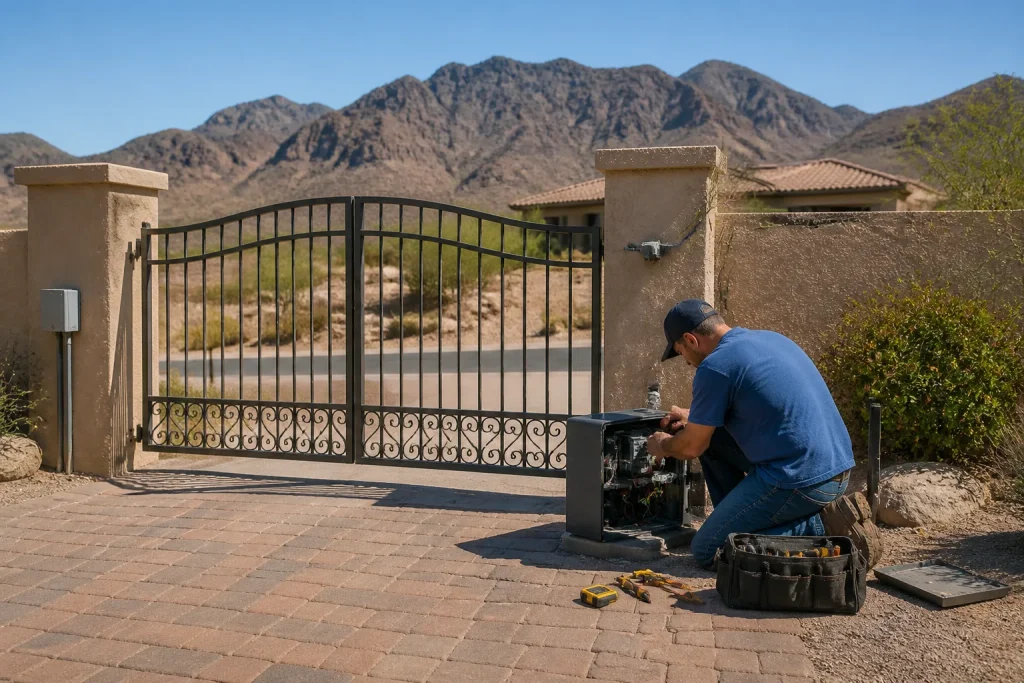
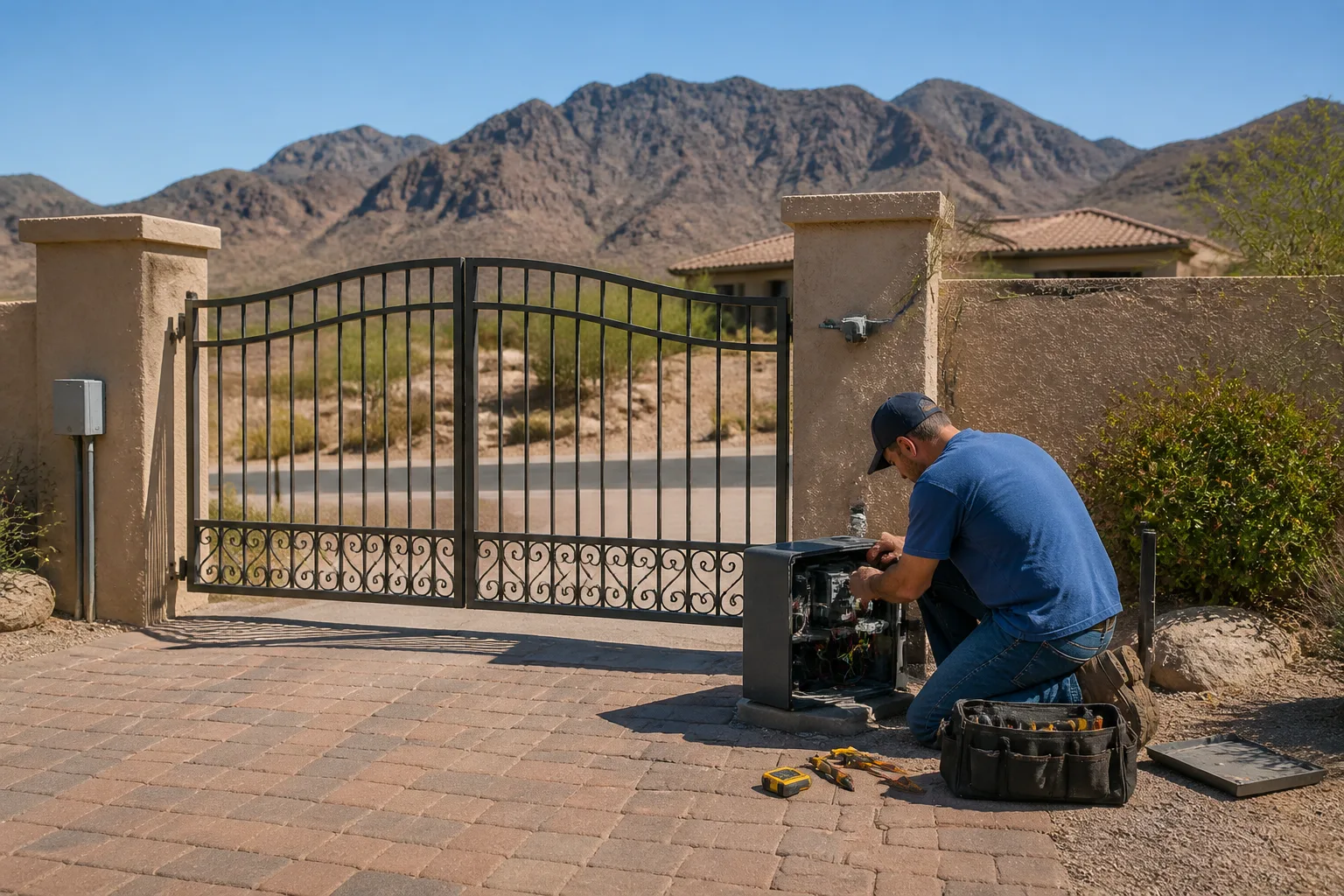
A gate motor that burns out twice in three years isn’t unlucky. It’s usually being asked to do more work than it was sized for, because a misaligned gate or worn hardware is forcing it to draw close to twice its rated amperage on every cycle. In Boulder City’s heat and dust, that hidden load is what kills operators. The repair-or-replace question is rarely about the motor alone. It’s about whether the failure is a correctable condition or evidence the whole drive system is past its design life. If you’d rather hand this to someone who reads it correctly the first time, call (888) 276-7609.
Key Takeaways
- A clamp-meter amperage test against the motor’s nameplate rating separates a motor problem from a mechanical load problem in about fifteen minutes.
- Repeated failures on the same operator usually point to gate resistance, not bad luck with parts.
- In Boulder City’s climate, cycle-count expectations run lower than manufacturer literature assumes.
- Motors discontinued more than seven years ago often cost nearly as much to repair as to replace.
- Upsizing the duty-cycle rating is often smarter than matching the failed model.
Why does a gate motor fail twice in three years in Boulder City?
Because the motor is doing penance for the gate. When a gate sags, its hinges wear flat, or a weld cracks at the frame, the operator has to push through resistance it was never rated for. A motor rated at 4 amps might pull 7 or 8 on every cycle. It still opens. It still closes. And it cooks itself quietly over a few hundred cycles until the windings give out.
We pulled an operator out of a garage over in the Historic District last spring where the homeowner had replaced the motor twice and was ready to buy a third. The gate hinge was worn enough that the leaf dragged a quarter inch on the strike post. Twenty minutes with a clamp meter and a pry bar told the whole story: the second motor had been fighting a mechanical problem that no new motor was ever going to fix. We’ve watched the same pattern repeat across Boulder City, from the neighborhoods off Nevada Way to the older lots near the lake.
Boulder City makes this worse than most towns. Summer temperatures push past 105°F, and the dust that settles on gate tracks acts like grinding compound on rollers and hinge pins. A motor that would last twelve years on the coast can be fighting a losing battle here by year six if the mechanical side isn’t maintained.
How do you test whether it’s the motor or the gate?
You measure the motor’s amperage draw against its nameplate rating with a clamp meter, and the reading tells you almost everything. A clamp meter costs about $40 at any hardware store. A technician with one can answer the question in fifteen minutes.
- Find the nameplate. The motor housing has a sticker listing rated amps, voltage, and duty cycle. Take a photo of it before anything else.
- Clamp the meter around the hot lead feeding the motor (not the whole bundle) while the gate runs through a full open-close cycle.
- Watch the peak reading during the heaviest part of travel. That’s usually the first and last few feet, where resistance builds.
- Compare it to the nameplate. A reading within 10-15% of rated amps means the motor is doing the work it was built for. A reading at 150% or more means the motor is fighting something – almost always the gate itself.
If the amperage is high, the fix is mechanical: realign the gate, replace worn hinges, true up the track, or re-weld a cracked frame. If the amperage is normal and the motor still fails, the operator is the problem. That single test is what separates a repair from a replacement, and it’s why we won’t quote a new motor without running it first. Knowing which brands you’re working with helps too – a LiftMaster and a Mighty Mule don’t fail the same way.
How long should a gate motor last in Nevada’s climate?
Shorter than the box says. Manufacturer cycle ratings are typically written for moderate climates and clean, level installations. Boulder City’s heat and dust eat into that margin. Here are realistic expectations for the five most common residential operator types we see on driveways around Boulder City:
- Swing-arm operators (LiftMaster, FAAC, BFT): 8-12 years typical, 5-7 if the gate isn’t maintained. Heat accelerates the capacitor and control board failures first.
- Slide-gate operators (DoorKing, Elite): 10-15 years on a clean track, 6-9 if dust and grit aren’t cleared. The track condition matters more than the motor brand.
- Solar and low-voltage operators (Ghost Controls, Mighty Mule): 6-10 years. The battery bank usually dies before the motor does; check battery health before condemning the operator.
- Heavy-duty commercial-grade residential (DoorKing): 12-18 years with annual service. These are overbuilt for most driveways and reward the investment.
- Older obsolete operators: variable, but if the model was discontinued more than seven years ago, parts availability shortens the practical life regardless of what’s left in the motor.
We’ve serviced gates across Boulder City long enough to know that a well-maintained operator on a well-maintained gate routinely beats these numbers, and a neglected one falls short every time. The maintenance is not glamorous. It is what makes the difference.
Why replacing a failed motor with the same model is sometimes wrong
Because the failed motor may have been undersized for how the gate is actually used. If a household runs the gate fifteen or twenty times a day – two cars, regular visitors, deliveries – a light-duty operator rated for six cycles an hour was the wrong choice from the start. Replacing it with an identical unit just resets the clock on the same mistake.
When we see heavy daily use on a Boulder City gate, we often recommend stepping up one tier in duty-cycle rating rather than matching the failed model. A DoorKing slide operator or a LiftMaster swing-arm rated for continuous duty costs more upfront, but it survives the workload the light-duty unit couldn’t. That’s a square deal over ten years. It’s a bad deal if you keep buying the same underpowered motor every four years.
The other case for changing models is parts availability. If the old operator was discontinued in, say, 2016, and the control board is $400, and a whole new operator with a warranty is $900, the math changes quickly. Repairing a motor you can’t get parts for next year is a way of paying twice.
What do control board failure and motor winding failure feel like?
They behave differently, and the difference helps you have a smarter conversation with any technician. You don’t have to diagnose it yourself – but knowing what you’re seeing means you won’t be talked into the wrong repair.
- Control board failure: the gate behaves erratically before it stops. It opens halfway, reverses for no reason, ignores the remote on some days and works fine on others, or throws a light code that comes and goes. The motor still hums when you trigger it manually. The behavior is inconsistent because the logic is failing, not the muscle.
- Motor winding failure: the gate stops cleanly and stays stopped. You hear a click from the board, maybe a faint hum from the motor, but nothing moves. Sometimes a burning smell lingers near the housing. The failure is sudden and total, because the windings have shorted and the motor can no longer generate torque.
- Mechanical failure (the sneaky one): the gate moves, but slowly, or stalls in the same place every cycle. Amperage climbs. The motor may not be failing at all – the gate is. This is the case that most often gets misdiagnosed as a bad motor.
If your operator is doing any of the above and you’d rather not guess, we’re happy to take a look. That’s what the free second opinion on any written estimate is for. If another company has already quoted you a full replacement, bring us the quote and we’ll tell you honestly whether the motor needs replacing or the gate does.
The parts-availability cliff: when repair stops making sense
Every gate operator eventually reaches a point where the parts cost as much as a new unit. The line is usually seven years past discontinuation. Before that, control boards, motors, and gear sets are still available through distributors, and a repair is the sensible move. After it, you’re often paying a premium for a rebuilt part or a used one pulled from a salvage unit, and the next failure is right around the corner.
Here’s how to tell if you’re on that cliff. Check the model number on the nameplate against the manufacturer’s current catalog. If the model is still in production, you’re fine. If it was discontinued in the last seven years, parts are likely still around. If it’s older than seven years past discontinuation, price the repair against a new operator before you commit – because the repair may cost 60% of a new install and only buy you another year or two. Around Boulder City, where the summer heat accelerates wear on older components, that gap closes even faster.
Our technicians have up to 13 years of experience across nine operator brands, and we’ve seen this play out often enough to know that honest advice here matters more than selling the biggest job. Sometimes the answer is repair. Sometimes it’s replace. The answer should be based on the gate, the motor, and the parts, not on what’s easiest to quote.
When to call a pro
Gate operators run on 120-volt line power in most residential installs, and the motor, control board, and safety-edge wiring are not places for a homeowner to learn electrical work. A miswired control board can destroy a new motor in seconds, and a safety edge that doesn’t reverse properly is a hazard to anyone on the driveway – child, pet, or delivery driver. We recommend a trained technician for anything past checking the battery and clearing debris from the track.
If you’re in Boulder City and want a straight answer about repair versus replacement, we offer free estimates and a no-hassle second opinion on any written estimate you’ve already received. Related services in Boulder City we handle include Gate Repair in Winchester and Gate Installation in Winchester, and when the motor truly is done, Ironworks Gate Co. Boulder City home outlines the full scope of what we do on driveway and estate gates.
The Bottom Line
The motor tells you what’s wrong if you know how to read it. Amperage draw against the nameplate splits the decision in two: high draw means a mechanical problem (repair the gate), normal draw with a dead motor means a bad operator (replace the motor, or the whole unit depending on age and parts availability). In Boulder City’s heat and dust, the timeline is shorter than the manufacturer’s literature suggests, and matching the failed model isn’t always the right call – especially if the gate is used more than the original install anticipated. When in doubt, run the test, check the parts, and get an honest second opinion before you commit to a quote.
If you’re in Boulder City and need help, Ironworks Gate Co. Boulder City offers free estimates – call (888) 276-7609. A live person answers the phone any hour, any day. Every job we finish is backed by our written 90-Day Done Right Promise, and we’ll tell you the truth even when the truth is that you don’t need us yet.
Frequently Asked Questions
Most residential gate motor repairs in Boulder City run between $250 and $650 depending on the failure – a control board replacement sits at the lower end, a motor or gear-set replacement at the upper end, and parts availability drives the range. Every price is quoted and agreed before any work starts. Call (888) 276-7609 for an exact quote – estimates are free.
Often, yes. We answer the phone 24 hours a day, and most gate motor repairs in Boulder City are completed in a single visit because our technicians are trained on nine major operator brands and carry the common parts. Call (888) 276-7609 and we’ll give you an honest arrival window.
Repair it if the parts are still available and the rest of the gate is sound. Replace it if the model was discontinued more than seven years ago and the repair quote comes within 60% of a new installation. Ten years is a reasonable service life for a residential operator in Boulder City’s climate, so at that age replacement is often the better long-term investment. Call (888) 276-7609 for a free second opinion on any quote you’ve already received.
A full installation includes the operator sized to the gate and its actual daily cycle count, the control board and wiring, a safety edge or photo-eye pair, the power run to the operator, remote programming, and a full open-close test cycle before we leave. It’s a measured, scheduled job rather than a same-day service, because the right operator has to be ordered for your gate. Call (888) 276-7609 for a free measure and a written price.
Written by the team at Ironworks Gate Co. Boulder City.
Need Gate Repair Help?
Call Ironworks Gate Co. Boulder City - licensed & insured, here with fast after-hours help in Boulder City.
(888) 276-7609