
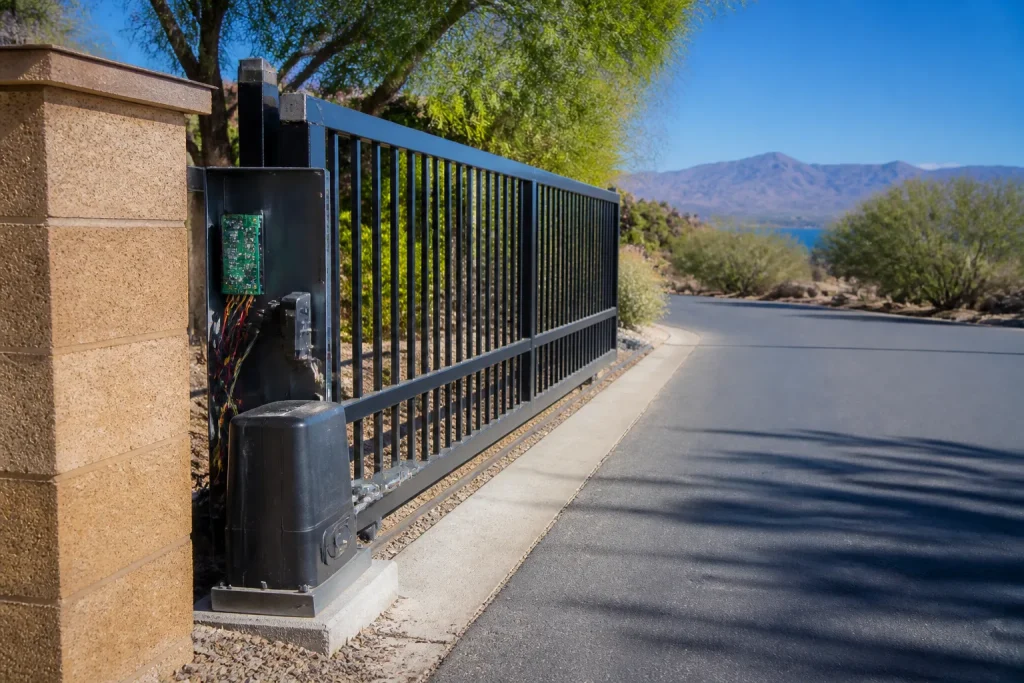
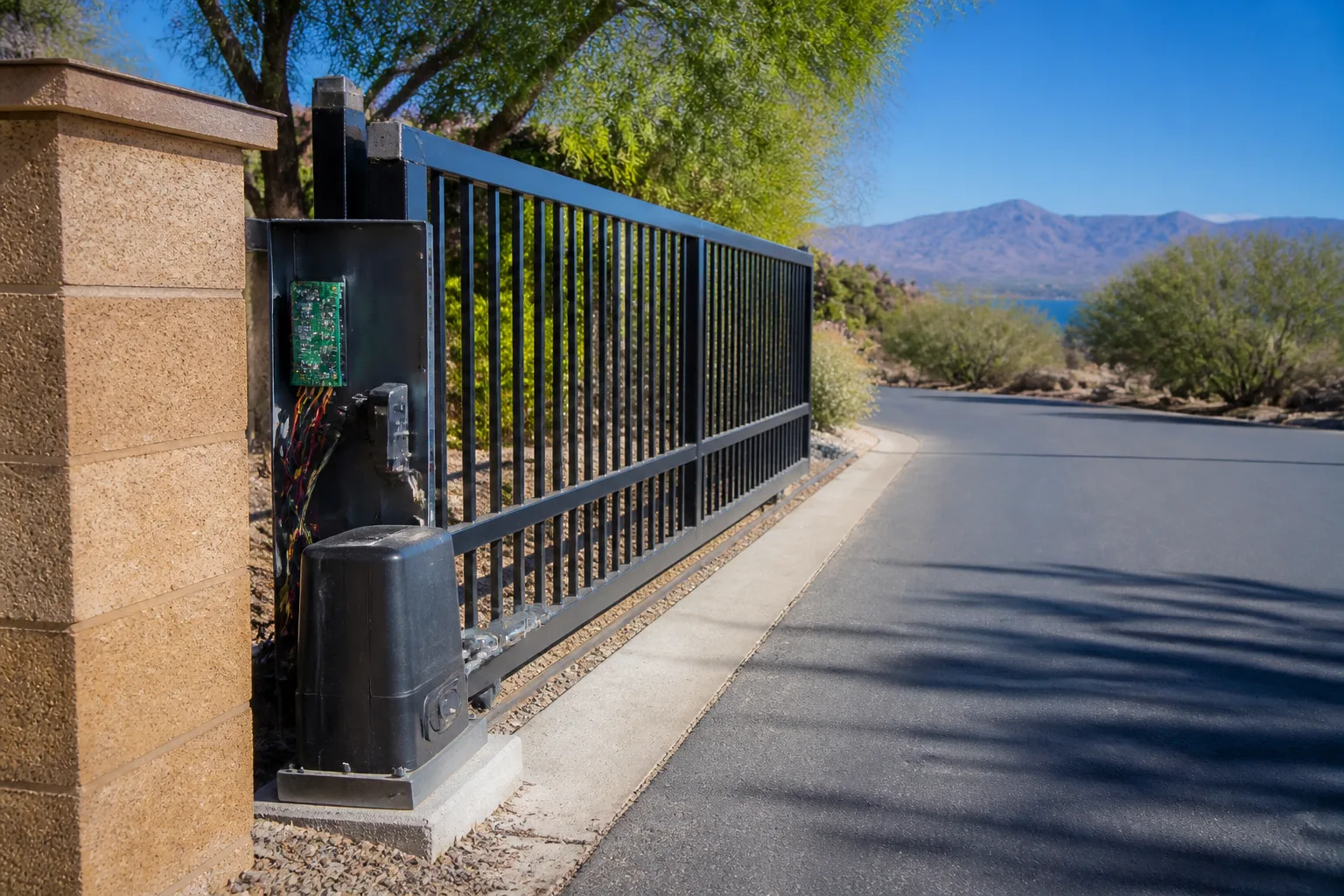
BFT Gate Repair in Boulder City: A Homeowner’s Guide
A BFT gate operator can flash a limit-switch or position error while the real problem is a worn rack gear that slips just enough to confuse the encoder. That one gap in diagnosis sends more Boulder City homeowners down the wrong road than any other fault we see on these systems. The board is telling the truth as it understands it. The trouble is that it’s reading position, not wear, and a slipping gear looks like a wiring fault until someone with BFT-specific training puts hands on it. If you’d rather not chase a code across the desert heat, call (888) 276-7609 and we’ll sort out what the automation is actually reporting.
How BFT’s encoder position system actually works
Older gate operators used mechanical limit switches: physical contacts that trip when the gate reaches a set point. BFT moved to an encoder-based position system, where the control board counts pulses from a sensor on the motor shaft to know exactly where the gate sits at every inch of travel. That’s genuinely more precise. It lets the board slow the gate on approach, reverse cleanly on obstruction, and hold a consistent open and closed position. It also means the board trusts its own position count over anything physical it can’t see.
Here’s where Boulder City conditions matter. Our dust is fine and it gets everywhere. It settles into the rack gear, mixes with whatever lubricant is on it, and turns into a mild abrasive paste. Over a few seasons that wears the teeth. When a tooth slips, the gate travels a fraction of an inch without the encoder registering the expected pulse. The board reads that missing pulse as a position error. Depending on the model, you’ll see a code pointing at the limit switch, the encoder wiring, or a travel calibration fault, and none of those are the worn gear sitting right in front of you.
In our experience, the fix is usually mechanical. New rack section, correct lubrication, clean encoder signal. What homeowners get quoted instead, all too often, is a control board replacement or a full rewiring job that never touches the real cause.
The BFT fault codes Boulder City dust and heat trigger most
Heat and grit don’t create every BFT fault, but they create a reliable handful. The DEIMOS and VIRGO lines show up on Boulder City driveways constantly, and a few codes come up again and again. Here’s what each one usually means in plain language:
- Limit switch or position fault: The board lost track of where the gate is. Most often a worn rack, a slipping gear, or debris in the rack channel, not a failed switch.
- Encoder error: The board isn’t getting a clean pulse count. Usually a dirty or loose encoder connection, or a motor that’s straining because the gate is binding.
- Obstruction or reverse fault: The gate met resistance it didn’t expect. In summer heat, a gate that swelled in its frame or a hinge that dried out will trigger this as readily as a real obstruction.
- Motor overload or thermal fault: The operator shut down to protect itself. Our July afternoons push these units hard, and a gate that’s fighting drag will overheat faster than the manual suggests.
Every one of these codes is a symptom, not a diagnosis. The board reports what it measured, and the measurement is only as good as the mechanical condition feeding it. That’s the whole reason brand-specific training matters here. A technician who knows BFT boards reads the code, then checks the rack, the hinges, the gate frame, and the encoder in that order before reaching for a replacement part.
Why BFT’s plug-and-play wiring can fool an unqualified installer
BFT designed these systems to be installer-friendly. The wiring harnesses are keyed and plug-and-play, so a competent tech can connect the operator, the safety edges, and the access control without much guesswork. That’s a real benefit when the installation is done correctly. It’s a trap when it isn’t.
Getting the wires connected is the easy part. Commissioning is where the work actually lives. That means setting the encoder travel points, tuning the reverse sensitivity to the weight and speed of your specific gate, programming the safety-edge response so the gate reverses on contact rather than stopping dead, and confirming the battery backup behaves the way the board expects. Those steps require knowing the BFT programming menu and understanding what each parameter does. An installer who plugs everything in and walks away leaves you with a gate that opens and closes, right up until it doesn’t.
We’ve pulled boards out of gates where a general handyman had swapped wires to “fix” a code, and the board was fine the whole time. The gate frame was two inches out of plumb and binding on the post. That’s not a wiring problem, and no amount of reconnecting harnesses was going to solve it. BFT certification exists for a reason: the commissioning work is what separates a working gate from a gate that works correctly.
Battery backup on BFT units: why a voltage test can lie
BFT operators prioritize power during an outage in a specific way: the board sheds non-essential functions first and reserves battery capacity for safe travel and obstruction detection. That’s smart design. It also puts a different kind of demand on the battery than a simple voltage check will reveal.
A battery can read a healthy voltage on a multimeter and still fail under BFT’s load. Voltage tells you the battery is charged. It doesn’t tell you the battery can deliver the current the motor needs when the board calls for a full open cycle under load. In our experience, this is one of the most common false passes we see. The homeowner’s been told the battery is fine, then the gate dies mid-cycle during the next outage and leaves them locked in or locked out. The right test loads the battery and watches how it performs, or simply times the gate through a few cycles on battery power alone.
Boulder City’s temperature swings age batteries faster than people expect. A battery that served fine last summer is not guaranteed to carry you through the next one. If your BFT gate only gets tested during an actual outage, you’re finding out the hard way.
Genuine BFT parts versus gray-market substitutes
BFT systems depend on matched component tolerances. The encoder, the control board, and the motor are designed to work together, and a substitute part that’s “close enough” on paper can throw the whole system off. Gray-market boards and clone encoders show up online at prices that look like a bargain, and they cause a specific kind of trouble: the gate runs, but the position count drifts, the reverse sensitivity is inconsistent, and you get intermittent codes that make no sense.
Here’s how to tell what you’re getting:
- Check the part number against BFT’s official documentation for your specific model. The DEIMOS and VIRGO lines have distinct boards and encoders that aren’t interchangeable.
- Look at the packaging and labeling. Genuine BFT parts carry clear branding and part numbers. Clones often have vague or missing labeling.
- Ask about the source. A reputable gate company will tell you where the part came from and stand behind it. A written guarantee is the proof.
- Watch for pricing that’s too far below market. A control board at half the going rate is not a control board you want feeding your gate.
We work with nine automation brands, including DoorKing and LiftMaster alongside BFT, and the parts-matching problem exists across all of them. It’s worse on BFT because the encoder logic is so dependent on clean, consistent readings. Put a clone part in and you’ve built the fault codes back in.
When to call a pro in Boulder City
Some things a homeowner can handle: clearing debris from the rack channel, keeping the gate track swept, checking that the safety edges aren’t obstructed by a fallen branch after a windstorm. Those are weekend tasks. Others are not. Wiring, control board work, and anything involving the operator’s electrical supply belong with a trained professional, for the plain reason that gate automation runs on household current and a gate that moves under its own power can hurt someone if the safety systems aren’t set right.
Call us when you see a fault code you’ve cleared twice and it keeps coming back. Call when the gate reverses for no reason, when the battery backup has never actually been tested, or when the gate is straining or dragging. Call when you’ve had a technician out once and the same code returned. That last one is the most common call we get, and it usually traces back to a mechanical fault that got treated as an electrical one.
For gate repairs beyond the automation, we handle hinges, welds, and the frame itself. You can read more on our Ironworks Gate Co. Boulder City home page, and if you’re near the neighboring communities, our Gate Repair in Winchester and Gate Installation in Winchester pages cover the same work. For operator issues, Gate Motor & Opener in Winchester explains how we handle automation and access control.
Every repair we do comes with upfront pricing settled before any work starts, so the number you agree to is the number on the bill. And every job is backed by our written 90-Day Done Right Promise: if it isn’t right, we come back and make it right.
The Bottom Line
BFT automation is good equipment. The encoder position system, the battery management, the matched components, all of it is designed to work precisely. That precision is exactly why a code can point you in the wrong direction. The board reports a position problem; the cause is often a worn rack, a binding frame, or a dry hinge that Boulder City dust and heat have been working on for years. Reading the code correctly and checking the mechanics before replacing electronics is the difference between a repair that lasts and a bill you pay twice.
If you’re in Boulder City and need help, Ironworks Gate Co. Boulder City offers free estimates. Call (888) 276-7609 and a live person will answer, any hour, any day. We’ll tell you what the code likely means, what to check, and what it will cost before a single bolt is turned.
Frequently Asked Questions
It usually means the board lost track of the gate’s position, and the cause is more often mechanical than electrical. A worn rack gear that slips, debris in the rack channel, or a gate binding in its frame will trigger the same code as a failed switch. That’s why the repair starts with the mechanics, not the wiring.
Yes. Voltage tells you the battery is charged, not that it can deliver the current the motor needs under load. Under BFT’s power-management scheme, the battery has to carry safe travel and obstruction detection during an outage, and a weak battery will fail that demand even with a healthy voltage reading. The real test loads the battery or times the gate through cycles on battery power alone.
For the electrical wiring, control board, and commissioning work, no. BFT’s plug-and-play harnesses make connection easy, but the setup of encoder travel points, reverse sensitivity, and safety-edge response requires brand certification and an understanding of the programming. A handyman can clear debris and keep the track clean; the automation itself needs a trained hand.
Check the part number against BFT’s official documentation for your specific model, inspect the packaging and labeling, and ask where the part came from. Genuine BFT parts carry clear branding and part numbers, and a reputable gate company will stand behind the part in writing. Pricing far below market is a red flag.
Written by the team at Ironworks Gate Co. Boulder City.
Need Gate Repair Help?
Call Ironworks Gate Co. Boulder City - licensed & insured, here with fast after-hours help in Boulder City.
(888) 276-7609