
5 Mistakes to Avoid With Gate Motor & Opener
Resetting a gate opener’s fault code without reading what it said is the single most expensive habit in residential gate ownership. It clears the warning, runs the motor straight back into the same failure condition, and turns a $150 repair into a $600 board replacement. The five mistakes below don’t happen during the emergency call. They happen quietly, during normal ownership, long before anything breaks. Here’s what to watch for, and if you’d rather hand it to someone who’s seen every version of these failures, call (888) 276-7609.
1. Clearing Fault Codes Without Reading Them First
A flashing LED or a diagnostic code on the control board is the motor telling you something specific. Linear and DoorKing boards, in particular, hand you a code that points to a real component: a limit switch that isn’t reporting, a photo-eye that’s losing its signal at dusk, a current-sense trip that says the gate is working harder than it should. If you press reset or cycle the power without noting which code came up, you’ve thrown away the cheapest diagnostic information you’ll ever get.
Some codes are a courtesy warning. Others are the last thing the board says before it fails. A recurring current-sense trip, for example, often means a hinge is binding or a roller is seizing, which loads the motor beyond its rating. Ignore it and the winding insulation breaks down run after run. In Boulder City, where summer heat already pushes the control board toward its thermal limit, that breakdown happens faster than most homeowners expect. We’ve pulled boards that failed within 18 months of the first ignored trip code.
What to do instead:
- Write the code down before you touch anything, along with what the gate was doing when it appeared.
- Check the manual for that brand’s code table, or call and describe it. A live person can usually tell you whether it’s a sensor issue or something more serious.
- Fix the cause, then clear. Never clear first and hope.
2. Running the Motor on the Wrong Power Supply
Residential gate motors are built to a voltage tolerance, and they expect to see it. When the supply sags, the motor draws more current to produce the same torque, and that extra current heats the windings. Neither the board nor the motor complains out loud. The gate just gets a little slower, then a little slower again.
In Boulder City, supply voltage tends to drop during peak summer demand, when every air conditioner on the block is running at once. A motor on a marginal circuit or a long undersized run feels that sag every afternoon. Over 18 to 24 months, the cumulative heat degrades the winding insulation, and one day the motor won’t start at all. The homeowner assumes the motor “just died.” It didn’t. It was cooked slowly.
What to check, not what to rewire yourself: confirm the motor is on a dedicated circuit sized for its rating, look for a supply that dips noticeably in the late afternoon, and have a qualified technician measure voltage at the motor under load. If the numbers are off, the fix is often upstream of the gate entirely. Getting that measurement right is part of why we carry certified service on nine leading brands, from Linear to Viking, so the diagnosis matches the equipment on your driveway.
3. Over-Lubricating the Rack-and-Pinion Drive
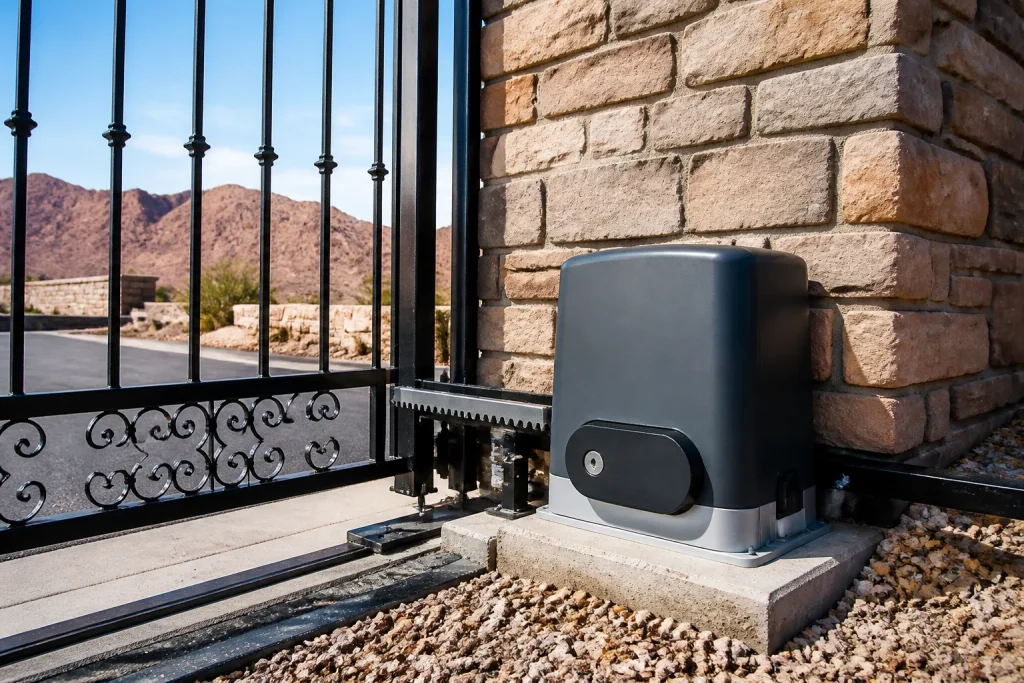
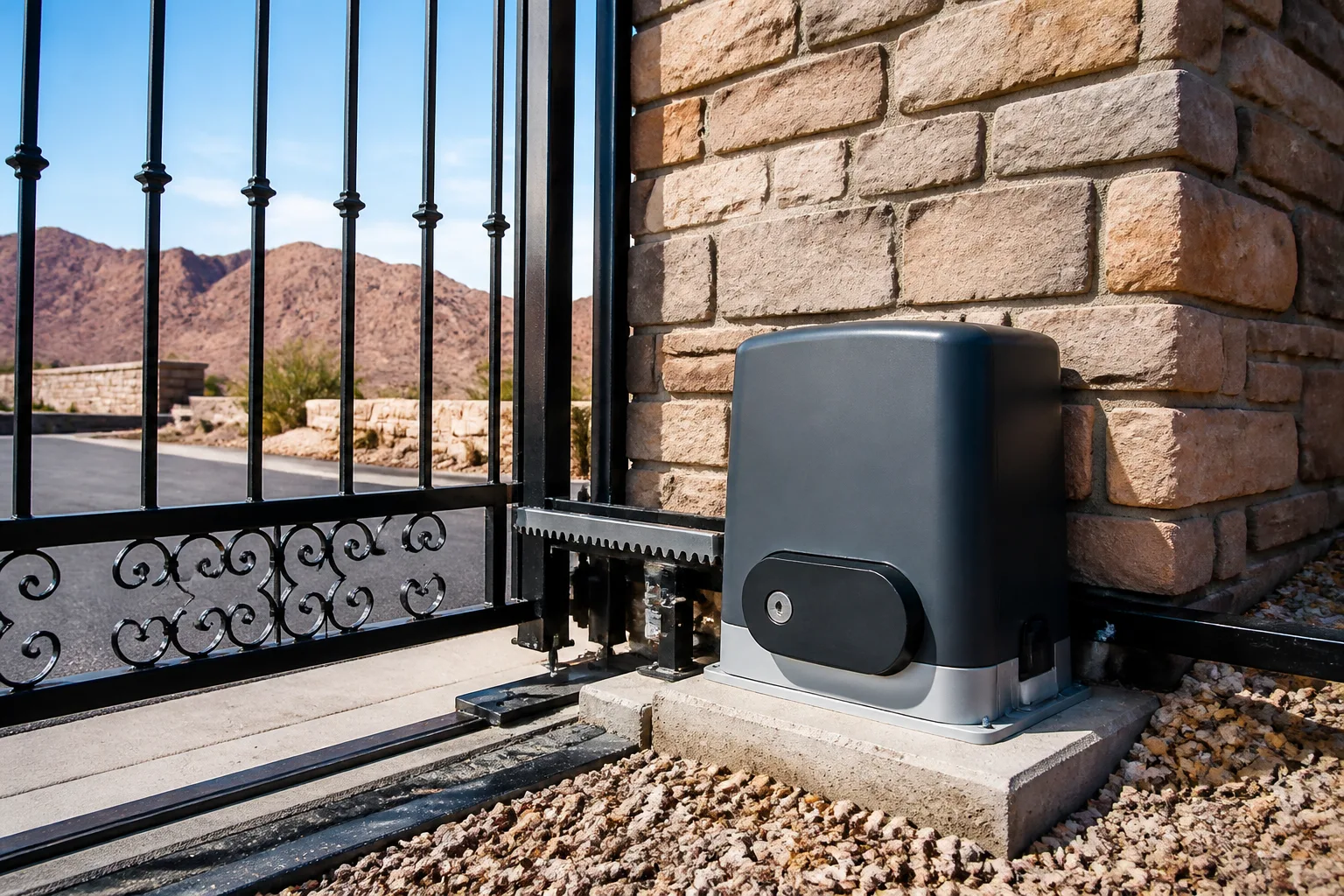
The one lubrication point that matters most on a rack-and-pinion drive is the pinion gear where it meshes with the rack. That’s it. That’s the spot. Most gate failures we see from “maintenance” come from too much grease in the wrong place, not too little.
Here’s the local reality: Boulder City sits in caliche country. That pale, cement-like soil dust is fine, abrasive, and everywhere when the wind picks up. Grease a rack with the wrong product, especially a heavy automotive grease, and you’ve built a dust magnet. The caliche sticks, the paste grinds between pinion and rack, and the drive wears faster than if you’d left it dry. A light application of the manufacturer-specified lubricant, wiped on and excess removed, keeps the mesh clean and the gate quiet. A thick coat does the opposite.
Ghost Controls and Viking drives both benefit from a seasonal check of the pinion mesh and a cleaning before any fresh lubricant goes on. If you’re not sure what your unit calls for, our Seasonal Tune-Up covers exactly this: clean, inspect, lubricate correctly, and note anything headed downhill before it becomes a repair.
4. Ignoring Duty Cycle and Abusing the Motor
Every residential gate motor is rated for a duty cycle: how many cycles it can run in a given window before it needs to cool. A busy weekend, with family arriving and leaving, kids running in and out, and a delivery or two, can push a residential unit past its rating without anyone noticing. Back-to-back cycles mean the motor and the control board never get their cool-down, and heat builds in both.
What adequate cool-down looks like in practice:
- Space out multiple open-close cycles during peak visiting hours; don’t send the gate through five full cycles in ten minutes.
- Let the motor rest between cycles rather than holding the gate open and closed repeatedly to test something.
- Watch for a motor that feels hot to the touch or slows noticeably after several cycles. That’s a sign you’re at or past the limit.
If you’re in Boulder City and your gate gets that kind of traffic regularly, it may be time to talk about a unit rated for heavier use. That’s a conversation, not a sales pitch.
5. Replacing a Remote or Receiver With a “Universal” One
A universal remote is a false economy. Gate openers run on specific frequencies and protocols, and a universal unit that “works with everything” often works reliably with almost nothing. The symptom looks like an antenna problem or a wiring fault: intermittent operation, a gate that opens from the driveway but not from the house, a remote that works one day and not the next.
What’s actually happening is frequency drift and a protocol mismatch. The receiver and remote aren’t quite speaking the same language, so the signal lands only under ideal conditions. A technician chasing the wrong diagnosis will spend time on the antenna and the wiring, replace them, and the problem stays. We’ve seen this misdiagnosed more than once, including a job where the “antenna fault” turned out to be a mismatched receiver installed two owners ago.
The correct fix is a receiver and remote matched to your specific opener, whether that’s a Linear, a DoorKing, or another unit. It costs a little more up front and saves a string of return visits. If you’re not sure what your opener needs, the Free Second Opinion on Any Written Estimate applies here: bring us the quote, we’ll tell you whether the proposed parts actually match your unit.
When to Call a Pro
Reading fault codes, checking voltage under load, and matching a receiver to its opener are jobs for a trained technician, not a weekend project. Gate motors carry real electrical current, and a gate that closes unexpectedly is a genuine hazard. When the warning signs point to a board, a winding, or a power run, that’s our work. From hinges and welds to keypads and automation, we handle it in a single visit wherever possible, with the price agreed before a single bolt is turned. Every job is backed by our written 90-Day Done Right Promise, and a live person answers the phone around the clock.
Related services in Boulder City: if your opener needs a closer look or you’re considering new automation, see Gate Motor & Opener in Winchester for the full scope, and start at our Ironworks Gate Co. Boulder City home for everything else.
The Bottom Line
The five costliest mistakes with a gate motor all happen between service calls, not during them. Read every fault code before you clear it. Respect the power supply, especially through a Boulder City summer. Lubricate the pinion sparingly and with the right product, not with a heavy grease that invites caliche dust. Give the motor its cool-down. And match any remote or receiver to the opener you actually own. Get these right and most residential units will outlast their warranty and then some.
If you’re in Boulder City and need help, Ironworks Gate Co. Boulder City offers free estimates. Call (888) 276-7609, and a live person will pick up. For repair, installation, or a second opinion on a quote you’ve already got, we’ll be there when we say.
Frequently Asked Questions
Check the diagnostic code every time the board shows one, before you clear it or cycle the power. Write it down along with what the gate was doing at the time. Some codes warn of a failing component; others are the last signal before a board fails. Reading them is the cheapest form of maintenance there is. Call (888) 276-7609 if you’re not sure what a code means.
Heat and voltage sag are the usual culprits. In Boulder City, peak summer demand drops supply voltage, and the motor draws more current to compensate, which heats the windings. Add the ambient heat of a garage or control box, and a marginal unit fails faster. If your gate slows or trips more in July and August, that’s worth checking before the motor gives out.
You can, but it’s a false economy. Universal remotes often suffer frequency drift and protocol mismatches that cause intermittent operation, and those symptoms get misdiagnosed as antenna or wiring faults. A receiver and remote matched to your specific opener costs a bit more and avoids a run of return visits.
Only the lubricant your manufacturer specifies, applied lightly to the pinion mesh, with excess wiped off. Heavy grease attracts caliche dust during Boulder City’s windy stretches, and the abrasive paste that forms wears the drive faster than running dry. When in doubt, clean first and apply sparingly. Our Seasonal Tune-Up covers this correctly.
Written by the team at Ironworks Gate Co. Boulder City.
Need Gate Repair Help?
Call Ironworks Gate Co. Boulder City - licensed & insured, here with fast after-hours help in Boulder City.
(888) 276-7609