
Last updated November 17, 2026
 Wrought iron
 Wood & steel frame
 Farm & ranch
 Sliding driveway gates
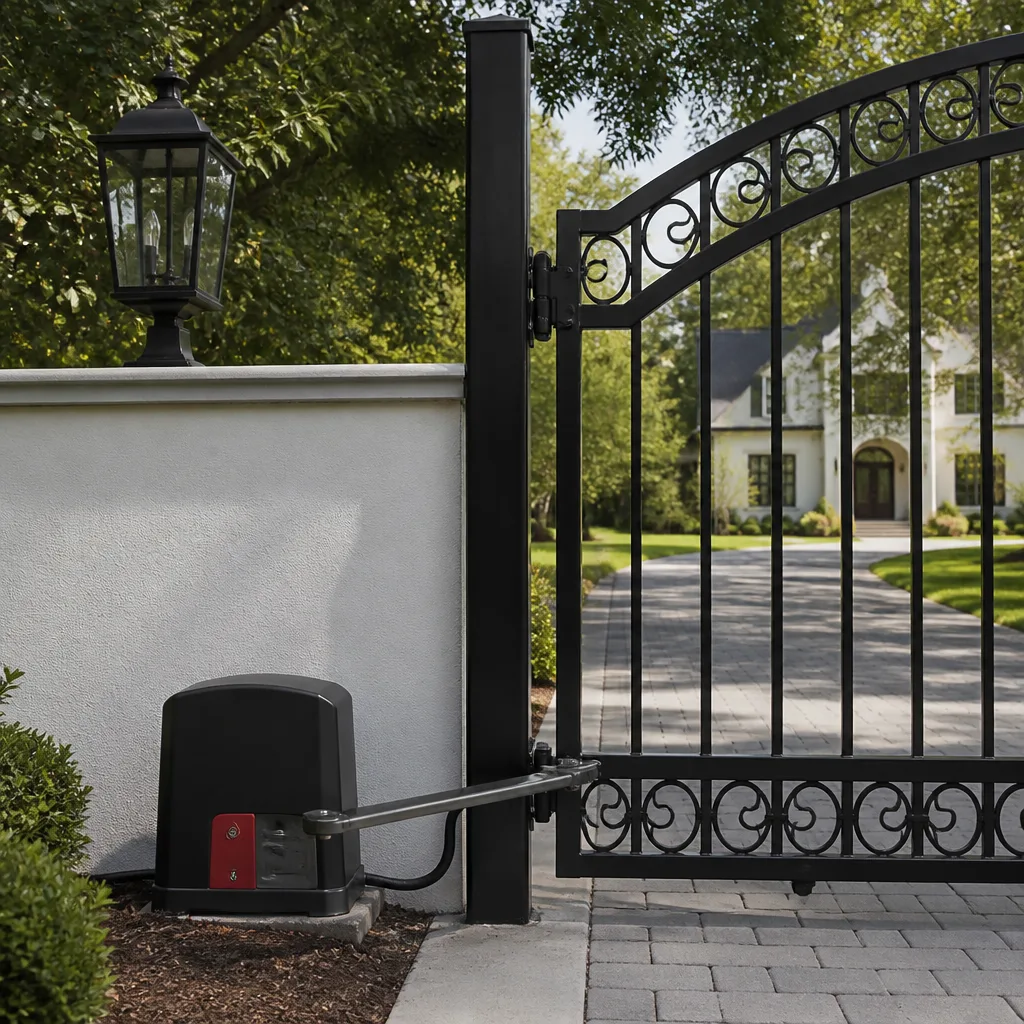 LiftMaster operators
Free on-site gate assessment - hinges, posts, and your LiftMaster or Nice gate operator checked before anything is quoted
The assessment is free and the quote is the invoice.
Get your free estimateGate Parts & Welding Warning Signs Every Homeowner Should Know
There’s a rust stain that means something specific, and most homeowners walk right past it. Orange bleeding that shows up at a weld joint before it shows up anywhere else on the gate tells you the weld’s heat-affected zone is corroding from the inside out. The heat of welding changes the metal’s structure, and that changed zone is the first part of a joint to go. The stain can sit there for a year and a half before the joint actually fails. We see it constantly on older gates around Boulder City, and almost nobody has been told what it means until we point it out. This guide covers the five visible signs of weld fatigue, why the same orange stain means two very different things depending on where it sits, what hinges and posts telegraph before they let go, and a 60-second monthly walk-around you’ll actually do.
Quick Answer
Gate parts and welds fail in predictable order, and the warning signs are visible for months before the gate stops working. Weld-zone rust at a joint, cracked paint at a hinge, a changed gap where the gate meets the post, soil heaving around the post base, and a swing that suddenly needs a hand to finish are the five signals to watch. Catch them early and the repair is small. Ignore them and you’re replacing a gate that was structurally fine a season ago.
Styles & brands we work with
- Wrought iron
- Wood & steel frame
- Farm & ranch
- Sliding driveway gates
- LiftMaster operators
Table of Contents
- The Five Visible Warning Signs of Weld Fatigue
- Weld-Zone Rust vs. Surface Rust: Same Stain, Different Meaning
- Hinge Warning Signs: Paint Cracks, Gap Geometry, and Swing Resistance
- What Post Movement Looks Like From Ground Level
- What to Check and What to Leave to a Welder
- The 60-Second Monthly Walk-Around Inspection
- When a Gate Part Can Be Fixed and When It Should Be Replaced
The Five Visible Warning Signs of Weld Fatigue
Almost every structural gate failure we’ve been called to in Boulder City announced itself months in advance. Welds don’t snap without reason. They fatigue, then crack, then let go, and each stage leaves visible evidence if you know what you’re looking at. Here are the five signs, in the order you should look for them.
- Weld-zone rust bleed. Orange staining that starts at the joint itself, not on a broad panel nearby. The heat-affected metal around a weld is more prone to corrosion than the surrounding steel, so that’s where pitting and material loss begin.
- Filiform rust webbing. Fine orange lines that crawl outward from a weld like veins under the paint. This is corrosion spreading along the metal under a paint film that has already lost adhesion around the joint.
- Hairline cracks at the toe of the weld. A short, thin crack where the weld bead meets the base metal. If you can see daylight through it when the gate is open, the joint is carrying load through a crack, not through steel.
- Paint lifting in a halo around a weld. When the paint blisters and peels in a ring around a joint while the rest of the panel holds, the joint has been flexing under the film.
- Rattles or a bell-tone clunk when the gate stops. A weld that has lost section thickness sounds different. If the gate used to hit its stop with a solid thud and now chatters, the joint geometry has probably loosened.
The urgency differs by sign. Filiform rust and lifting paint are early, measured-in-months problems. A visible hairline crack at the weld toe or a rattle under load is measured in weeks. If you’re unsure which one you’re looking at, a professional evaluation is cheap compared to a gate that drops a leaf onto a driveway in Boulder City.
Weld-Zone Rust vs. Surface Rust: Same Stain, Different Meaning
Not all rust on a gate is created equal, and this is where homeowners get into trouble. A broad patch of orange on a flat panel is usually surface corrosion from a scratched paint film. Clean, prime, and repaint it and you’re fine. A smaller orange stain at a weld is a different animal. Two identical-looking orange marks can have opposite urgency depending on their location.
- Surface rust on flat steel: cosmetic erosion of the outer surface, typically caused by a chip, a scrape, or salt exposure. It rarely affects load-bearing capacity on its own.
- Rust at a weld joint: corrosion starting inside the joint’s heat-affected zone. The welding process changes the crystal structure of the metal right next to the bead, and that changed zone becomes the least corrosion-resistant part of the joint.
- Rust where a rail meets a stile: a mechanical joint or weld that carries the leaf’s weight. Corrosion there undermines how the leaf holds its shape, not just how it looks.
- Rust pitting the paint from underneath: the tell is that the paint looks intact but bumps up in tiny points. By the time the paint opens, a lot of material has already gone.
Boulder City’s dry, high-desert climate lowers overall corrosion rates compared to coastal areas, and homeowners often lean on that fact. The flip side is that irrigation overspray, sprinkler mist hitting the gate hinge-side post, and winter runoff that dries repeatedly against the joint all concentrate moisture at the exact weld-zone spot that’s most vulnerable. We’ve seen joints on a twenty-year-old Boulder City gate lose years of life because a sprinkler head had been quietly wetting a single weld.
Hinge Warning Signs: Paint Cracks, Gap Geometry, and Swing Resistance
Hinges go before welds do. The hinge is where every day’s movement gets concentrated, and a bad hinge can crack the weld on the door panel that carries it. Three signals run together as a set, and any one of them by itself is a small problem. Two or more at the same time means a hinge failure is coming.
1. The paint crack pattern
Look at the paint right where the hinge plate meets the gate frame. A single short crack that appeared recently is usually a stress mark. A fan of fine cracks radiating out from the bolt heads or from where the plate is welded on means the hinge has been flexing against the frame for a while. Vertical cracks above and below a hinge barrel on a steel post are the classic signature of a hinge that has pulled its bolts loose and is leveraging the post.
2. The gap geometry change
Stand at the closed gate and look at the gap between the leaf and the hinge-side post. The gap should be even top to bottom. If the bottom gap has opened 1/4 inch or more compared with the top, or if the top gap has closed while the bottom opened, the leaf has shifted on its hinges. That’s a structural change, not a lubrication issue. Photograph the gap once, then check it again in thirty days. A gap that changes month to month means the hinge is the failure point.
3. The swing resistance increase
A gate that used to swing freely and now needs a nudge to finish closing is telling you something. If the leaf resists when you push near the outer edge but moves freely near the hinge side, the leaf has dropped on the hinge and is dragging. A gate operator fighting that same resistance will burn out faster, which is why we check hinge drag first on any automatic gate service call in Boulder City. An opener paired with FAAC or Viking hardware is built to handle a normal load, not a leaf that’s scraping along the ground.
Many homes in the older residential streets around Boulder City have driveways pitched toward the street, so the gate leaf naturally wants to swing open. That’s a fine feature until hinge drag starts working in the same direction.
What Post Movement Looks Like From Ground Level
Posts don’t move overnight. They creep, and the ground around them tells the story. When we arrive at a Boulder City property with a gate that’s sagging at the latch, a post inspection is the second thing we do after checking the hinges. Here’s what to look for at ground level.
- Cracks in the concrete running diagonally away from the post base. A single 45-degree crack is a warning. Three or more radiating from the base means the post has rotated or lifted against the slab.
- Gaps between the slab and the post baseplate. Slide a screwdriver blade under the plate. If you can slide it in more than a coin’s thickness anywhere around the perimeter, the base has lost bearing and the post is being held by its bolts, not by the slab.
- Soil ring around the post’s concrete pier. On gates with a poured pier, dirt mounded or a separation ring at the surface means the pier has shifted or the soil has settled away from it.
- A hairline gap between the post and a fence panel attached to it. Wood fence panels pulling away from a steel post sit right next to a gate problem that’s coming.
- Latch alignment drift. The latch used to snick closed and now needs a lift to seat. That drift is often measured in millimeters per month and points straight at a post that’s moving.
Post movement is the most expensive warning sign to ignore. A re-set of a post is a measured, planned job. A post that moves far enough to drop a gate leaf means frame damage, hinge damage, and often a call to replace the whole gate, all of which is avoidable with a check every month.
What to Check and What to Leave to a Welder
A homeowner can spot and document every warning sign on this page. What a homeowner should not do is weld on a load-bearing gate joint, cut into a hinge weld, or attempt to re-seat a post baseplate that has lost bearing. Welding under load on a hanging gate, cutting out a weld on a joint that is carrying the leaf’s weight, and opening up a rusty joint are all quick ways to be underneath a falling leaf. Spring and cable assemblies on gate operators, and any low-voltage wiring, are the same story. Those are trained-professional work.
What you can absolutely do is photograph the joint, the hinge, the gap, and the post base, date the photos, and call. That’s the entire safe scope. We’ve seen more than one homeowner make a gate worse by running a fresh bead over a rusted weld without cutting back to sound metal, which traps the corrosion instead of fixing the joint. If the gate is motorized, don’t take the operator out of service to troubleshoot the weld yourself either, especially on Linear or BFT units where the limit cams are set at the factory and get lost the moment a homeowner starts turning them.
If a leaf or post has already started to move, don’t wait to see how far it goes. Gate repair in Winchester is the safe, licensed response for a moving post or a cracking weld, and the same standards apply throughout the Boulder City area.
The 60-Second Monthly Walk-Around Inspection
This is the entire inspection. Do it once a month, ideally the first Saturday, and it takes about as long as making coffee. It’s deliberately short because an inspection that takes twenty minutes doesn’t get done.
- Walk to the hinge side of the gate, eyes on the paint. Look for cracks radiating from the hinge plate and for cracks above and below the barrel. (10 seconds)
- Look at the gap between the leaf and the hinge-side post. Even all the way up, or has it changed since last month? (5 seconds)
- Open the gate slowly with one finger. Does it move freely, or does it drag somewhere between half-open and fully open? Then close it and listen to how it meets the stop. (10 seconds)
- Walk to each weld joint on the leaf: top rail to stile, bottom rail to stile, and the diagonal braces. Look specifically for orange staining, filiform webbing, and paint blisters. (15 seconds)
- Crouch at the hinge-side post base and look at the concrete. Any new diagonal cracks, any gap under the baseplate, any soil mound around the pier. (10 seconds)
- Photograph anything you flagged, with your hand or a shoe in frame for scale. That gives you a comparison next month and gives us a head start if you call. (10 seconds)
If the gate has an automatic operator, add one monthly item: with the operator in manual release, do the hinge-gap and swing-resistance checks the same day. An operator can mask hinge drag for months, because the motor just works harder. When the operator finally stops, the hinge has usually been failing for two seasons. For motorized gates, gate motor & opener service in Winchester covers the operator side once you’ve flagged a drag.
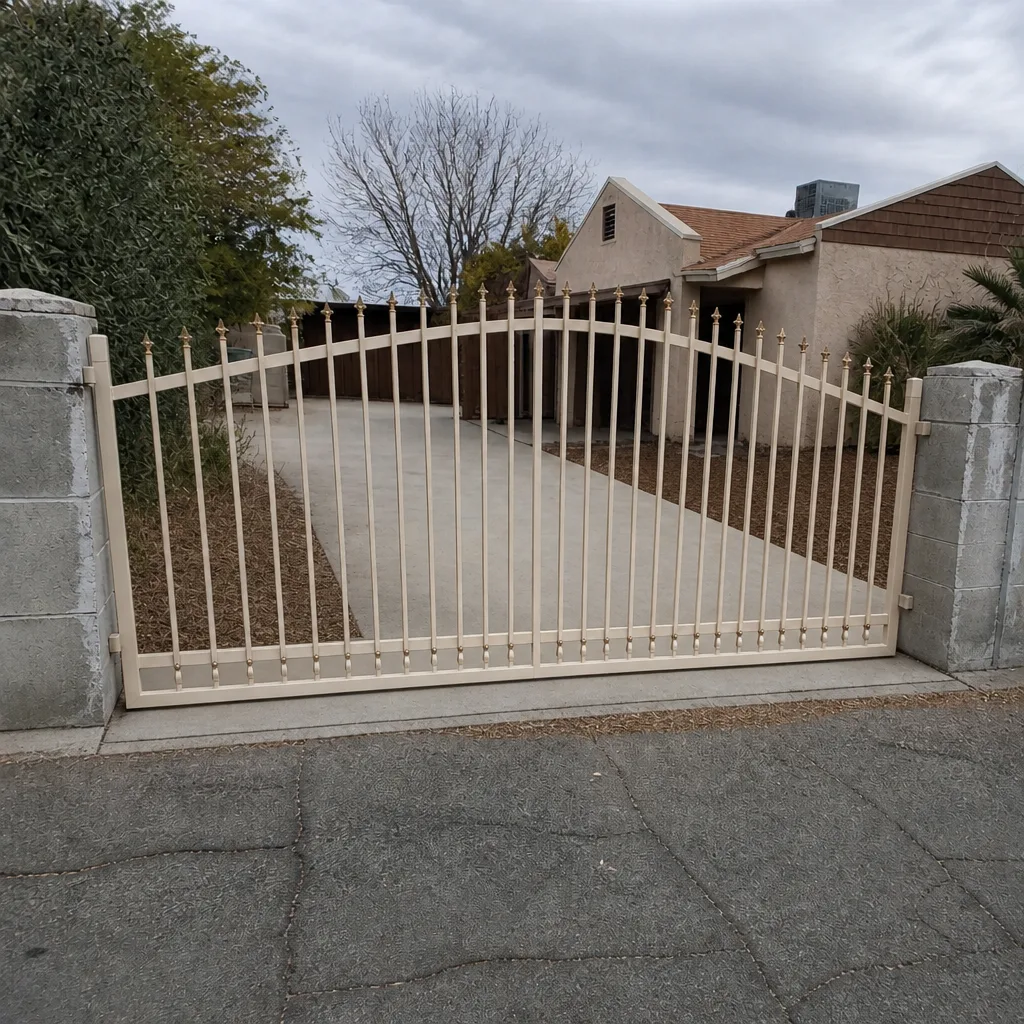
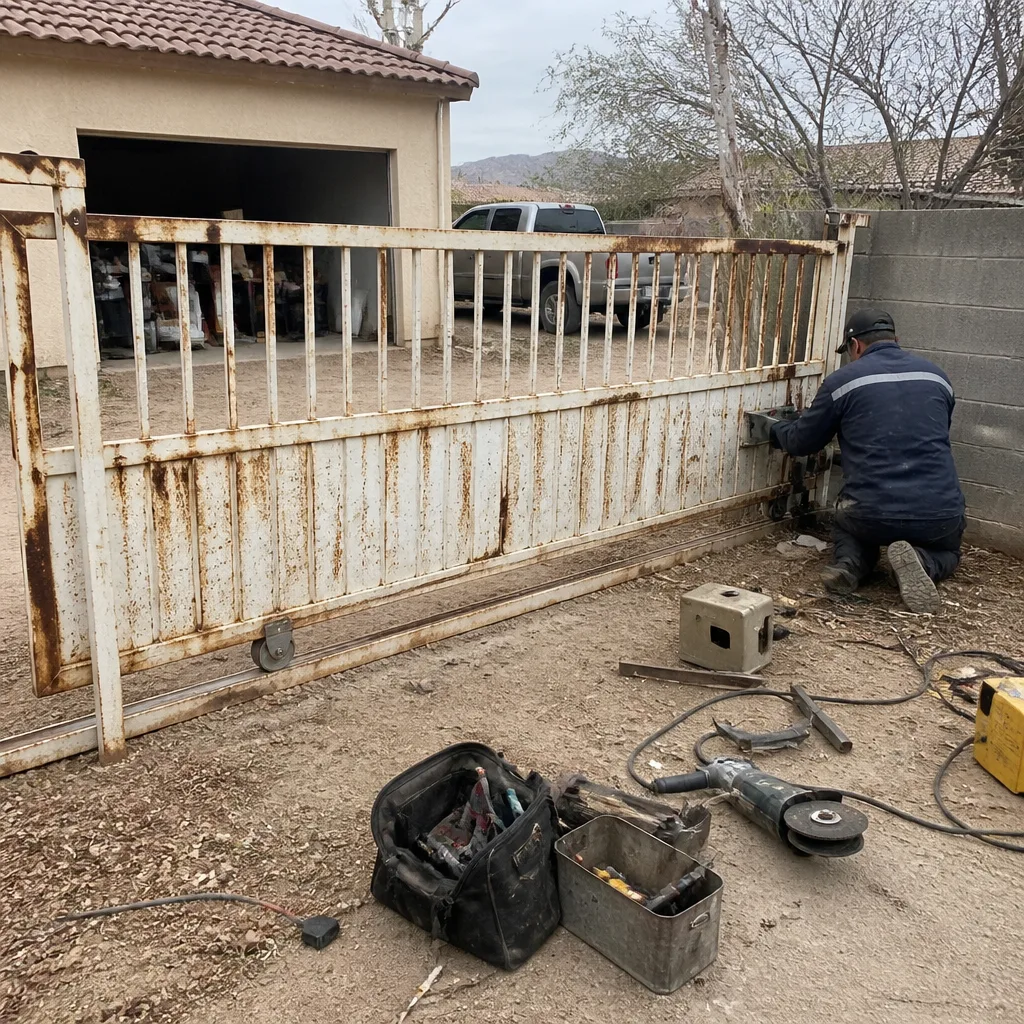
See the difference
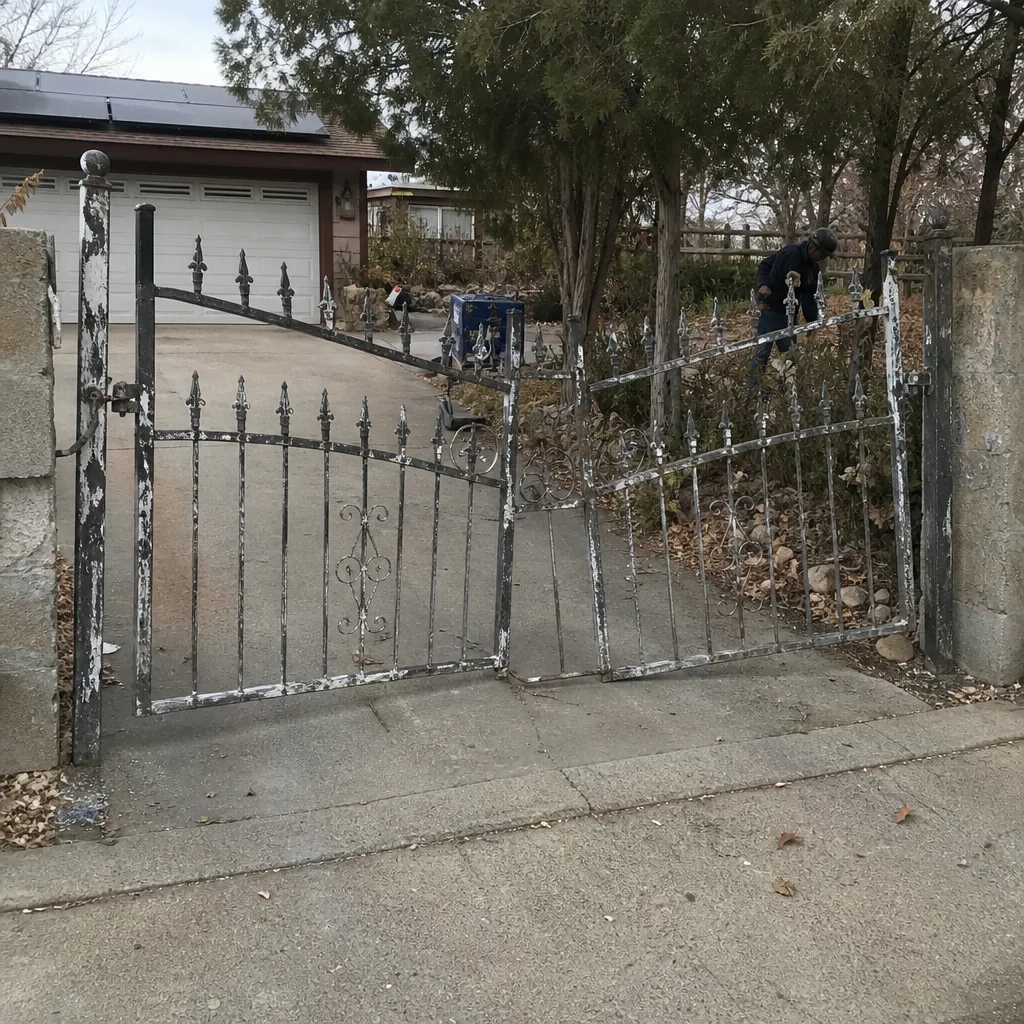 Before
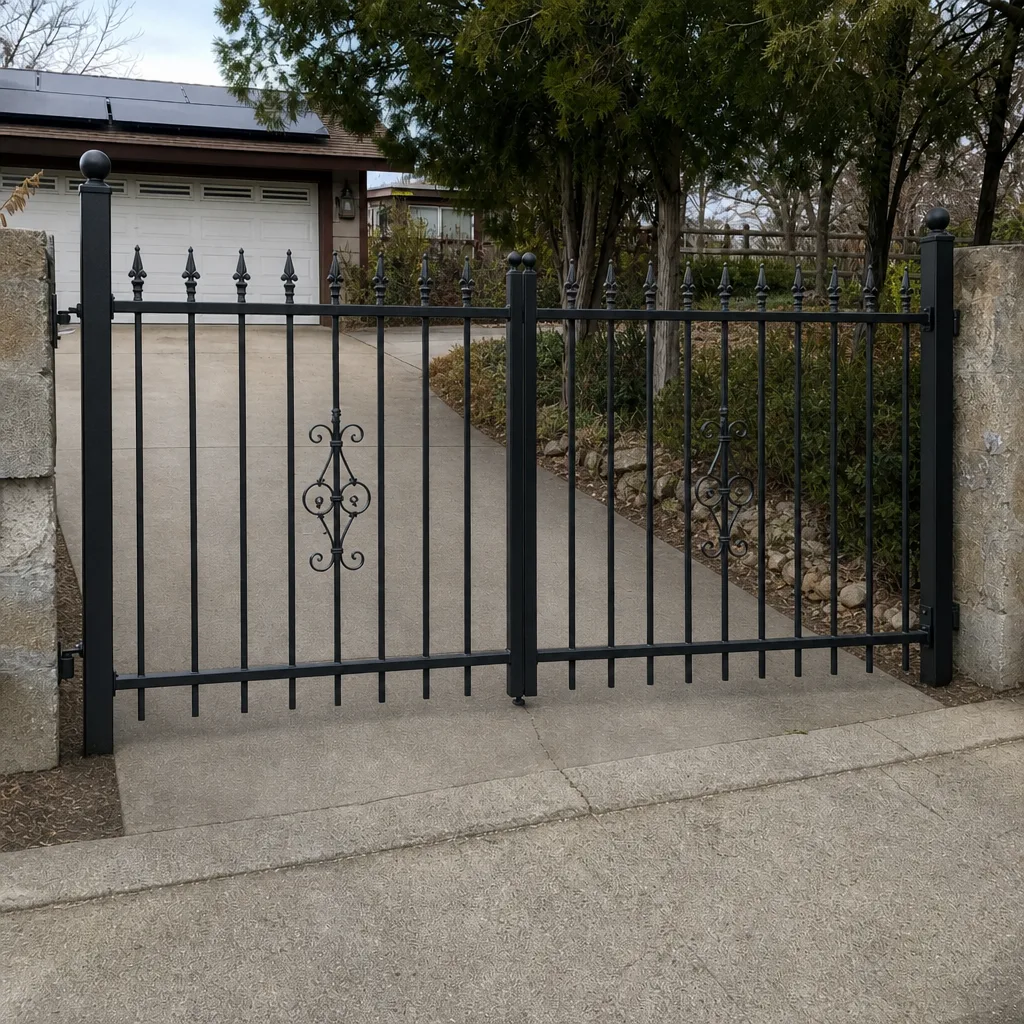 After
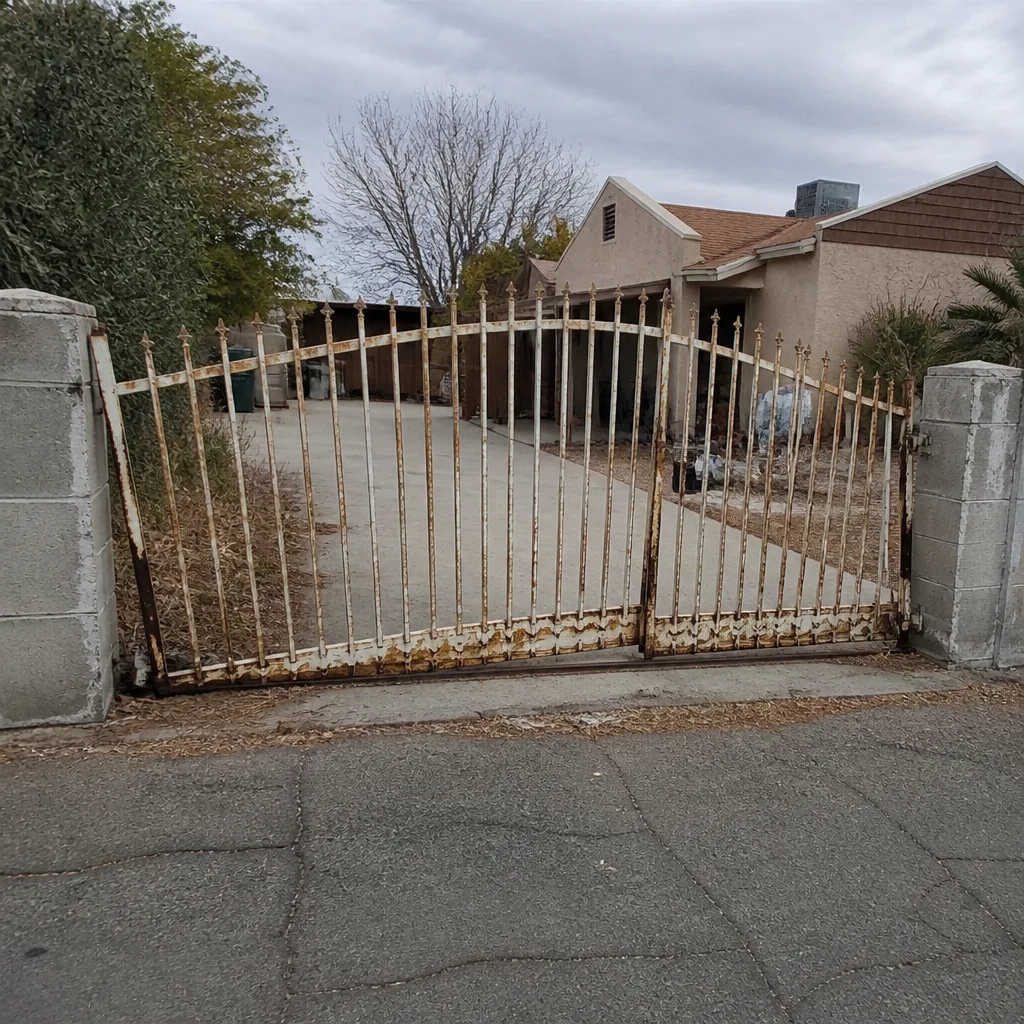 Before
 After
 Before
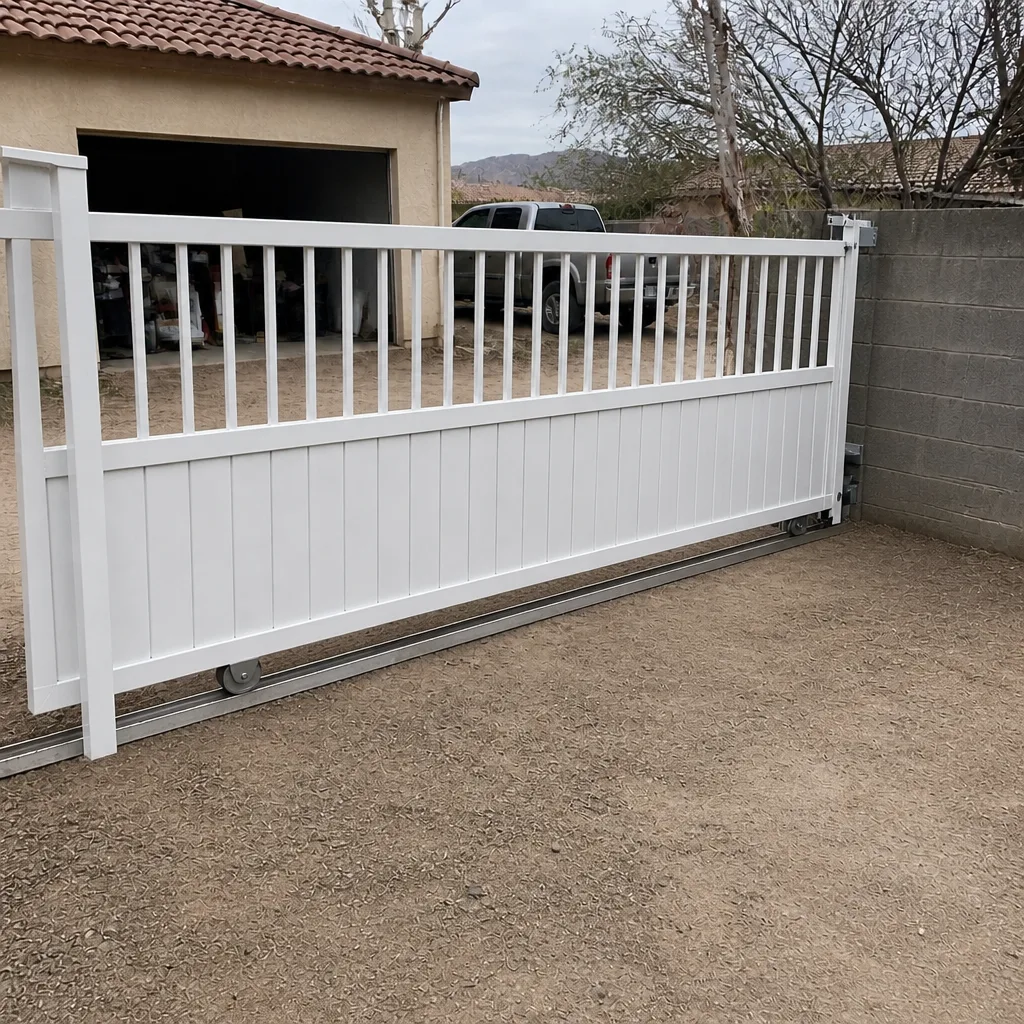 After
When a Gate Part Can Be Fixed and When It Should Be Replaced
Catching warning signs early almost always keeps the repair in the “fix” column. Here’s the split we use when diagnosing a Boulder City gate.
Fix it
- Surface rust only, welds intact underneath. Repaint and re-seal.
- Weld-zone rust caught early, sound metal still surrounding the bead. Cut back the corrosion, re-weld the joint, prime and paint.
- One hinge showing paint cracks and slight drag. Replace the hinge set before the leaf shifts further.
- Post base with a minor crack pattern but no gap under the baseplate. Monitor, don’t re-set yet.
Replace it
- Weld zone with visible section loss, i.e., the metal has actually thinned at the joint. A new weld won’t hold on unsound metal.
- Hairline crack at the weld toe is more than 1/8 inch long or has propagated past the joint. The joint has lost structural capacity.
- Post with a gap under the baseplate or three-plus radial cracks. The post needs a re-set, and that’s a scope beyond a repair.
- Two or more welds on the same stile failing at once. The frame geometry is compromised and repair cost often approaches replacement.
When a repair would mean patching three joints on a leaf that’s already structurally compromised, we recommend replacement and say so plainly. That’s the honest answer even though it’s a bigger job. For a full new gate or a major rebuild, gate installation in Winchester can walk you through what a measured, planned install looks like. You can also see the full range of gate work our team handles on the Ironworks Gate Co. Boulder City home page.
Common Mistakes to Avoid
- Painting over a weld-zone stain. Covering it hides the only evidence you have. Address the rust first, then paint.
- Treating a hinge-side crack the same as cosmetic paint damage. Crack patterns at a hinge are structural, and repainting them neither stops nor slows the failure.
- Greasing a hinge that’s actually dragging from a shifted leaf. Lubrication is for a free-swinging hinge with slight stiffness, not one where the leaf has dropped and is holding the gate up.
- Running a fresh bead over rusted metal. A weld laid over corrosion traps moisture and accelerates the failure. Cut back to sound metal or don’t do it.
- Ignoring a sprinkler head that oversprays a gate hinge. On Boulder City properties with timed irrigation, one misdirected head is a slow-motion hinge failure. Reposition it and the gate stops degrading.
- Skipping the operator’s manual release when checking hinge drag. An automatic gate hides hinge problems behind motor torque. Test the leaf by hand every month.
- Waiting for the gate to stop working before calling. By the time a gate won’t close, three warning signs were already there for months and the repair scope is usually double what it would have been.
When to Call a Professional
Call when you see orange staining at a weld joint, when a hinge-side paint crack appears in a fan pattern, when the gap between the leaf and post has changed since last month, when you can slide a screwdriver under a post baseplate, or when the gate needs a nudge to finish its swing. Call when a motorized gate is spinning more than it used to, when latch alignment has drifted, or when you’re simply not sure whether a rust patch is the cosmetic kind or the weld-zone kind. Those are all cases where a quick check saves real money. Ironworks Gate Co. Boulder City offers free estimates in Boulder City – call (888) 276-7609 and a live person will answer, day or night.
Frequently Asked Questions
The first sign is usually orange rust staining at the weld joint that appears before rust shows up on adjacent flat panels. The staining is concentrated in the heat-affected zone around the bead. If you see that pattern, photograph it and get a professional to look before the joint loses more metal.
Weeks, not months. A visible hairline crack at the toe of a weld means the joint is already carrying load through a crack rather than through sound steel. Waiting past a few weeks risks a sudden failure, especially on a gate that’s used daily. Call us for a same-week evaluation.
No. Broad rust on a flat panel is almost always a paint film problem, not a structural one. Rust at a weld, or rust webbing trapped under the paint in a small pattern around a joint, is a structural concern. The location matters more than the amount. Call (888) 276-7609 for an exact quote on it – estimates are free.
Not on a load-bearing joint, and not on a gate that’s still hung. Welding under load, cutting a weld on a leaf that’s suspended, and reopening a rusted joint all create a serious injury risk if the leaf drops. A hobby welder on a decorative, non-structural joint is a different conversation, but structural welds are a trained professional’s job.
Less often from general atmospheric humidity, but not immune. Boulder City’s dry high-desert air slows broad surface corrosion, but concentrated moisture from irrigation overspray, winter runoff against the hinge-side post, and afternoon sun causing paint expansion and contraction around welds can eat into joint life. We see joint-zone rust most often at the hinge-side post where sprinklers reach.
Usually yes, temporarily. A post re-set means the leaf comes off to let the post be squared and re-set properly. The good news is a planned re-set is a much smaller job than a gate that dropped because the post moved. Call (888) 276-7609 for a free estimate and we’ll tell you exactly what your post needs.
The Bottom Line
Gate failures are almost never sudden. Weld-zone rust at a joint, filiform webbing, hinge paint cracks, a changed leaf-to-post gap, and concrete cracks radiating from a post base cover the whole map of what’s coming. The 60-second walk-around catches them all. Add a monthly release-and-swing check if the gate is motorized, and photograph anything that looks unusual so you have a baseline. Our team brings up to 13 years of technician experience to this exact kind of diagnosis, we’re trained on nine automation brands, and every completed job is backed by our written 90-Day Done Right Promise. The company that makes a 40-year-old gate close like the day it was hung is the one you want looking at your hinge and weld.
Get It Looked At Before the Joint Fails
Free estimates on any gate inspection, hinge replacement, weld repair or post re-set. Our current offers include $50 off any repair over $250, a free second opinion on any written estimate, an $89 seasonal tune-up, and a standing 5% senior and veteran discount. Call (888) 276-7609 and a live person will answer – 24 hours a day, 7 days a week.
Written by the team at Ironworks Gate Co. Boulder City.