
Last updated November 17, 2026
 Wrought iron
 Wood & steel frame
 Farm & ranch
 Sliding driveway gates
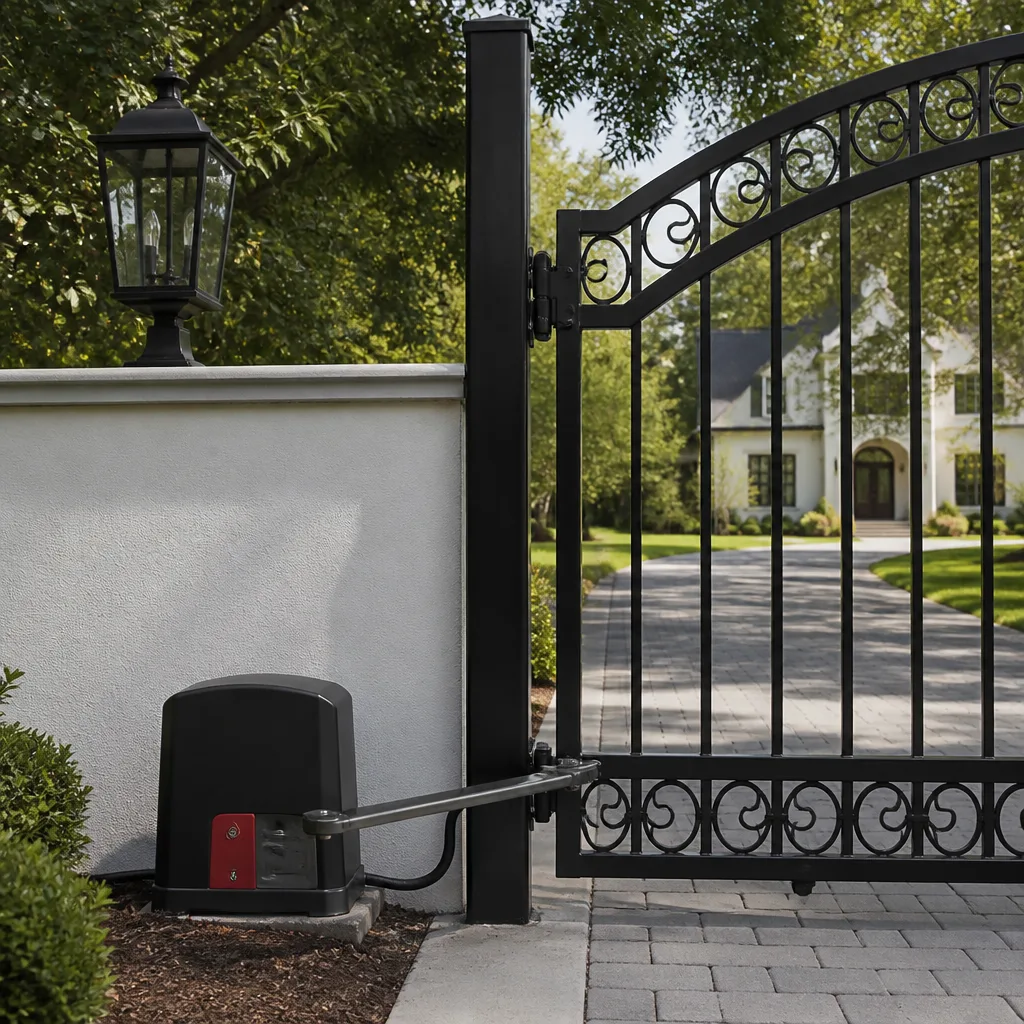 LiftMaster operators
Free on-site gate assessment - hinges, posts, and your LiftMaster or Nice gate operator checked before anything is quoted
The assessment is free and the quote is the invoice.
Get your free estimateGate Installation Troubleshooting: Common Problems and How to Fix Them
A gate that binds only in July and August was almost certainly hung at the wrong clearance for thermal expansion. A remote that opens the gate from 15 feet but refuses at 40 is usually a grounding problem, not a bad transmitter. In our experience across Boulder City, the problems that surface in the first 90 days after a new gate goes in are installation errors nine times out of ten, not factory defects. That distinction matters, because it changes the conversation you can have with your contractor from “something’s wrong” into a documented complaint with a specific cause. This guide walks through the eight defects we see most, how to photograph and log them, what Nevada warranty law expects, and what a legitimate response looks like.
Quick Answer
The most common gate installation problems are wrong post plumb, incorrect hinge clearance, inadequate concrete footings, poor grounding of the operator, misaligned safety edges, sloped-track binding, undersized power runs, and keypad or access-control wiring errors. Nearly all show up within the first 90 days and are covered by the installer’s workmanship warranty. Document each symptom with dated photos and a written log, report it in writing, and give the contractor a reasonable window to correct it. Safety issues, like a non-reversing operator or a failed safety edge, need same-day attention.
Styles & brands we work with
- Wrought iron
- Wood & steel frame
- Farm & ranch
- Sliding driveway gates
- LiftMaster operators
Table of Contents
- The Eight Most Common New-Installation Defects
- Match the Symptom to the Installer Step That Caused It
- How to Document a Problem So It Supports a Warranty Claim
- The Nevada Timeline for Correcting Installation Defects
- Safety Issue vs. Scheduled Follow-Up: How to Tell the Difference
- What a Legitimate Contractor Response Looks Like
- Red-Flag Responses That Should Concern You
- Common Mistakes to Avoid
The Eight Most Common New-Installation Defects
These aren’t hypothetical. They’re the same eight calls we get in Boulder City and the surrounding foothills, and each one traces back to a specific installation step that was rushed or skipped. Knowing the list helps you name what you’re seeing instead of describing it vaguely.
- Posts out of plumb. A gate hung on a post that’s off-level by even a quarter inch will swing and sag within weeks. Usually the hole was dug too shallow or the concrete was poured without bracing.
- Wrong hinge clearance. Hinges set too tight or too loose cause binding at the latch side. This is the single most common cause of “the gate won’t close right.”
- Undersized footings. Gate footings need to be sized to the gate’s weight and swing, not eyeballed. In Boulder City’s caliche-heavy soil, a footing that’s too small will shift after the first wet season.
- Poor operator grounding. This is the one that shows up as a remote with short range or intermittent control. The operator’s ground rod was undersized or not driven deep enough.
- Misaligned safety edges. A safety edge that doesn’t make solid contact with the obstruction won’t trigger reversal. Dangerous, and easy to verify by hand.
- Sloped-track binding. On sloped driveways, the track has to follow the grade or the gate will bind at the low end. Common on hillside lots.
- Undersized power runs. Wire gauge too small for the distance from the panel means voltage drop, and the operator behaves erratically or the battery never charges fully.
- Keypad and access-control wiring errors. Wrong pair, loose terminal, or a keypad wired to the wrong voltage. The gate works fine; the code doesn’t.
If you’re seeing more than two of these on one gate, the installation wasn’t done to a standard. That’s a conversation worth having early rather than letting it drift.
Match the Symptom to the Installer Step That Caused It
The value of diagnosing the specific step is leverage. “The remote doesn’t work from the driveway” gets a shrug. “The remote works at 15 feet because the operator ground rod wasn’t driven to depth, so the receiver is picking up noise” gets a return visit. Here’s the mapping we use in the field.
- Gate sags or drags within a month: post plumb or footing. Check with a 4-foot level on both the post face and the hinge side.
- Gate binds only in summer: hung too tight for thermal expansion. Steel and aluminum both grow; Boulder City’s temperature swing from a 40-degree winter morning to a 100-degree afternoon is enough to close a wrong gap.
- Remote short range or intermittent: operator grounding. A properly grounded LiftMaster or FAAC receiver holds range across the whole driveway, not just near the gate.
- Operator runs but gate doesn’t move: limit switch or operator-arm alignment. Usually set at install and never re-checked.
- Gate reverses on nothing: safety edge or photo-eye misalignment, sometimes a sun-strike on the reflector.
- Keypad works intermittently: wiring or voltage, almost never the keypad itself.
- Operator motor hums and stops: voltage drop from an undersized power run, or a binding gate loading the operator past its rated torque.
- Gate drifts open or closed after cycling: limit switches set by eye, not by the manufacturer’s procedure.
Notice that none of these are “the motor is bad.” Motors and operators fail, but almost never in the first 90 days. If a brand-new operator is failing, suspect the install before the box. The installer’s job is to match the operator’s torque and duty rating to the gate’s actual weight and swing, and a mismatch will burn out a good motor fast. If you’d rather start from the equipment side, our page on gate motors and openers walks through how operators are selected and set.
How to Document a Problem So It Supports a Warranty Claim
Warranty claims succeed on documentation, not on how frustrated you sound on the phone. The good news is that a homeowner can build a strong file in about ten minutes per problem. Here’s the process we recommend.
- Photograph the symptom, not the gate in general. A close shot of the hinge gap with a tape measure visible, or the safety edge not contacting, is worth more than a wide shot of the property.
- Include a dated reference photo in each shot. A phone’s timestamp is fine, but lay a newspaper or a phone showing today’s date in at least one frame of the set.
- Keep a written log. Date, time of day, what happened, and whether it was cold, hot, or windy. Patterns like “binds only after noon” point directly to thermal expansion.
- Film a short video of the symptom happening. Thirty seconds of the gate failing to reverse on a safety edge is worth a page of prose.
- Send it in writing. Email or a text thread with the installer. A phone call is fine to report, but follow it up in writing the same day.
- Keep the original contract and the manufacturer’s documentation. The installer is responsible for workmanship; the manufacturer is responsible for the components. Know which you’re claiming against.
This is also the point where a second opinion pays for itself. A licensed gate contractor can look at your photos and tell you which of the eight defects you’re looking at before you send the email, so your written complaint names the actual cause. We offer a free second opinion on any written estimate for exactly this reason. In Boulder City, homeowners who’ve been through a bad install once tend to want that confirmation before they push back.
The Nevada Timeline for Correcting Installation Defects
Nevada law gives homeowners real protection on contractor workmanship, and knowing the framework changes how quickly you should act. The short version: report early, report in writing, and don’t let the calendar run while you’re being polite.
- Report as soon as you notice it. A defect you sat on for six months is harder to claim than one you logged in week two.
- Give the contractor a reasonable window to fix it. In practice, that means a firm written request with a specific date you expect a response, typically 10 to 14 days for non-safety items.
- Safety items get same-day attention. A non-reversing operator or a failed safety edge is a hazard, and a contractor who won’t prioritize it is telling you something about how they work.
- Keep a paper trail. Every phone call followed by an email, every photo with a date, every written response from the contractor saved to a folder.
- Nevada requires contractors to be licensed for the work they perform. Verifying the license number and the contractor’s standing with the state board is the first step if a defect claim isn’t being honored.
We won’t pretend to give legal advice. If a defect claim stalls, the state contractor board and a licensed attorney are the right next steps. What we can tell you from 42 years of doing this work is that most contractors will honor a clear, well-documented claim long before it reaches that point. The ones who won’t tend to be the ones you can spot in the red-flag section below. For the repair side of what comes next once a defect is confirmed, our gate repair page covers how a failing hinge or a binding gate gets corrected.
Safety Issue vs. Scheduled Follow-Up: How to Tell the Difference
Not every post-installation problem is urgent, but some absolutely are. Here’s how to sort them in the field.
Treat as urgent (same-day attention)
- The gate doesn’t reverse when it meets an obstruction. Test it by placing a 2×4 flat on the ground in the gate’s path and running the gate into it. It should reverse on contact. If it doesn’t, stop using the operator until it’s fixed.
- The safety edge is misaligned or won’t trip. Same test: press the edge with your hand while the gate is moving. If it doesn’t stop, it’s a hazard.
- Gate is dropping off a hinge or a weld is failing. A gate that falls on a person or a vehicle is a serious liability. Stop operating it.
- Exposed wiring or a damaged power run. Call an electrician or the gate contractor. Don’t operate a gate with a compromised electrical connection.
- Keypad or access control locking someone in. If the only way out is the keypad and it’s failing, that’s a same-day fix.
Schedule a follow-up (within 10 to 14 days)
- Gate binding seasonally or sagging slightly.
- Remote range shorter than expected.
- Cosmetic weld marks or paint inconsistencies.
- Keypad intermittently failing but working with the manual release.
- Gate drifts after a cycle but the operator still reverses on obstruction.
We take the safety side of this very seriously. On a high-tension gate operator, the spring and arm mechanisms carry stored energy that can cause real injury, and we don’t recommend homeowners adjust them. If your gate is dropping, binding hard, or failing to reverse, that’s a professional call. In Boulder City we’ve seen gates on historic lots where a failing hinge took a whole gate down onto a parked car, and it’s a bad afternoon for everyone.
What a Legitimate Contractor Response Looks Like
The response to a post-installation complaint tells you more about a contractor than the installation itself. Here’s what we consider a proper response, and it’s what we hold ourselves to on every job.
- A live person answers the phone. Not a voicemail, not an answering service, not “we’ll get back to you Monday.” Our calls are answered live 24 hours a day, 7 days a week, and that’s not a marketing line; it’s the standard we set for ourselves.
- They schedule a return visit within a reasonable window. For non-safety items, a week to two weeks. For safety items, same day or next morning.
- They ask for the documentation. Photos, video, written log. A contractor who wants to see the evidence is a contractor who plans to fix it.
- They show up on time and in person. Background-checked, uniformed technicians on every job, working in your home the way they’d work in their own mother’s.
- They diagnose before they charge. A genuine defect is corrected at no charge under the workmanship warranty. A wear item or a customer-caused issue is explained and quoted before any work starts.
- They put the fix in writing. A dated note on what was corrected, and a reminder of the warranty window. Our 90-Day Done Right Promise is written for a reason: no paperwork, no arguing, if it’s not right we come back and make it right, every time, on every job.
That’s the standard. Anything less is a contractor who’s already moved on to the next job. If you’re in Boulder City and want a second opinion on a written estimate, we’ll give you one for free, no strings, no pressure.
Red-Flag Responses That Should Concern You
Some responses tell you the contractor isn’t going to fix the problem, and the sooner you recognize them the sooner you can plan around them.
- “It’s a manufacturer defect, call them.” Workmanship is the installer’s responsibility. Components are the manufacturer’s. A contractor who won’t distinguish the two is dodging.
- “You must be using it wrong.” A gate that fails the 2×4 safety-edge test is not a user error. This one is a red flag on both the fix and the contractor’s judgment.
- “We’ll get to it when we can.” No date, no window, no written commitment. That’s a contractor who’s not coming back.
- “We don’t warranty that part of the work.” If the written contract says otherwise, this is a legal problem, not a customer service one.
- “We’ll need to charge a diagnostic fee.” For a defect inside the warranty window, a diagnostic fee is a red flag. For a wear item, it’s a normal part of a service call.
- No answer, no callback, no email. The clearest red flag of all. A contractor who won’t pick up the phone a month after the install won’t pick up six months later either.
We hear these responses secondhand regularly, usually from Boulder City homeowners who’ve already been through one bad install and want to make sure the next contractor is different. If that’s the position you’re in, a Boulder City home has the same set of questions every time, and the answers tend to line up.
Common Mistakes to Avoid
- Waiting to report a defect. A sag that becomes a fallen gate becomes a much harder claim, and a real safety hazard. Report early, in writing, even if it feels minor.
- Relying on a phone call alone. Contractors forget phone calls. They don’t forget a dated email with photos. Follow up the same day.
- Adjusting the operator yourself. On a high-tension operator, the spring, the arm, and the limit switches carry stored energy. A wrong adjustment can cause a serious injury. This is not a homeowner task.
- Skipping the second 2×4 safety-edge test. Once after the install, once a month for the first six months. It takes 30 seconds and it will catch a failing safety edge.
- Letting a well-meaning handyman “tweak” a gate operator. Generalist handymen aren’t trained on the specific operator on your driveway. A wrong adjustment voids manufacturer warranty on the operator itself, and you’ll be explaining that to the manufacturer later.
- Ignoring soil and drainage on a new install. Boulder City’s caliche and our wet-season runoff will move a footing that wasn’t sized right. Ask about footing dimensions before the concrete gets poured, not after.
- Not knowing the warranty terms before you sign. Workmanship window, what’s covered, what’s not, how to report a defect. If it’s not in writing, it’s not a warranty.
See the difference
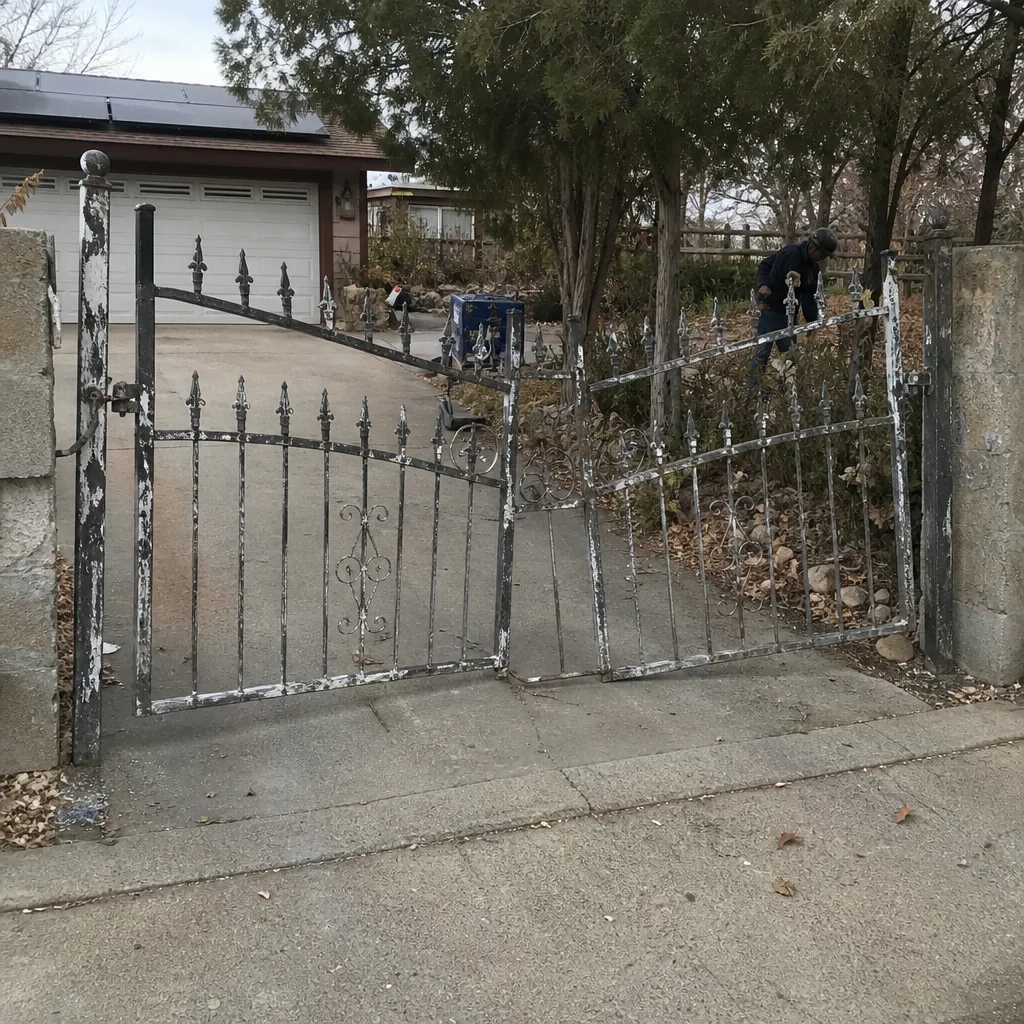 Before
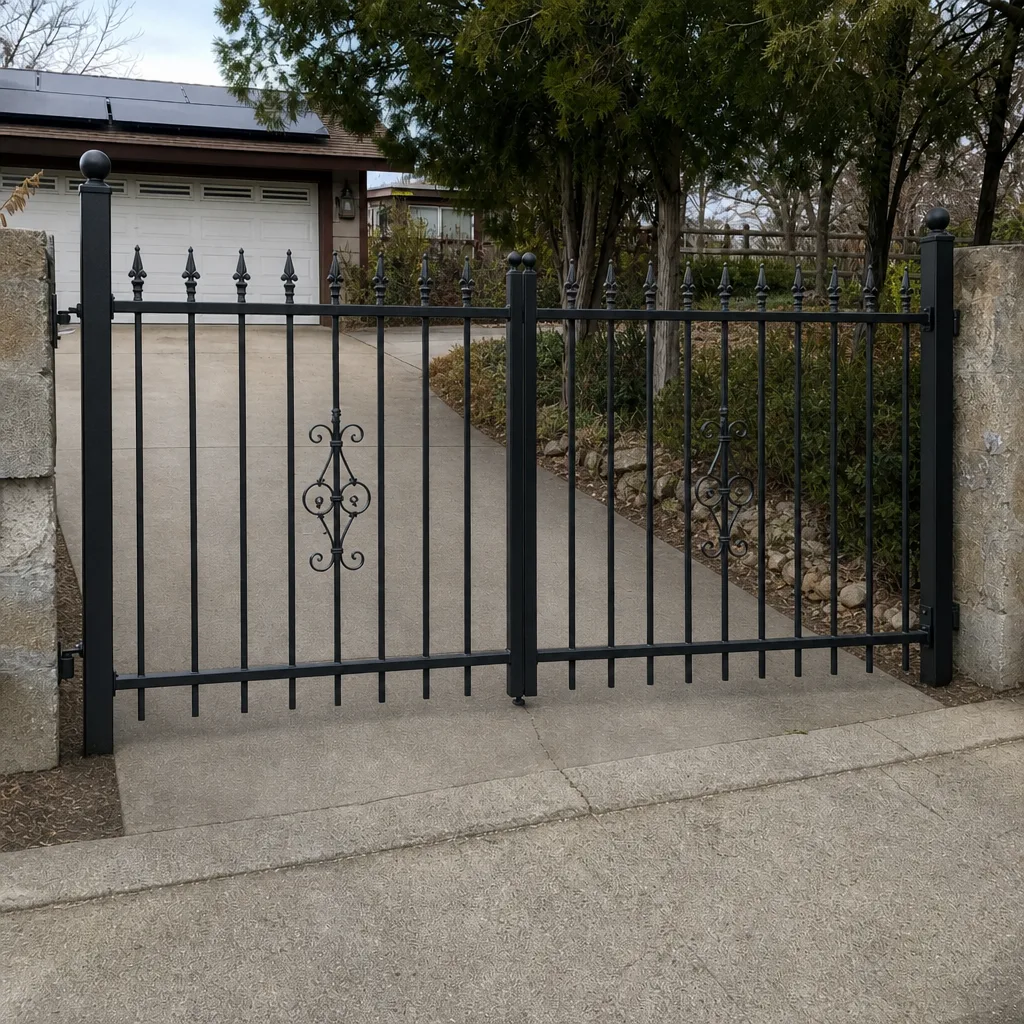 After
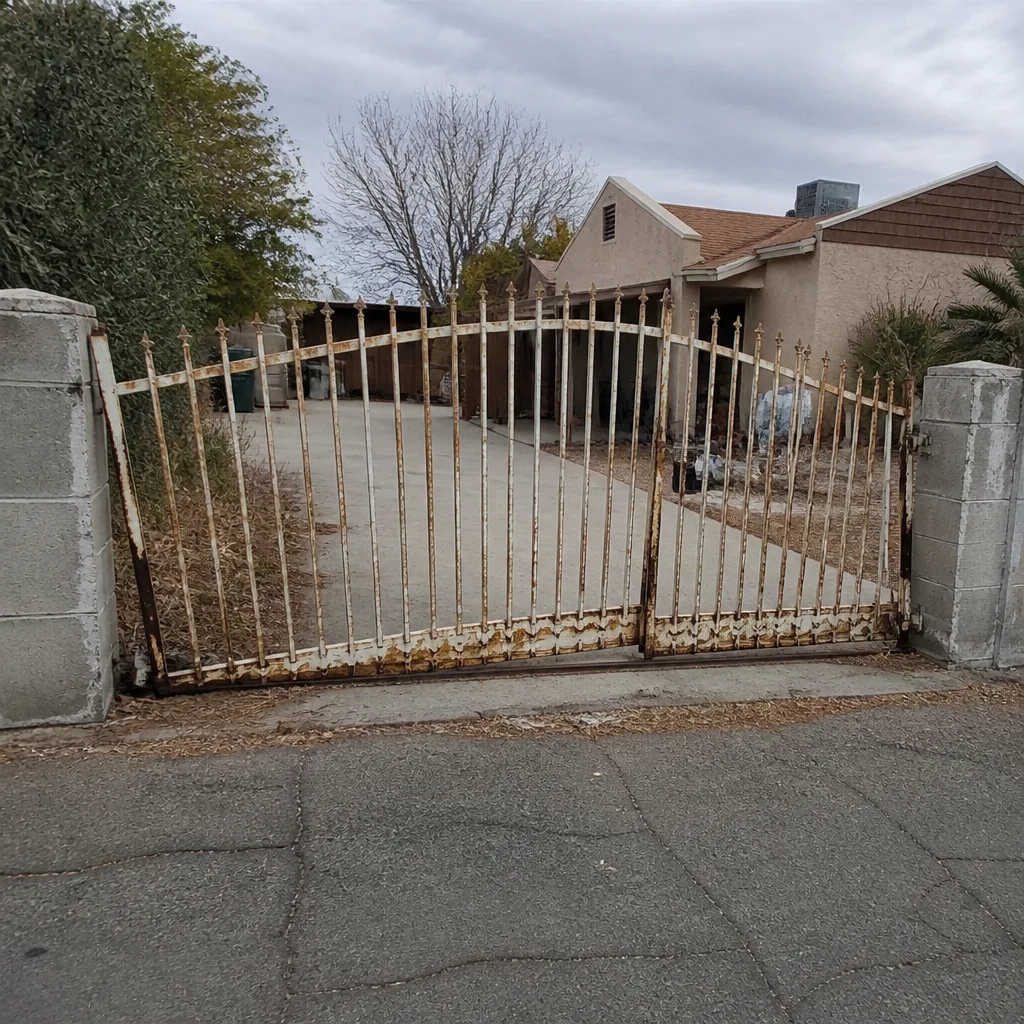 Before
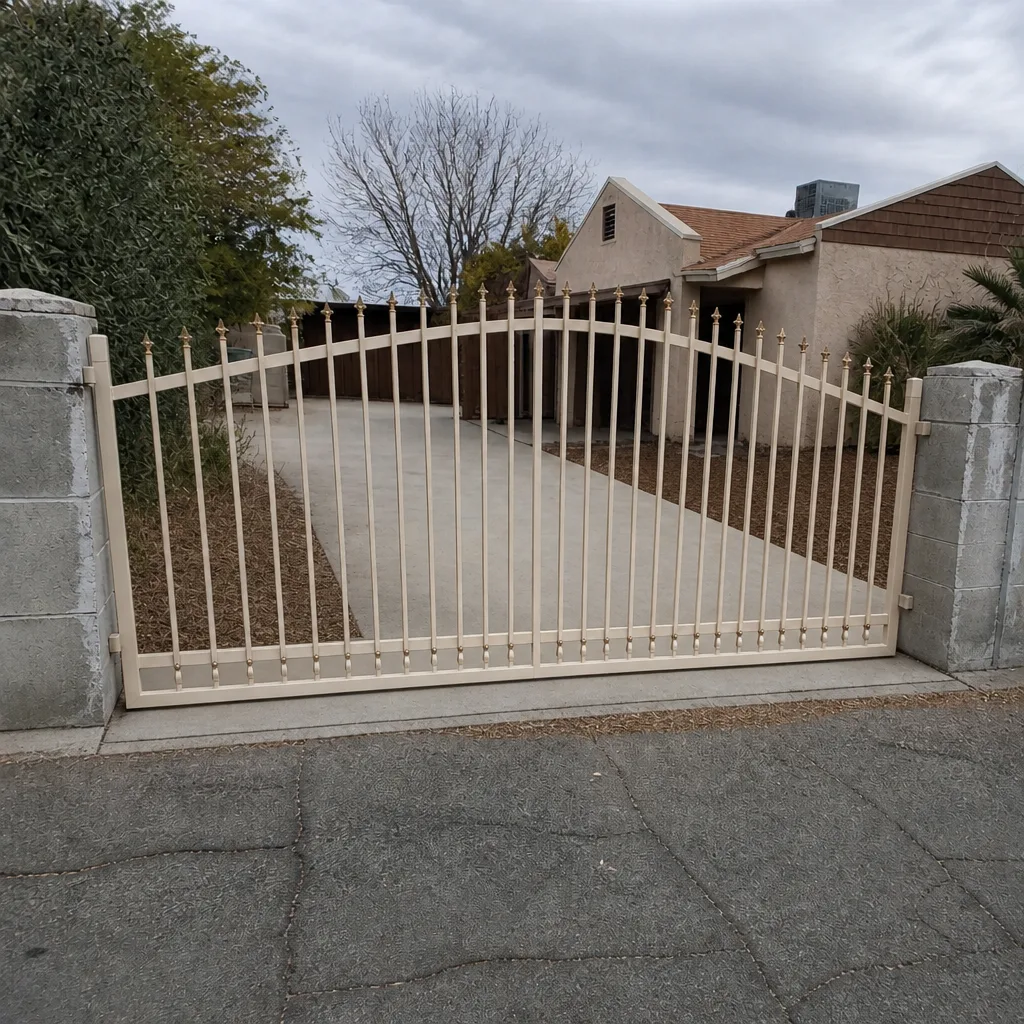 After
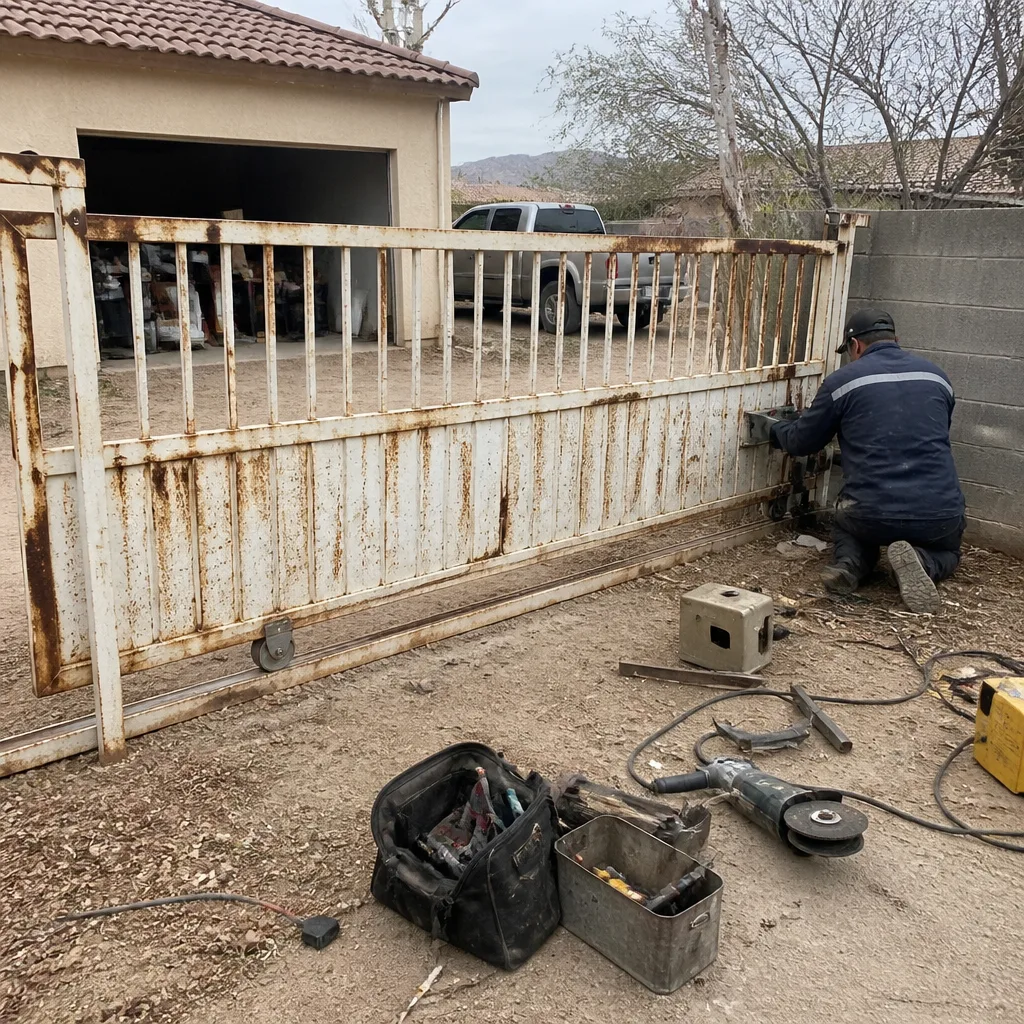 Before
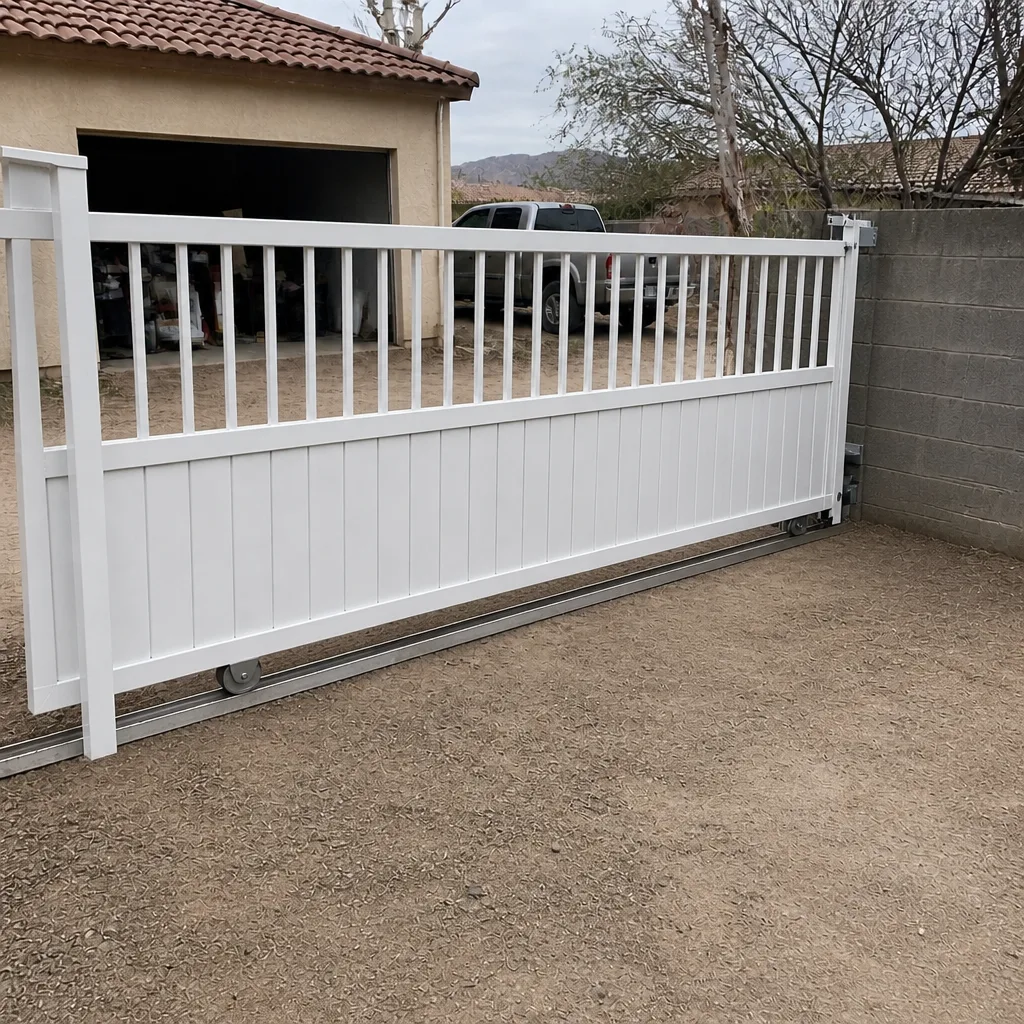 After
When to Call a Professional
Call a licensed gate contractor if the gate fails the obstruction test, a hinge or weld is failing, the operator is behaving erratically, or you’re running out of patience with an installer who won’t return your calls. Also call if the gate is on a slope, the operator is a brand you don’t recognize, or the original installer is out of business. Those jobs need a trained eye and a written estimate before anyone touches a bolt. Our technicians have up to 13 years of experience and we’re trained and equipped on nine major gate-automation brands including LiftMaster, FAAC, BFT, and Linear, so the correct fix is made on the first visit regardless of what’s on the driveway. Ironworks Gate Co. Boulder City offers free estimates in Boulder City; call (888) 276-7609 and a live person will pick up, day or night.
Frequently Asked Questions
A properly installed driveway gate should run for years without a workmanship defect surfacing, and if one is going to show up it’s almost always within the first 90 days. That window is why we back every job with a written 90-Day Done Right Promise: no paperwork, no arguing, if it’s not right we come back and make it right. If you’re seeing binding, sagging, or operator trouble past the 90-day mark, a diagnostic visit will tell you whether it’s a workmanship issue, a wear item, or normal adjustment. Call (888) 276-7609 for a free estimate.
A gate that binds seasonally was hung at the wrong clearance for thermal expansion, which is an installation error. Steel and aluminum both grow with heat, and a gate set too tight for a 40-degree swing between winter mornings and summer afternoons in Boulder City will bind at the high end of that range. The fix is a clearance and hinge adjustment, usually a single visit. If your gate is binding, call us for an exact quote; estimates are free.
No. A safety edge that isn’t tripping is a genuine hazard, and the fix involves working inside a powered operator with stored energy. Stop using the operator and call a trained professional. A 2×4 obstruction test will tell you whether the edge is failing, and if it is, that’s a same-day call. We’re available 24 hours a day at (888) 276-7609.
Send a written request by email with your dated photos and log, and set a specific date you expect a response. If the contractor still won’t respond, the state contractor board and a licensed attorney are the right next steps. In the meantime, get a second opinion from a licensed gate contractor so you know exactly which defect you’re looking at. We offer a free second opinion on any written estimate, and we’ll tell you in plain terms whether you have a claim worth pursuing.
Short remote range almost always points to an operator grounding problem, not a bad transmitter. The operator’s ground rod was undersized or not driven to depth, so the receiver is picking up electrical noise that shortens its effective range. It sounds counterintuitive, but the fix is usually at the operator, not the remote. This is one of the eight defects we see most often in Boulder City on new installs. Call (888) 276-7609 to schedule a diagnostic; a live person answers any hour.
Yes, in almost every case. The technician needs access to the gate, the operator, and in some cases the interior of the panel, and it’s better to walk through the symptom with you in person. Our technicians are background-checked and uniformed, and we work in a customer’s home the way we’d work in our own mother’s. We’ll schedule the visit around your day. For the repair side, our installation page covers what a proper install looks like up front so you know what to expect on the back end.
The Bottom Line
First-90-day gate problems are almost always installation errors, not bad products. Learn the eight defects, match the symptom to the installer step, and document in writing from day one. Treat safety-edge and reversing failures as urgent, and treat binding, sagging, and range issues as a scheduled follow-up. A good contractor answers the phone, shows up in person, corrects genuine defects under the workmanship warranty, and puts the fix in writing. A bad one dodges, blames the manufacturer, and disappears. In Boulder City, the difference shows up fast, and the documentation you keep is what tips the outcome in your favor. Ironworks Gate Co. Boulder City has been doing this work for over 42 years and plans to be here for another forty, so if you’re looking at a problem nobody else will fix, call (888) 276-7609 for a free estimate and a straight answer about what you’re dealing with.
Written by the team at Ironworks Gate Co. Boulder City.